Science
Hubble Telescope Captures Comet K1 Breaking Apart
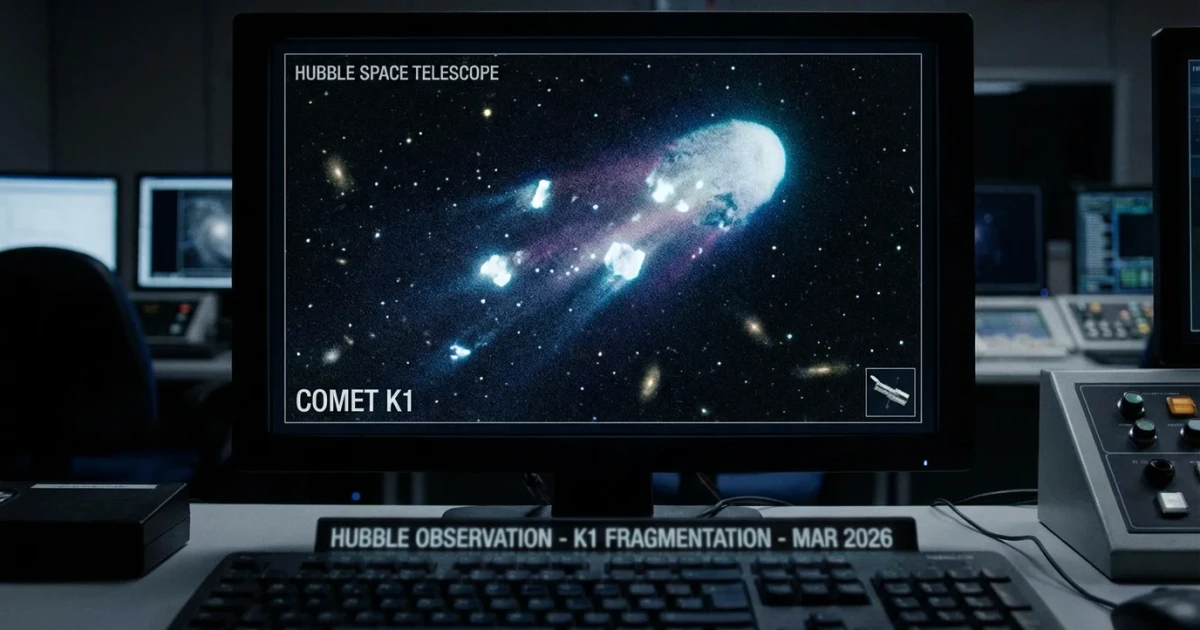
NASA’s Hubble Space Telescope has provided an unexpected glimpse into the dynamic and sometimes violent lives of comets, capturing detailed images of Comet K1 breaking apart as it traveled through the solar system. The event, reported by The New York Times, offers a rare opportunity for astronomers to study a comet’s fragmentation in real time.
Hubble’s Rare Observation
The Hubble Space Telescope was observing Comet K1 when it unexpectedly documented the icy body splitting into several fragments. According to NASA Science, such direct observations are uncommon due to the unpredictable nature of cometary breakups. Hubble’s high-resolution imagery revealed multiple pieces separating from the main nucleus, surrounded by a cloud of dust and gas. These observations were made possible by Hubble’s advanced imaging capabilities, which allow it to monitor distant and faint objects in detail.
What Happens When a Comet Breaks Up?
Comets are often described as “dirty snowballs” composed of ice, dust, and rocky material. As they approach the sun, increased heat causes ices to vaporize, sometimes triggering dramatic fragmentation events. The breakup of Comet K1 adds to a relatively small but important list of such events observed directly by astronomers. NASA’s feature article explains that observing these episodes helps scientists understand the physical properties and structural weaknesses of cometary nuclei.
- Fragments can range in size from mere meters to several kilometers across.
- The process releases large clouds of dust and volatile gases, altering the comet’s appearance and trajectory.
- Fragmentation events like this can answer questions about the internal structure and evolution of comets.
For more on the science behind comet breakups, NASA’s Hubble Science: Comets page offers accessible explanations and further reading.
Scientific Importance and Future Research
Directly witnessing the fragmentation of Comet K1 gives researchers a window into the composition and mechanical strength of cometary bodies. Each fragment’s motion and brightness can be analyzed to estimate how comets might respond to solar heating or gravitational tugs from planets. According to NASA and astronomers cited by The New York Times, this data will be cross-referenced with previous fragmentation events observed by Hubble and ground-based telescopes.
For scientists, these observations can help:
- Predict the likelihood of future breakups in other comets
- Refine models of cometary evolution and solar system history
- Assess potential hazards posed by comet fragments that could intersect Earth’s orbit
Comet K1’s breakup also contributes valuable data to NASA’s Small-Body Database, which tracks orbits and key characteristics of known comets and asteroids.
Looking Ahead
As new fragments from Comet K1 continue on their journey, astronomers will monitor their movements and any further disintegration. Events like this highlight the importance of space-based observatories like Hubble in capturing fleeting yet scientifically crucial moments in our solar system. For the public and researchers alike, the images and data from this discovery deepen our understanding of how comets evolve—and sometimes self-destruct—on their long journeys around the sun.