World
India temporarily blocks Telegram over medical exam fraud allegations
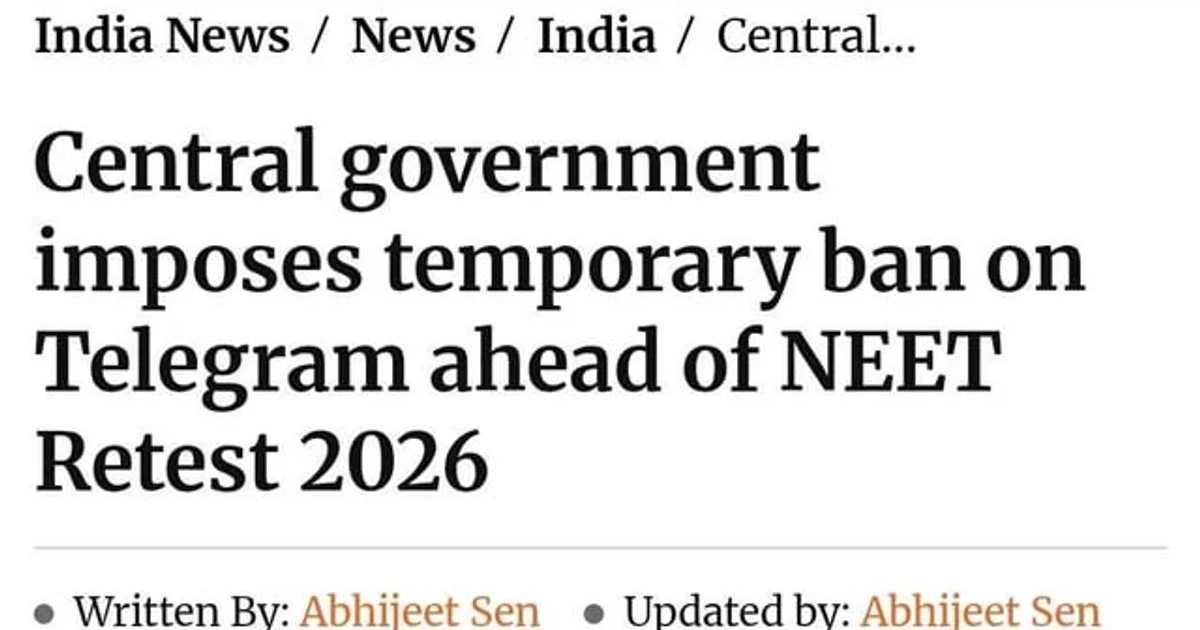
India temporarily blocked Telegram after officials said cheating networks used the messaging app to target candidates in the country’s national medical entrance exam, turning a platform dispute into a test of how far governments will go to protect exam integrity. The National Testing Agency said the restriction ran through June 22 and that Telegram’s message-editing feature would be disabled in India through June 30, all ahead of the NEET (UG) 2026 re-examination scheduled for June 21.
The NTA said the move was recommended because Telegram was being used by fraud rings to defraud NEET candidates, and said the Indian Cyber Crime Coordination Centre, under the Ministry of Home Affairs, had been the principal nodal agency coordinating the response. Authorities in Bihar, Gujarat and Rajasthan worked with cyber investigators to take down a substantial number of Telegram channels, groups and bots linked to the fraud network.

The government order said repeated takedowns had not stopped a fraudulent ecosystem from spreading on Telegram, with new channels and groups continuing to appear even after enforcement action. Officials also said the app’s editing tool had allegedly been used to fabricate post-exam paper-leak evidence, sharpening the case for a temporary block. The NTA said the action was taken in the interest of public order and students, reflecting how a test that decides entry into medical education has become a broader governance problem.
The stakes were high because the 2026 NEET-UG exam, held on May 3, was canceled on May 12 after paper-leak allegations, sparking protests and renewed scrutiny of exam security. In that climate, regulators treated Telegram not just as a communications service but as infrastructure that could be weaponized for collusion, resale of answers and confidence-breaking rumors. CNBC reported that some channels sought payments ranging from a few thousand to several lakhs of rupees for purported leaked papers, while the NTA has maintained that no exam paper is available outside the secure examination chain.

Telegram founder Pavel Durov said the restriction punished "150 million" users in India rather than the people responsible for the leaks, arguing that the fraud simply moved to other apps. The clash captures a wider democratic dilemma: when states believe encrypted or semi-private platforms are enabling high-stakes cheating or crime, they are increasingly willing to shut down a major app first and justify the decision later, even as that approach raises obvious concerns about proportionality, due process and the rights of ordinary users.
Sources
- [1]thestar.com.my
- [2]nta.ac.in
- [3]cnbc.com
- [4]indianexpress.com
- [5]thehindu.com
- [6]economictimes.indiatimes.com