World
India’s Himalayan villagers build ice pyramids to save water

In the high Himalayas of Ladakh, villagers are building their own answer to a water crisis that arrives seasonally and now lasts longer each year. In Sakti, a settlement at almost 4,000 meters, or 13,000 feet, farming has always been hard because rain is scarce and snowfall no longer arrives in the same dependable way. The result is a simple but striking adaptation: winter water is frozen into artificial ice pyramids, then allowed to melt slowly when fields need it most.
A water system designed for the wrong season
Sakti sits in a landscape where summer thirst is the rule, not the exception. Ladakh is a trans-Himalayan cold mountain desert that can drop to -30 C and gets only about 100 mm of rain and snowfall a year, which means every drop matters and every season is mismatched. Spring runoff used to be enough to keep fields alive, but warming glaciers have retreated farther uphill, weakening the meltwater supply that mountain communities once counted on.
That mismatch is the core problem the ice pyramids are meant to solve. Water tends to arrive in winter, when crops are not growing, and disappear before the planting season begins. The village response is to store that water as ice and release it gradually later, turning a climate liability into a usable reserve.
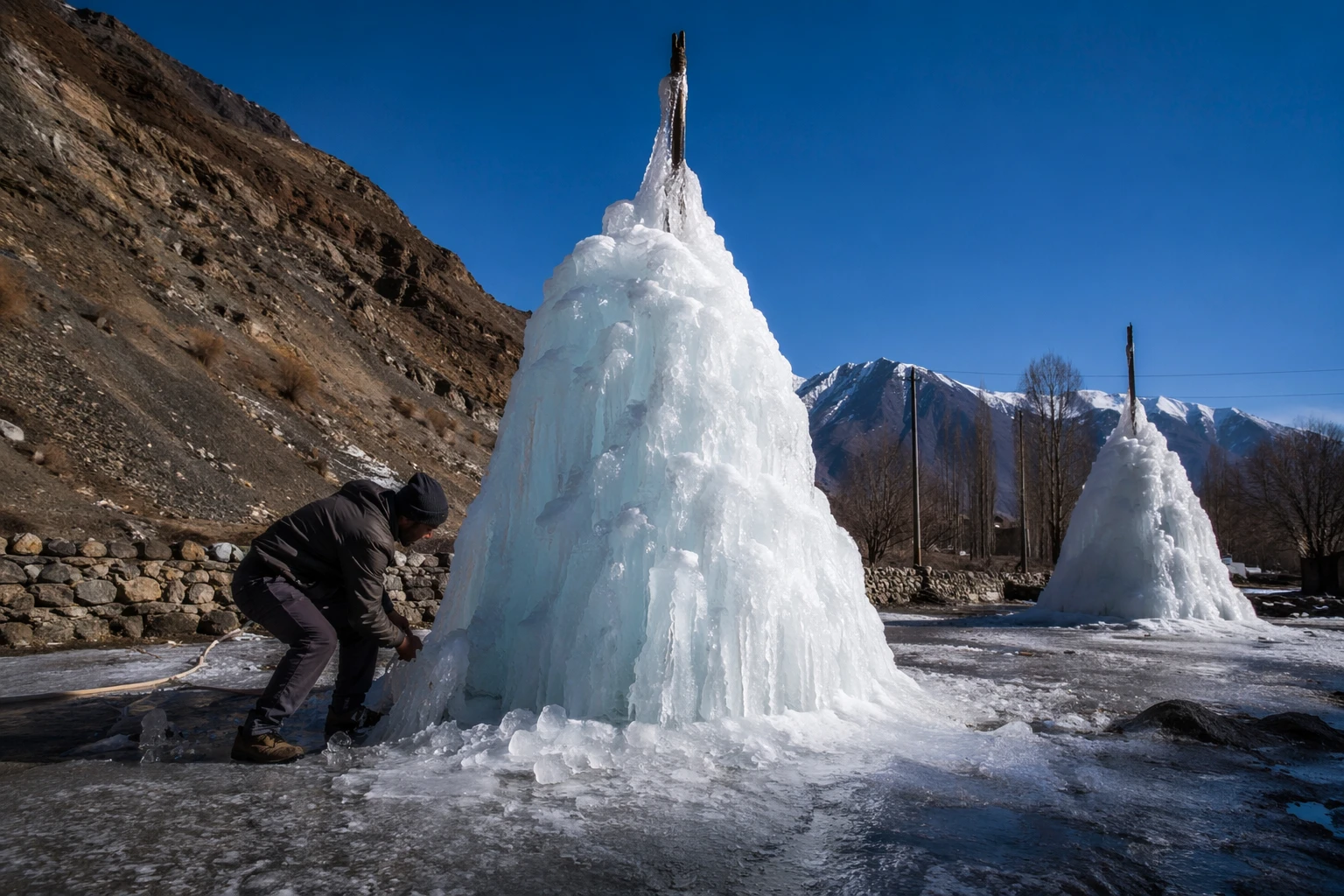
How an ice stupa works
The design is deceptively simple. Winter water is piped from higher ground and sprayed into sub-zero air, where it freezes into a cone shaped mound that resembles a Buddhist stupa. Gravity does the work, the cold does the rest, and the structure becomes a seasonal reservoir without the need for major mechanical infrastructure.
That simplicity is part of the appeal. One estimate places a village-scale ice stupa at around $1,000 to build, a sum that puts it within reach of remote communities that cannot wait for large public works. A TIME profile said one ice stupa can produce about 264,000 gallons of water for farmers during the critical months of May and June, exactly when fields are most vulnerable to drought.

From local experiment to Ladakh’s climate toolkit
The idea did not emerge from a lab, but from Ladakh itself. Ice stupas were developed in the early 2010s as a climate-adaptive water-management strategy, and the concept has long been linked to Sonam Wangchuk and SECMOL, the Students’ Educational and Cultural Movement of Ladakh, which was founded in 1988. The project’s symbolism matters, but its practical value is what has kept it alive: it uses local materials, local knowledge and the freezing temperatures already available in the mountains.
A JSTOR analysis describes the ice stupa as a new model for climate-adaptive design thinking, and the Sakti project shows why that framing has gained traction. A 2019 ice stupa in Sakti was reported to stand about 30 meters tall and release more than 8 million liters of meltwater, proof that a locally built structure can become a meaningful source of irrigation. In a region where farmers often measure resilience in weeks of water, not years of policy, the scale is enough to matter.
What government backing now looks like
The latest phase in Sakti suggests that this is no longer just an informal village innovation. India’s public broadcaster reported that the Leh Hill Council allocated Capex budget support for vertical automated ice reservoirs, and local reporting said an automated ice reservoir in Sakti was inaugurated on December 16, 2024, near Warila Pass. The inauguration was reported to have been led by LAHDC Leh chairman and CEC Tashi Gyalson.
The new version adds sensors and live monitoring, while village-level committees oversee water allocation. That shift is important because it shows how community-built infrastructure can evolve into something more durable without losing local control. The project now sits at the intersection of public investment and village management, a mix that may prove more scalable than either approach alone.
Why Sakti matters beyond one village
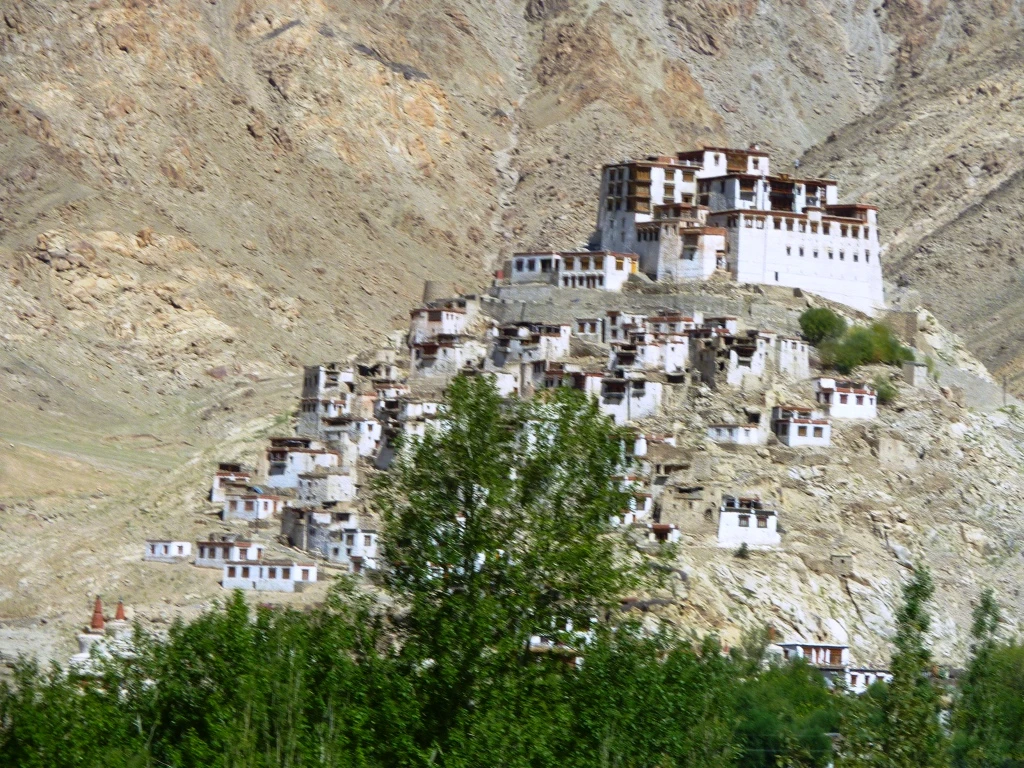
The broader significance of Sakti is not just that villagers found a clever way to freeze water. It is that they created a practical adaptation model in a place where climate change is no longer an abstract trend but a direct threat to planting, migration and the survival of mountain livelihoods. If water arrives too early and disappears too soon, then resilience has to mean storage, timing and local stewardship, not just more distant promises of infrastructure.
That is why the latest reports matter. Farmer Gutme is described as more optimistic about the future and wants at least two more artificial glaciers in the village, while Balasubramanian has framed the central question as whether one reservoir could become a dozen. The answer will say a great deal about the future of climate adaptation in India: whether communities can scale solutions that are cheap, local and governed from below, or whether water stress will keep outrunning the systems built to manage it.
Sakti’s ice pyramids are more than a mountain curiosity. They are a working demonstration that in some of the hardest places on earth, resilience may come first from villagers who know how to hold winter in reserve.
Sources
- [1]ca.news.yahoo.com
- [2]adiprasaran.tribal.gov.in
- [3]time.com
- [4]atmos.earth
- [5]jstor.org
- [6]secmol.org
- [7]newsonair.gov.in
- [8]etvbharat.com
- [9]thekashmirtoday.com
- [10]acresofice.com