US News
Inside Annin Flagmakers, where America’s oldest flag maker still sews U.S. flags
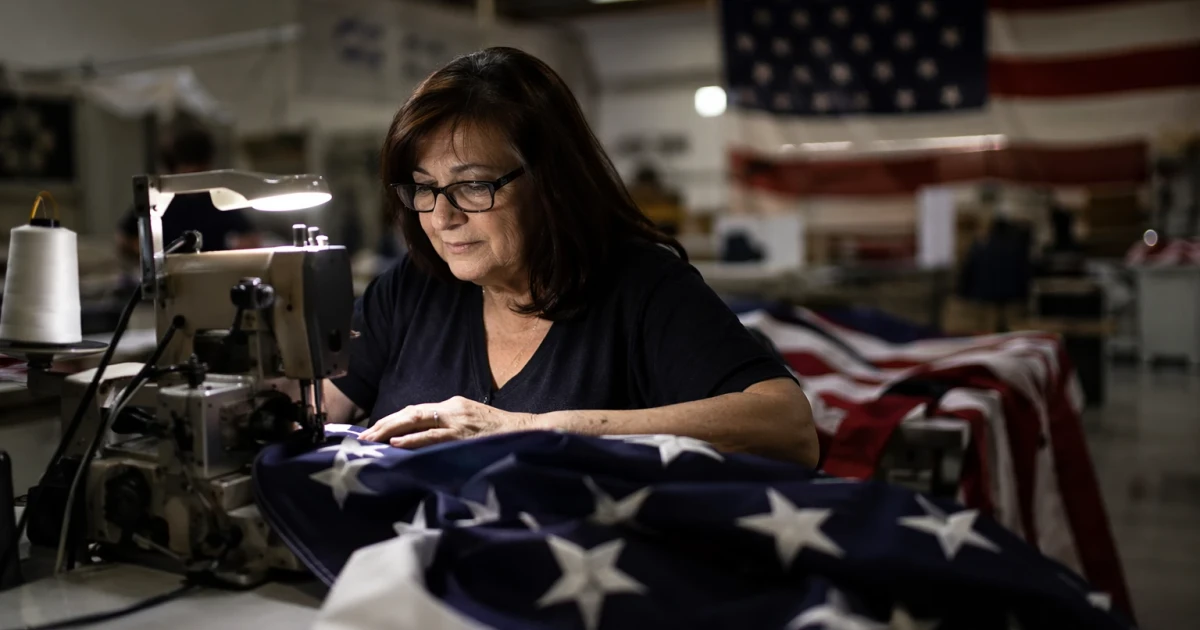
Annin Flagmakers is still sewing the nation’s most recognizable cloth in South Boston, Virginia, inside a business that traces its flagmaking back to 1847. The company describes itself as the oldest and largest flag manufacturer in the United States, and its story now sits at the intersection of heritage, regulation, and the economics of domestic production.
A factory built around a national symbol
Jericka Duncan visited Annin’s factory in South Boston, Virginia, where the company continues to make U.S. flags as part of a manufacturing network that still relies on American workers. Annin says it is a sixth-generation family-owned and operated business headquartered in New Jersey, with more than 500 American workers spread across three domestic factories in South Boston, Virginia; Coshocton, Ohio; and Cobbs Creek, Virginia.
That footprint matters because Annin is not just selling one product. It is maintaining a domestic operation large enough to supply a wide range of flags and related gear, from U.S. flags and state flags to international flags, historical flags, military flags, custom flags, special-interest flags, and flagpoles and hardware. In an era when so much textile production has moved overseas, the company’s continued U.S. manufacturing gives the flag business a distinctly industrial base.
From ship outfitting to full-time flagmaking
CBS News has noted that Annin and Co. began as ship outfitters in New York before shifting to flagmaking full time in 1847. That transition turned a family business into a specialized manufacturer with one central focus: making flags for public, ceremonial, military, and private use.
The company’s history also includes a place in one of the country’s most solemn rituals. CBS News reported that Annin and Co. provided flags for President Abraham Lincoln’s funeral, a detail that shows how deeply the business has been tied to national moments as well as everyday commercial demand. Over time, that legacy has helped Annin turn a historic identity into a market position that still carries weight.
Why the label on a flag matters
Annin says it is one of the founding members of the Flag Manufacturers Association of America, a group formed after September 11, 2001. The association was created to help ensure that U.S. flags sold in the United States are properly labeled with their country of origin and meet Federal Trade Commission and Textile & Wool Act requirements.
That regulatory context is central to the modern flag business. A flag is not only a symbol of identity; it is also a consumer product governed by labeling and origin rules. The association’s role gives the market a compliance framework, and it underscores how patriotism and consumer protection intersect when the object in question is the national flag.
For Annin, that means its value is not limited to the emotional meaning of the product. It also depends on whether customers, institutions, and resellers can trust what they are buying and how it is represented. In that sense, the business operates in both symbolic and legal territory at once.
What Annin makes now
Annin’s product line reflects a company that has turned one emblem into a broader catalog. Alongside U.S. flags, it sells state flags, international flags, historical flags, military flags, custom flags, special-interest flags, and flagpoles and hardware. The range shows how a manufacturer built around a single civic icon can stay relevant across schools, governments, veterans’ groups, ceremonial settings, businesses, and private consumers.
The company also says it produces America250-related products. With the country approaching the 250th anniversary of American independence, that line gives Annin a direct role in the commercial machinery of national commemoration. It is another example of how patriotic milestones create demand not only for speeches and ceremonies, but for the objects used to stage them.
What a long-running flagmaker says about U.S. manufacturing
Annin’s scale is modest by the standards of mass industry, but its structure is revealing. Three domestic factories, more than 500 American workers, and a sixth-generation family-owned model show that some manufacturing businesses survive by staying close to their brand, their supply chain, and their product’s meaning.
The company’s durability also suggests that not every consumer category behaves like a commodity market. Flags are purchased for government buildings, schools, cemeteries, parades, memorials, homes, and civic events, which gives the business a recurring baseline of demand that is tied to public life as much as to retail trends. When national symbolism becomes visible, the manufacturers that supply it become visible too.
Annin’s headquarters in New Jersey, its long-running factories in Virginia and Ohio, and its history stretching back to 1847 make it one of the clearest examples of how an American company can keep a traditional product in domestic production while adapting its catalog to changing moments. The flags still move through sewing machines and factory floors, but they also move through the country’s rituals, laws, and commemorations, which is why the business remains relevant long after the first stitches were sewn.
Sources
- [1]cbsnews.com
- [2]annin.com