Science
Interstellar Comet 3I/ATLAS Offers Clues to Ancient Star Origins
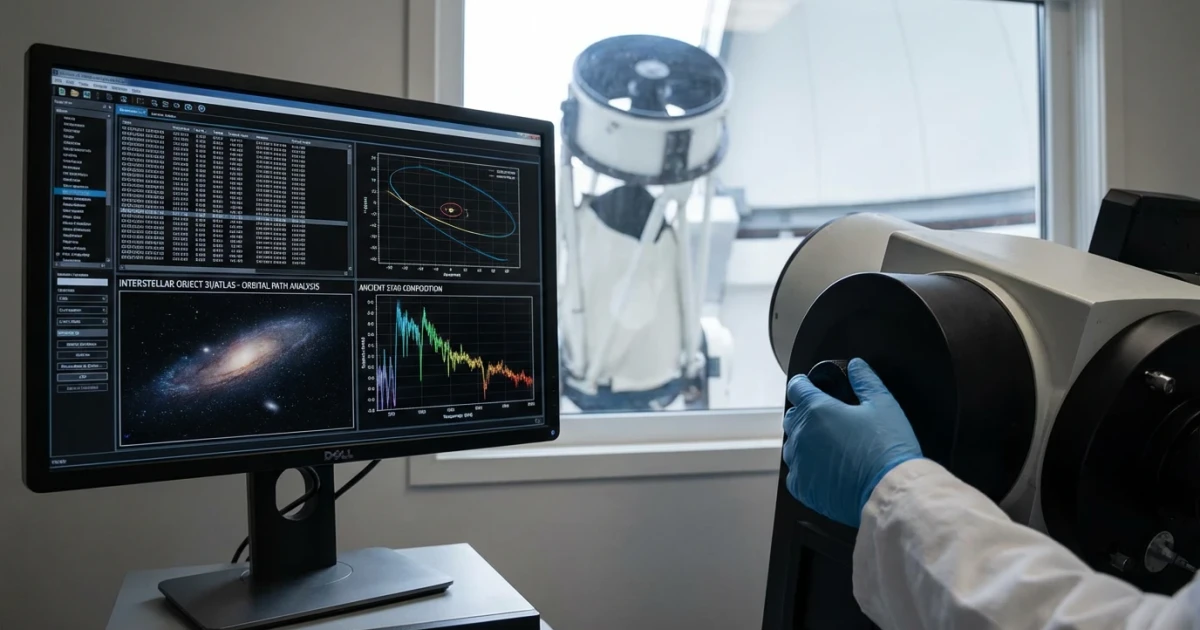
Comet 3I/ATLAS, only the third known interstellar comet to pass through our Solar System, is reshaping astronomers’ understanding of how such objects originate. Recent analyses suggest that this rare visitor likely formed around an old, low-metallicity star in the Milky Way’s outer disk, offering unique insights into the galaxy’s structure and chemical evolution.
Tracing the Path of an Interstellar Visitor
First detected in 2019, 3I/ATLAS has drawn significant attention for its hyperbolic trajectory, confirming its origin from beyond the Solar System. According to the official NASA JPL Small-Body Database, its orbital parameters differ significantly from comets bound to the Sun, supporting its interstellar status. Observation data, compiled and made openly available by NASA, has enabled researchers worldwide to study the comet’s composition and dynamical properties in detail.
Evidence for Formation Around a Low-Metallicity Star
Analysis of the comet’s spectrum and chemical makeup points to an origin near a star with low metallicity—meaning it contains fewer elements heavier than hydrogen and helium—characteristics typical of stars formed early in the Milky Way’s history. IFLScience reported that 3I/ATLAS’s formation likely took place in the galaxy’s outer disk, where such old, metal-poor stars are more common. This finding aligns with recent peer-reviewed studies, including research published in The Astrophysical Journal Letters, which present chemical and dynamical evidence supporting this scenario.
- Orbital data confirms a trajectory consistent with ejection from a distant stellar system
- Low metallicity composition suggests formation in an environment poorer in heavy elements than our Sun
- Estimated age of the parent star likely exceeds several billion years, placing it among the Milky Way’s older stellar populations
Open Data Accelerates Global Research
The availability of NASA’s open observation datasets for 3I/ATLAS has empowered astronomers and citizen scientists alike to contribute to its study. These datasets provide photometric measurements, orbital simulations, and astrometric logs, allowing for independent verification and new lines of inquiry. The Minor Planet Center’s database further catalogs discovery and observation records, ensuring data transparency and accessibility.
Implications for Our Understanding of the Milky Way
Comets like 3I/ATLAS serve as time capsules, preserving material from the environments in which they formed. Their study can shed light on the chemical evolution of the galaxy and the processes that lead to the ejection of icy bodies from their home star systems. The possibility that 3I/ATLAS originated around a low-metallicity star suggests that the exchange of material between stellar systems is not limited to young, metal-rich regions, but also includes older, more primitive parts of the galaxy.
As new interstellar objects are discovered and studied, the groundwork laid by open data initiatives and collaborative research will continue to expand our understanding. The ongoing analysis of 3I/ATLAS, combined with future discoveries, promises to refine models of planetary system formation and interstellar dynamics—showing that each visitor from beyond the Solar System brings not just mystery, but new knowledge about our place in the cosmos.