Technology
James Webb reveals salty clouds on pink planet GJ504b
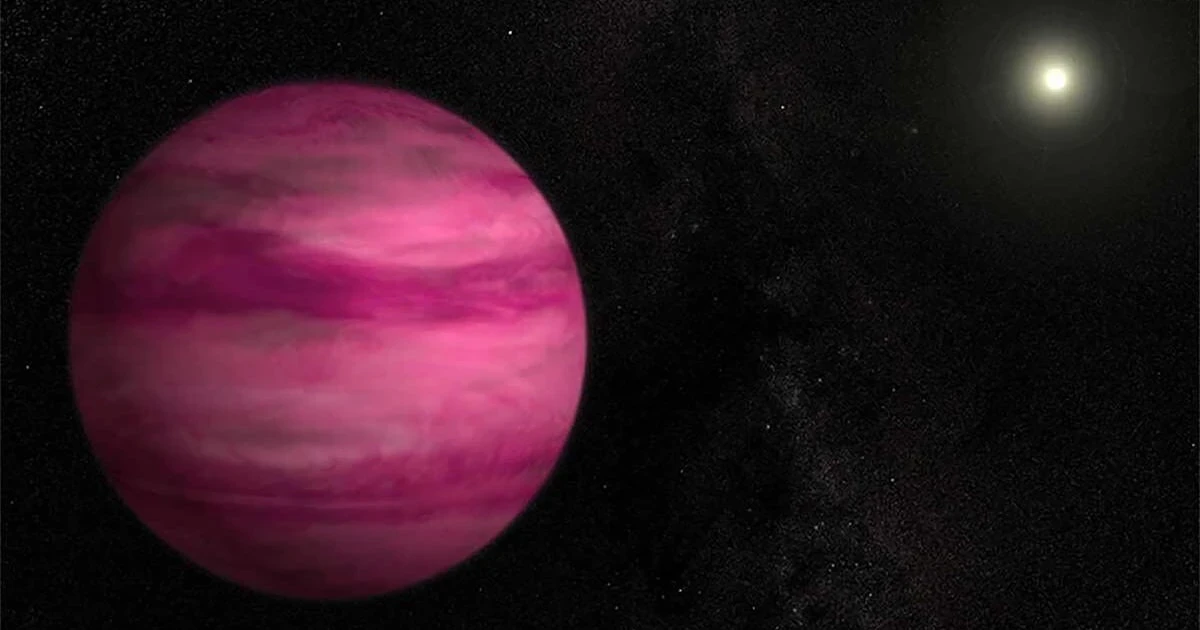
The James Webb Space Telescope has turned GJ504b from a faint curiosity into a laboratory for planetary science, revealing atmosphere-shaping chemistry and clouds loaded with salt. For researchers studying worlds beyond the solar system, the finding matters less as a novelty than as a rare, direct look at how cold, dim objects may build and keep their atmospheres.
GJ504b, discovered in 2013 and nicknamed the Pink Planet for its color, orbits a sun-like star about 57 light-years from Earth. Scientists describe it as a planetary-mass companion because it sits near the fuzzy boundary between giant planets and brown dwarfs. Some descriptions put its mass at about 25 times Jupiter’s, while NASA’s exoplanet catalog lists it as a gas giant with 4 Jupiters of mass, an orbital radius of 43.5 astronomical units and an orbital period of 259.9 years. That wide, slow orbit has long challenged simple ideas about how such objects form.
The new Webb observations, led by Northwestern University researchers with collaborators including Aneesh Baburaj, Michael McElwain, Markus Janson and Motohide Tamura, delivered the first direct spectroscopy of GJ504b. The study, published in the Astronomical Journal, found evidence of exotic atmospheric chemistry and salty clouds, offering what researchers described as some of the first direct evidence for salt clouds in the atmosphere of a cold object. That is especially important because scientists had theorized such clouds more than 15 years ago, but had lacked the data to see them clearly.
Marshall Perrin of the Space Telescope Science Institute devised the observing program. Perrin is also a member of the JWST Telescope Scientist Team. The object had been too faint for ground-based telescopes to dissect its light effectively, and the Space Telescope Science Institute said its estimated temperature is about 550 K, a level of faintness and redness that pushes beyond the reach of even the largest observatories on Earth.

The result gives astronomers a new way to compare worlds that do not fit neatly into existing categories. By separating atmospheric chemistry from simple size and color, Webb is helping redraw the line between planets and brown dwarfs while showing how cold, wide-orbit companions evolve. In a field where classification often shapes theory, GJ504b now stands as a test case for the next generation of planetary science.
Sources
- [1]cbsnews.com
- [2]news.northwestern.edu
- [3]science.nasa.gov
- [4]nasa.gov
- [5]arxiv.org
- [6]stsci.edu