Technology
Japanese robotics firms turn to Nvidia for physical AI push
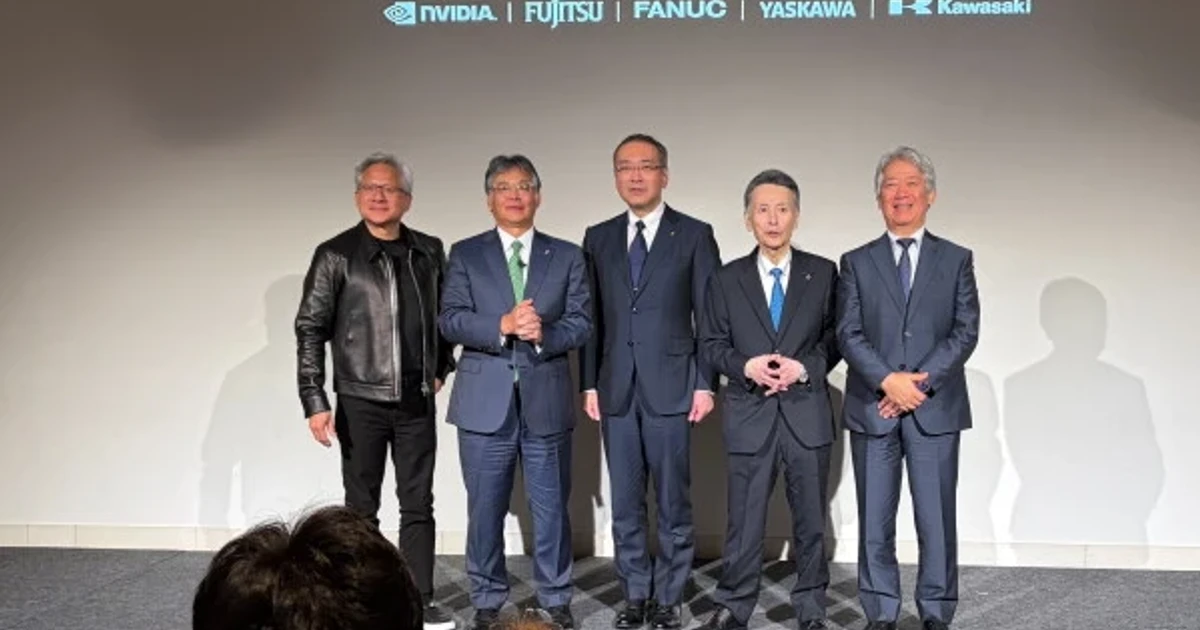
Fujitsu and three of Japan’s biggest robotics and industrial automation names moved to deepen work with Nvidia in Tokyo on July 16, betting that the next wave of artificial intelligence will control machines, not just generate text on a screen. Jensen Huang, Nvidia’s chief executive, and Fujitsu chief executive Takahito Tokita appeared at the event as the companies outlined plans to develop what they described as physical AI.
Physical AI refers to systems that perceive the physical world, make decisions and act through industrial robots, warehouse equipment and other automated machines. Fujitsu said it would explore physical AI development and implementation across industries with FANUC, Yaskawa Electric and Kawasaki Heavy Industries, integrating Nvidia technology into the effort. Kawasaki Heavy Industries said it was starting a business study with Fujitsu in physical AI, while Kawasaki Robotics said it was working with Nvidia, Analog Devices, Microsoft and Fujitsu to accelerate physical AI development toward social implementation through a new development hub in Silicon Valley.
The pitch is especially pointed in Japan, where an aging population and persistent labor shortages have made automation a strategic necessity as much as a productivity tool. Japan is already one of the world’s centers of robotics research and manufacturing, and Nvidia has been trying to position its chips and software as the computing layer that can speed training, simulation and deployment for robots that must navigate cluttered factory floors and changing conditions in warehouses and service settings.
For Fujitsu, the July announcement extended a relationship with Nvidia that was already deepening. On Oct. 3, 2025, Fujitsu said it was expanding its strategic collaboration with Nvidia to deliver full-stack AI infrastructure, setting up the robotics move as part of a longer commercial buildout rather than a one-off partnership.
Nvidia has also been framing Japan as one of the key battlegrounds for physical AI. In a July 2026 blog post, the company highlighted Japan as a major center of AI, robotics and manufacturing and pointed to partners in the country showcasing the latest advances in its ecosystem.
The practical question is whether that ecosystem can turn industrial robotics strengths into a broader commercial market for AI-powered machines. If Japanese firms can use Nvidia’s hardware and software to make robots more adaptable, less dependent on hard-coded routines and quicker to train in simulation, the payoff could reach assembly lines, logistics networks and eventually health-care settings. If not, physical AI may remain another well-branded chapter in the AI boom.
Sources
- [1]apnews.com
- [2]global.fujitsu
- [3]reuters.com
- [4]reutersconnect.com
- [5]kawasakirobotics.com
- [6]blogs.nvidia.com