Business
July 2026 CD rates still offer outsized returns for savers

On a $15,000 deposit, a short-term CD can still pay hundreds of dollars in interest in mid-2026. The difference between locking cash for six months or parking it in a high-yield savings account can be measured in dollars, not cents, but the gap is narrow enough that flexibility still matters.
What a $15,000 CD pays right now
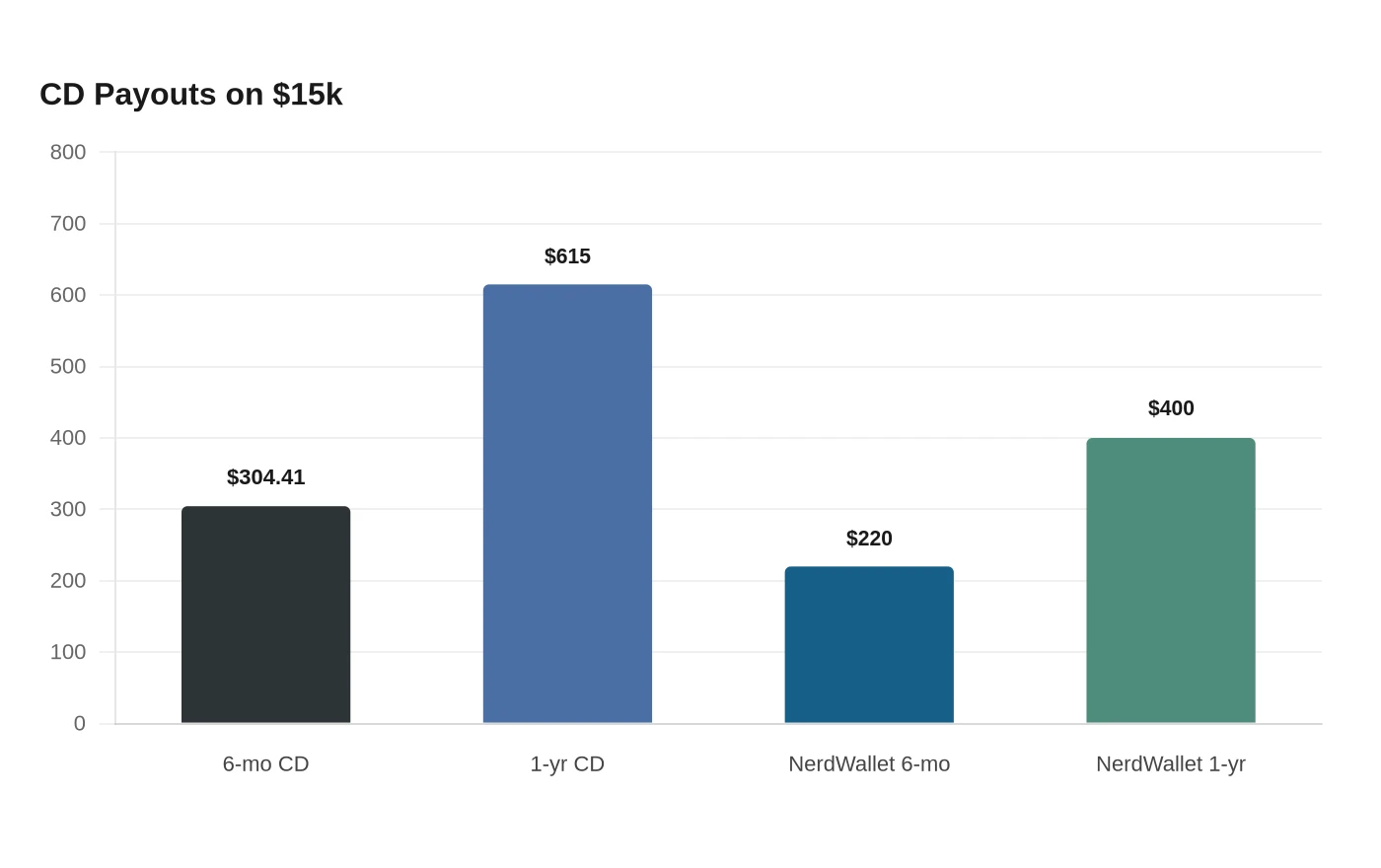
The clearest way to judge a CD is to start with the actual payout. A $15,000 six-month CD at 4.10% APY pays $304.41, and the same deposit in a one-year CD at 4.10% APY pays $615.00, based on Yahoo Finance’s July calculator.
NerdWallet’s July example of a 6-month CD at 4.50% APY comes out to about $220 on a $15,000 deposit, while a 1-year CD at 4.00% APY would earn about $400.
WSJ Buy Side’s July 20 roundup listed the highest CD APYs between 4.14% and 4.50%, and CD Valet’s July 13 roundup listed top CD rates at 4.50% APY or more.
How CDs compare with high-yield savings
High-yield savings accounts are close enough to CDs that the decision often comes down to liquidity. Sabrina Karl’s July NerdWallet list put the best high-yield savings accounts around 4.15% APY, Investopedia put the top rate at 4.26% APY, and some July roundups reached 4.50% APY. The spread between a strong savings account and a strong CD is slimmer than it has been in many rate cycles.

A 4.26% high-yield savings account on $15,000 would generate about $639 over a full year, slightly more than the $615 a one-year CD at 4.10% APY would pay. The savings account does that without tying up your money.
The choice is even less dramatic if your money only needs to sit for a few months. A six-month CD at 4.10% APY pays $304.41, and a top savings account near 4.15% to 4.26% APY will land close to that over a comparable stretch while letting you move cash if something changes.
Why these rates are still elevated
CD pricing is still tied to expectations for Federal Reserve policy and broader interest-rate conditions. The Federal Reserve’s Monetary Policy Report, released July 10, 2026, outlines the policy backdrop behind still-elevated deposit rates. Banks and credit unions are still competing for deposits, and that competition is keeping both CDs and savings accounts above levels savers saw when rates were near zero.
The inflation backdrop also matters. The U.S. Bureau of Labor Statistics reported consumer prices rose 3.5% in June 2026, while core inflation, which strips out food and energy, was 2.6%. A 4% to 4.5% CD still offers a positive nominal return above headline inflation, even though the cushion is not enormous once taxes and future price changes are considered.
The FDIC’s national 12-month CD series, tracked through June 2026 in FRED, remained well below the strongest advertised rates. Shoppers willing to compare banks, online lenders, and credit unions can still find yields that stand out from the national average.
Who should consider a short-term CD now
A short-term CD makes the most sense if your cash has a clear job and a clear date. If you know you will not need the money for six to 12 months, a CD can turn idle cash into a predictable return without forcing you to watch the market every day. The best fit is money that is already beyond your emergency fund and is not earmarked for a near-term bill.
It also works well if you want certainty. A CD locks in the APY for the term, so you do not have to wonder whether rates will drift lower before you can act. A CD locks in rates that are still around 4% to 4.5% for the full term.
Who may be better off waiting or staying liquid
If your cash may be needed before maturity, a high-yield savings account is the cleaner choice. The yield gap is too small to justify a penalty if you might need to break the CD early, especially when strong savings accounts are already paying roughly 4.10% to 4.26% APY.
You may also want to stay liquid if you think rates could rise further. The Federal Reserve’s policy path will keep influencing deposit pricing, and savers who prefer to keep options open can wait for a better CD offer without sacrificing access in the meantime.
Sources
- [1]cbsnews.com
- [2]nerdwallet.com
- [3]finance.yahoo.com
- [4]wsj.com
- [5]fred.stlouisfed.org
- [6]federalreserve.gov
- [7]cdvalet.com