Technology
KPMG pulls AI report after citations and case studies prove false

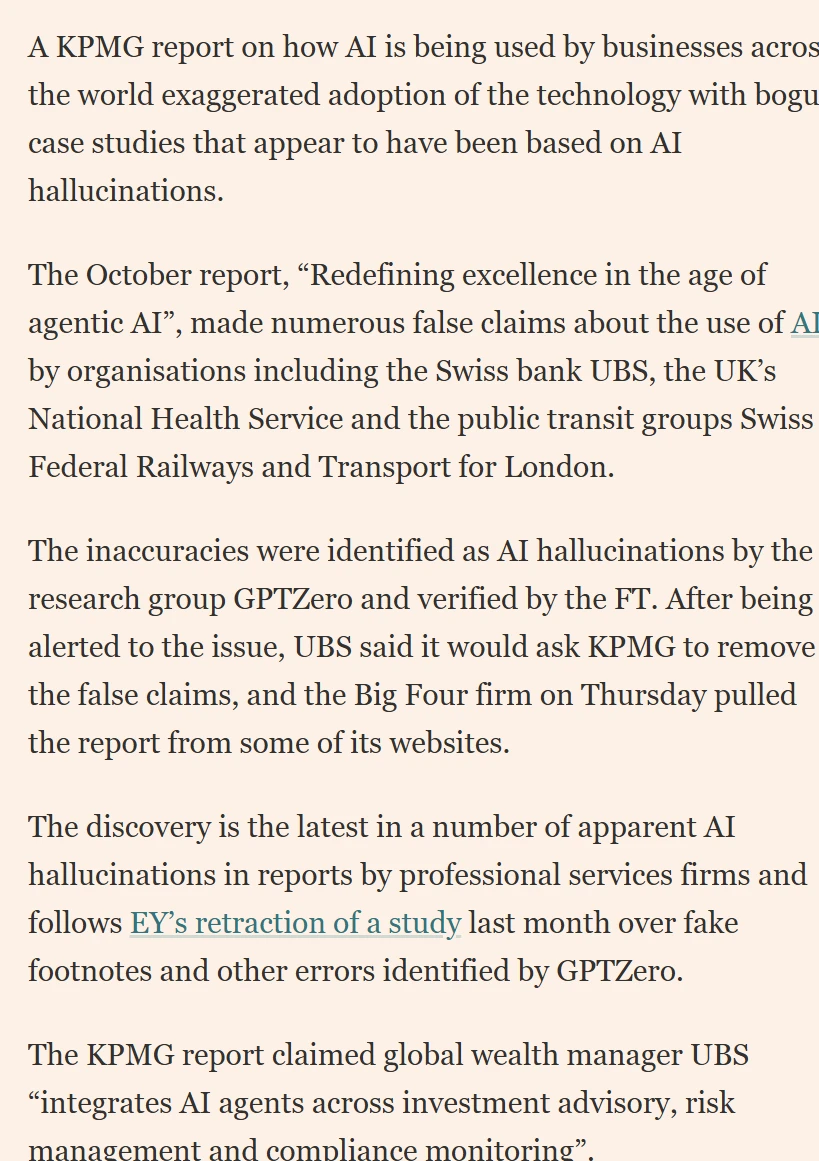
KPMG’s pitch for agentic AI has become a credibility test for the firm itself. Its October 2025 report, Total Experience: Redefining Excellence in the Age of Agentic AI, was later pulled from KPMG websites after GPTZero found that only five of 45 citations accurately pointed to the sources they claimed to support, a failure the Financial Times verified.
The problems went beyond sloppy sourcing. The report included bogus or fabricated case studies involving UBS, NHS Greater Manchester, Transport for London, and Swiss Federal Railways, turning a business research paper into a warning about how AI-assisted analysis can distort facts at scale. KPMG, one of the world’s Big Four professional services firms, had used the report to promote the benefits of agentic AI while also marketing its enterprise AI governance work. That combination makes the episode especially damaging, because it suggests the same standards the firm urges clients to adopt were not applied inside its own research process.

KPMG’s broader customer experience work has been presented as highly rigorous. The firm describes its 2025 to 2026 Global Customer Experience Excellence study as the 16th edition of the series, based on 80,594 interviews across 2,684 brands in 16 countries. The false citations and invented examples in the agentic AI report therefore land as more than an isolated publishing error. They undercut the credibility of a research brand built on scale, methodology, and trust.
The timing also matters. On June 9, 2026, KPMG announced a global expansion of its relationship with Microsoft, including the use of Microsoft Agent 365 and broader deployment of Microsoft 365 Copilot. That public push into AI shows how closely the firm’s commercial ambitions are tied to the technology it is advising others to adopt. When a company sells AI guidance, every fabricated citation or hallucinated case study becomes more than a mistake. It becomes evidence of whether the firm can police its own claims.
The episode fits a wider pattern of AI-related problems in consulting and professional-services research, with similar issues reported at Deloitte and EY. For clients weighing AI adoption in healthcare, government, finance, and other sensitive sectors, the lesson is stark: firms promoting machine intelligence must prove their diligence before asking anyone else to trust the output.
Sources
- [1]techcrunch.com
- [2]finextra.com
- [3]theregister.com
- [4]gptzero.me
- [5]assets.kpmg.com
- [6]kpmg.com
- [7]cityam.com