Health
Late-night eating disrupts gut body clocks in mice, study finds

Eating off schedule desynchronized intestinal clocks in mice, a June 8, 2026 study in Proceedings of the National Academy of Sciences found, sharpening the link between meal timing and digestive health. The work, co-led by Yuuki Obata and Shin Yamazaki at UT Southwestern Medical Center in Dallas, points to a gut that runs on its own daily rhythm and can be thrown off when food arrives at the wrong biological hour.
The researchers tracked five intestinal cell types, enteric neurons, enteric glial cells, interstitial cells of Cajal, smooth muscle cells and muscularis macrophages, and used the clock gene Per2 as a marker of activity. When feeding occurred during the biological night, those cell types became less synchronized, showing that the intestine is not just passively processing calories but coordinating its own timing signals. Joseph Takahashi’s engineered mice were used in the experiments, giving the team a way to watch how the gut’s clocks shifted under misaligned feeding.
That mechanism matters far beyond the laboratory. Night-shift workers, people dealing with jet lag and anyone who regularly snacks deep into the night live in the gap between social schedules and biology. The UT Southwestern team framed the findings as potentially relevant to irritable bowel syndrome, inflammatory bowel disease, constipation and other gastrointestinal disorders that often cluster with shift work and travel across time zones. The study does not prove that every late snack harms people in the same way it affected mice, but it does make a plausible case that repeated overnight eating may confuse the timing cues that help the digestive tract work smoothly.
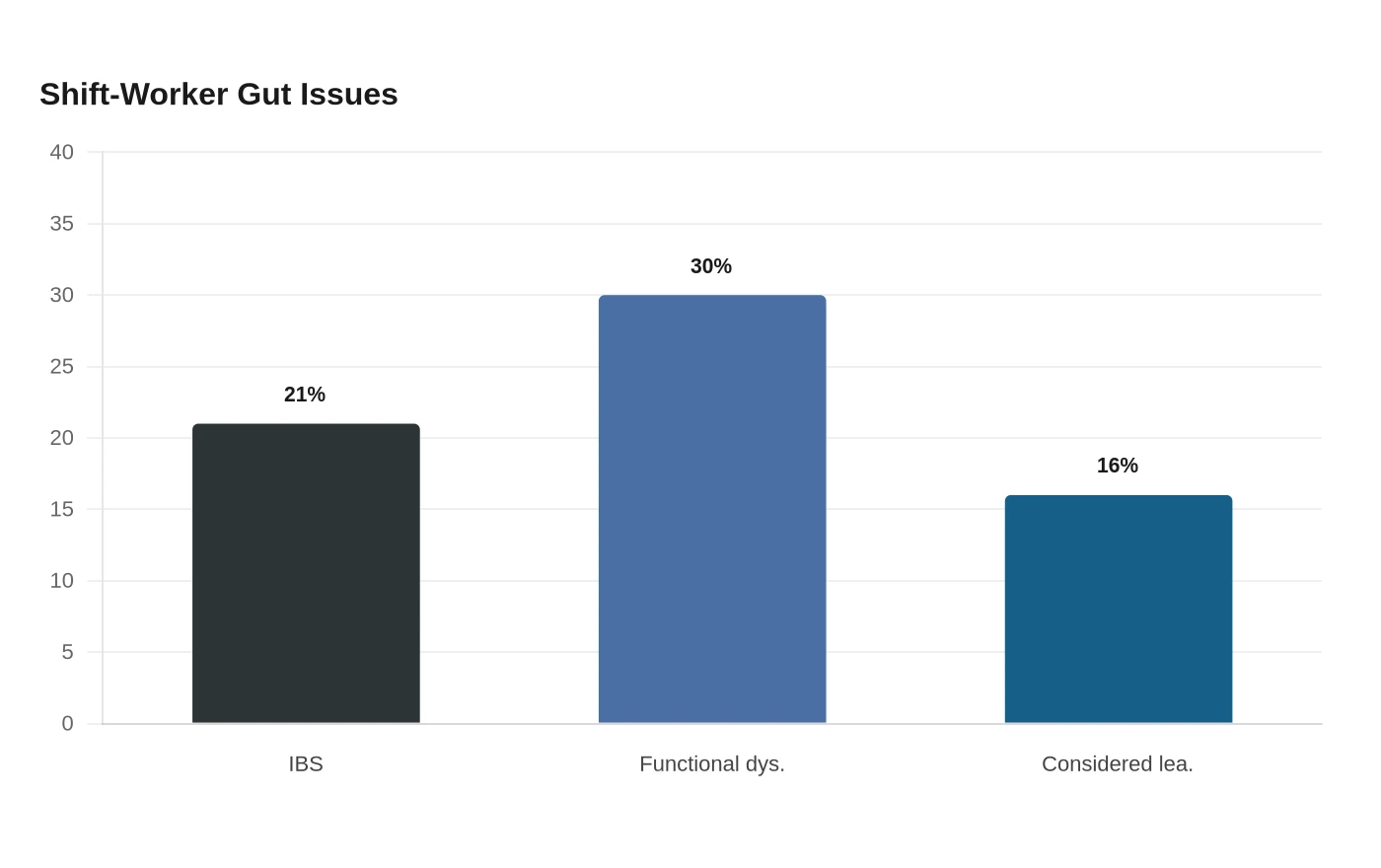
Human data already point in the same direction. In a University of Melbourne-led survey of 392 night-shift workers in Australia and the United Kingdom, 21% met criteria for IBS and 30% met criteria for functional dyspepsia. The survey found gut health issues at three to five times the general-population rate. More than half of the workers said night shifts worsened their symptoms, and 16% had considered leaving night work altogether.
Earlier reviews and animal studies have also tied time-restricted eating and regular meal timing to circadian and metabolic pathways, including gut rhythmicity. That body of work has been building toward a simple but disruptive idea for modern life: eating time is a biological variable, not just a lifestyle choice. In obesity care, diabetes management and occupational health, especially for rotating schedules, the question is no longer only what people eat but when their bodies are most prepared to handle it.