Science
LHCb Decay Anomaly Challenges Standard Model Assumptions
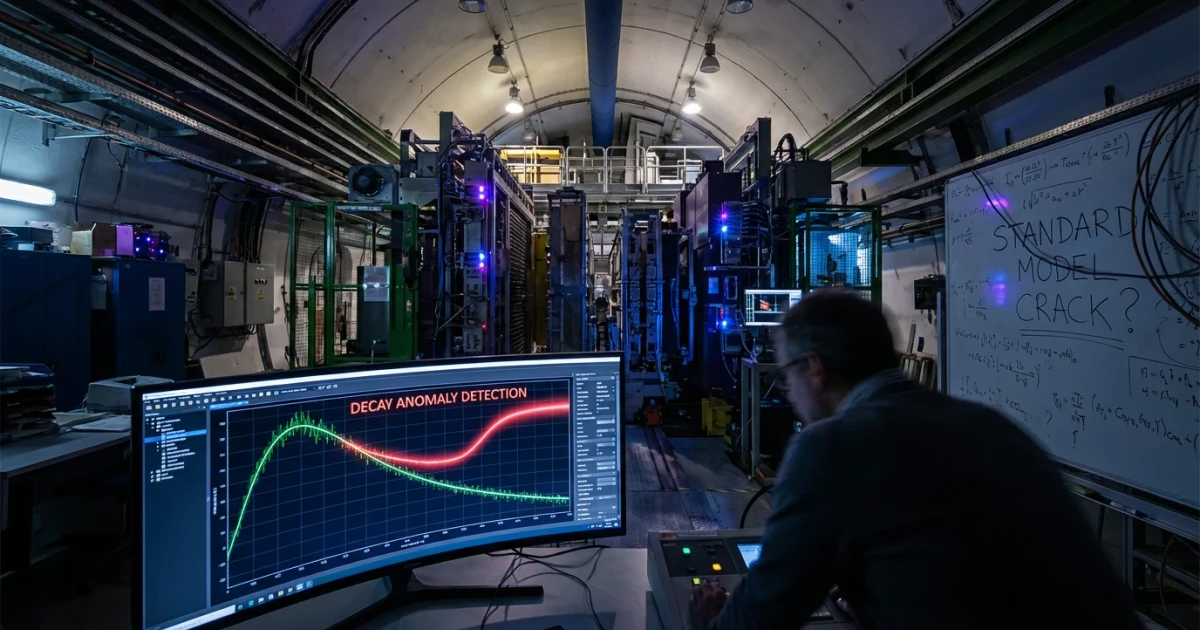
Recent findings from the LHCb experiment at CERN’s Large Hadron Collider (LHC) have highlighted an unexpected anomaly in particle decay rates, raising important questions about the completeness of the Standard Model of particle physics. The results, reported by Phys.org, have prompted excitement and cautious debate among physicists worldwide as they consider whether these measurements indicate the presence of new, undiscovered physics.
Unusual Decay Patterns in B-Mesons
At the heart of this development is the observation of rare decays involving B-mesons—particles containing a bottom quark and another quark. In particular, the LHCb collaboration measured how often B-mesons decay into final states containing electrons compared to those containing muons, two types of leptons expected to behave identically except for their mass. According to the Standard Model, a principle called lepton universality dictates that these decay rates should be nearly identical after accounting for mass differences.
- LHCb researchers analyzed thousands of B-meson decay events produced in high-energy collisions at the LHC.
- They found that decays involving electrons and muons occur at slightly different rates, a result diverging from Standard Model predictions.
- The statistical significance of the anomaly is not yet sufficient to claim a discovery, but it is strong enough to warrant further investigation.
Potential Implications for Fundamental Physics
If the anomaly is confirmed by future experiments, it could suggest that new particles or forces are influencing the decays. Such a result would be a major breakthrough, as the Standard Model has long served as the foundation for our understanding of subatomic physics, describing the behavior of known particles and their interactions with remarkable accuracy. However, the Standard Model leaves several phenomena unexplained, including the nature of dark matter and the imbalance between matter and antimatter in the universe.
Phys.org notes that this is not the first time hints of lepton universality violation have emerged, but the latest results from LHCb are among the most precise to date. The measurements were conducted using advanced detectors capable of distinguishing between different types of leptons and reconstructing their origins with high fidelity.
Scientific Caution and the Road Ahead
Physicists are approaching the anomaly with measured caution. As highlighted by the researchers, statistical fluctuations are always possible in complex experiments, and systematic uncertainties must be carefully ruled out. The LHCb team is currently working to collect and analyze more data from upcoming LHC runs to strengthen or refute the anomaly’s existence.
For readers interested in the technical details and raw data, the LHCb collaboration provides public results and data tables that allow for further exploration of the experiment’s findings.
Key Points from the LHCb Decay Anomaly
- The anomaly involves deviations in electron and muon production rates during B-meson decays, challenging lepton universality.
- Measurements show a statistically significant but not yet conclusive deviation from Standard Model expectations.
- Further analysis and independent verification are needed to determine whether this is the first sign of physics beyond the Standard Model.
Context Within Particle Physics
The LHCb anomaly is part of a broader effort to test the Standard Model’s predictions to ever greater precision. As described in Scientific American’s explainer, even small cracks in the Standard Model can point to entirely new physical principles, such as unknown particles or interactions. The LHCb’s focus on rare decays is crucial because these processes are particularly sensitive to effects from new physics.
Looking Forward
With the LHC continuing to operate and upgrades planned for both the machine and its detectors, physicists are optimistic that more data will help clarify whether the anomaly persists. If confirmed, it could open the door to discoveries that reshape our understanding of the universe’s most fundamental laws. For now, the physics community watches closely as the search for answers continues.