Technology
Microsoft pushes in-house AI models to cut OpenAI and Anthropic costs

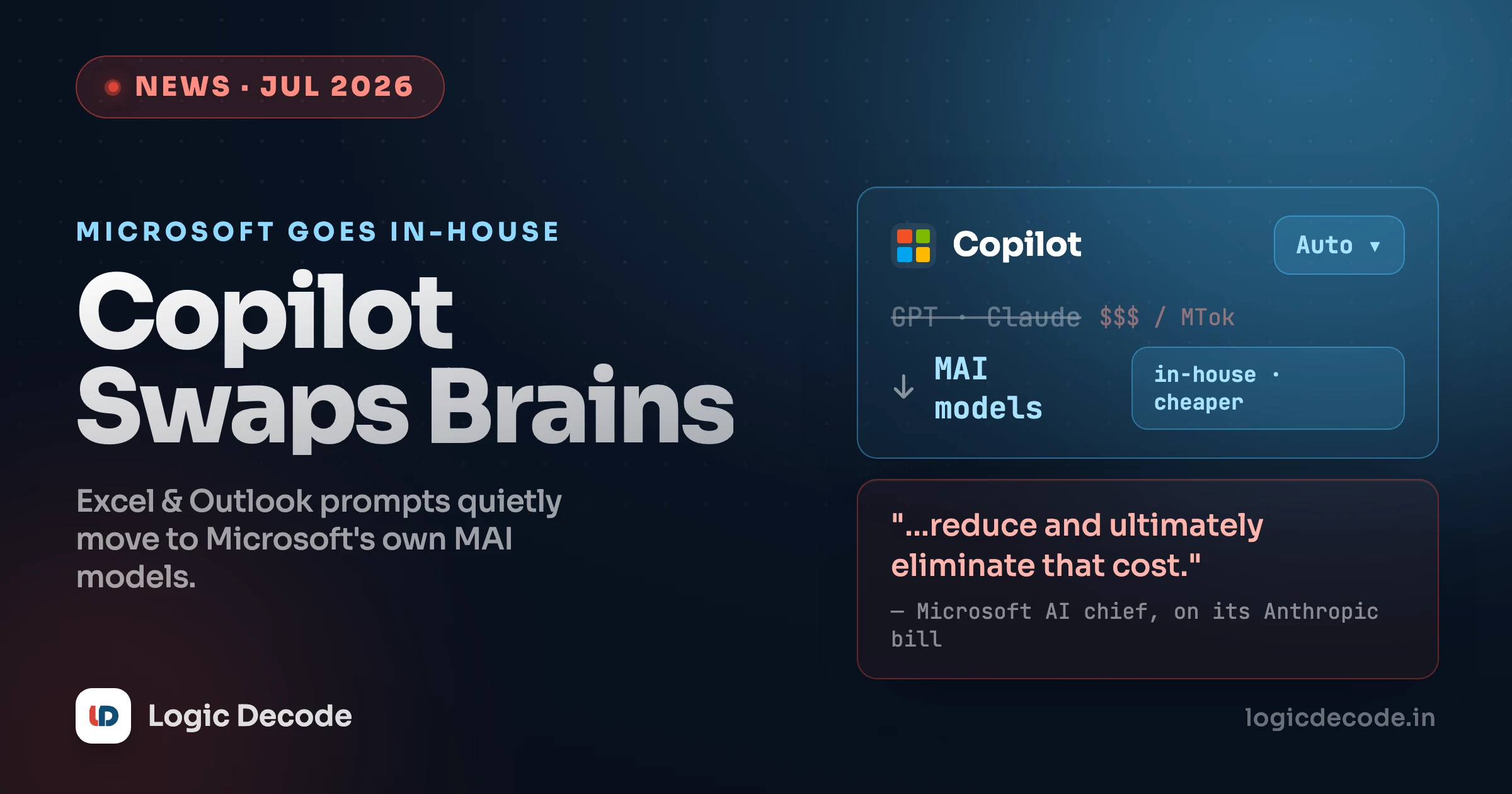
Microsoft has started routing some AI prompts in Excel and Outlook to its own MAI models, with tens of thousands of requests a week already moving off OpenAI and Anthropic. The change shows Microsoft pressing harder on price and control inside the software it sells to businesses, even as it remains one of OpenAI’s biggest backers.
Mustafa Suleyman, Microsoft AI chief, put the economics plainly: “We pay a lot of money to Anthropic — so our goal is to reduce and ultimately eliminate that cost.” Microsoft unveiled seven in-house MAI models at Build 2026 on June 2, including MAI-Thinking-1, a 35-billion-active-parameter reasoning model with a 256,000-token context window. Microsoft says the model was trained from scratch on commercially licensed enterprise data and without distillation from third-party models, a signal that it wants these systems to stand on their own rather than simply mirror outside labs.

The company has spent more than $11 billion on OpenAI and holds a nonvoting board observer seat, but it has also increasingly used Anthropic models in some enterprise products. That leaves Microsoft in a rare position in the AI market: still a partner to the model makers it depends on, yet increasingly a direct rival competing for the same corporate workloads. The question for enterprise buyers is no longer only which model scores best on benchmarks, but which provider can deliver acceptable performance at lower cost inside the tools employees already use every day.

That calculation matters because Microsoft’s AI bill is tied to inference, the recurring expense of running models at scale across millions of prompts. Shifting even a slice of traffic in Excel and Outlook to MAI models can trim those costs and give Microsoft more room on margins, while also reducing dependence on outside vendors whose pricing and road maps it does not control. In a market where hyperscalers are pouring money into data centers and compute, the advantage may go to the company that can package “good enough” intelligence into the most widely distributed products.