Health
Midjourney unveils full-body ultrasound scanner and San Francisco spa

Midjourney, the AI company known for image generation, has moved into medical imaging with a pitch that blends clinical ambition with wellness branding. The company announced Midjourney Medical and a scanner it calls Ultrasonic CT, describing it as a full-body ultrasound that uses sound and water, takes as little as 60 seconds, and avoids radiation and powerful magnetic fields.
The scale of the plan is what makes the announcement more than a novelty. Midjourney said it wants to deploy about 50,000 scanners around the world over the next six years and eventually perform a billion full-body scans every month. The first site is slated for San Francisco, where a flagship Midjourney Spa is planned for the end of 2027 with hot tubs, saunas, cold plunges and 10 scanners. The company has also framed the experience as something “as casual as a trip to the spa,” and described the setting as “cozy rooms with pools of golden light which softly scan your body.”
Midjourney’s own site has added to the sense that this is a live business push, not just a concept deck. It shows a scan gallery and spa renders, while its careers page is recruiting for engineering, reconstruction, quality, operations and medical roles in San Francisco. The company had already signaled a hardware push in August 2024, when it said it was getting into hardware and formed a San Francisco-based hardware team. Around that period, Midjourney also had fewer than 100 employees and hired Ahmad Abbas, an ex-Neuralink staffer who helped engineer Apple Vision Pro, underscoring that the pivot has been building for months.
The most concrete commercial piece is Midjourney’s tie-up with Butterfly Network, the publicly traded ultrasound company. Butterfly said the prototype uses 40 Ultrasound-on-Chip imaging modules per system under a co-development agreement worth up to $74 million over five years, including a $15 million one-time fee, $10 million in annual licensing fees and up to $9 million in milestone payments. Butterfly said future versions are expected to use many more imaging modules, and its shares jumped sharply after the announcement.
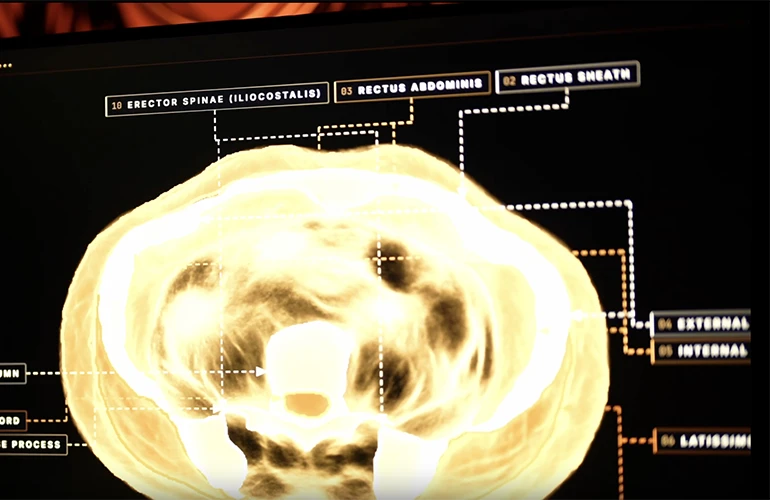
The credibility test is still ahead. The BMJ reported skepticism from clinicians and researchers, including a neuroradiologist in Italy who said it was concerning that potentially revolutionary medical technologies were being introduced through cinematic marketing rather than rigorous scientific evidence. The BMJ also quoted a cardiology professor warning that more sensitive and more frequent scanning can increase overdiagnosis. That concern matters for public health, because a wellness-flavored screening business can generate follow-up tests, anxiety and cost long before it proves clinical value.
There is real science behind the idea, but it is narrower than Midjourney’s presentation suggests. A 2024 preprint and later peer-reviewed work in Nature Biomedical Engineering described whole-body human ultrasound tomography in healthy volunteers, with uses such as adipose-thickness assessment and biopsy-needle localization. Those papers describe a prototype imaging method, not a consumer spa or a mass screening network. Midjourney is betting that it can turn a research frontier into a branded medical experience, but regulators, clinicians and patients will still demand proof that the promise is more than a polished image.
Sources
- [1]theverge.com
- [2]midjourney.com
- [3]radiologybusiness.com
- [4]bmj.com
- [5]techcrunch.com
- [6]pmc.ncbi.nlm.nih.gov
- [7]nature.com