Science
Moon and Planets Offer Striking Sky Show on May 21
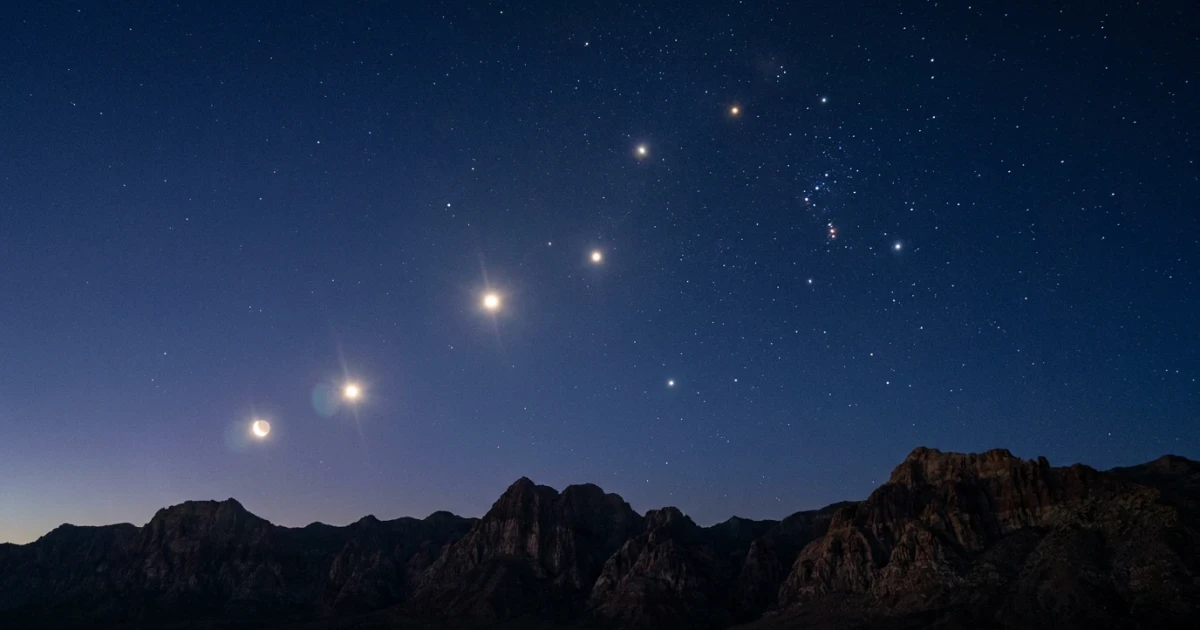
May 21 brings a stunning celestial display to night sky enthusiasts: The Moon shines brightly amid a swarm of stars while Venus, Jupiter, and Mercury form a striking lineup nearby. This rare arrangement, visible shortly after sunset, offers a unique opportunity for both seasoned stargazers and casual observers to witness an eye-catching planetary gathering and a star-filled lunar backdrop.
What to Expect in the Night Sky
On the evening of May 21, the Moon will be positioned against a dense patch of stars, making it appear especially luminous and surrounded by a sparkling swarm. According to Space, this phenomenon is enhanced by the Moon's alignment with a rich star field, likely within or near the plane of the Milky Way. Using tools like the AAVSO Variable Star Plotter, observers can visualize the magnitude and density of stars in the lunar vicinity for this date.
Meanwhile, three of the solar system's brightest planets—Venus, Jupiter, and Mercury—will appear in close proximity to the Moon, forming a visually striking lineup. The arrangement can be confirmed with interactive tools such as Stellarium Web Online Star Map, which allows users to simulate the sky from any location and time. According to the Harvard-Smithsonian Center for Astrophysics Ephemeris Service, Venus will be the most prominent, shining just above the horizon, with Jupiter and Mercury following along the ecliptic line.
Best Viewing Practices
- Time: The optimal viewing window is shortly after sunset, when the sky is darkening but the planets and Moon have not set.
- Location: Seek an unobstructed western horizon. Rural areas or higher elevations improve visibility, as city lights can obscure faint stars and planets.
- Equipment: While the event is easily visible to the naked eye, binoculars or a small telescope can enhance the star swarm around the Moon, revealing fainter stars and even the subtle colors of the planets.
Why This Alignment Is Special
Planetary lineups, while not uncommon, are always a highlight for skywatchers, especially when bright planets like Venus and Jupiter are involved. According to analysis found in peer-reviewed studies on planetary alignment visibility, such configurations are infrequent and depend on the orbital mechanics of the planets as seen from Earth. The simultaneous presence of a dense star field near the Moon adds visual drama, making this event particularly photogenic and memorable.
For those interested in the official astronomical context, the International Astronomical Union maintains records of constellations and star clusters, helping to identify the specific regions of the sky involved in this event. The star swarm near the Moon on May 21 may correspond to a notable open cluster or a particularly dense segment of the Milky Way.
Regional Highlights and Observing Tips
According to The Desert Sun, the event will be visible across much of California and the western United States, with Venus and the Moon sharing the sky for a single night. Observers are encouraged to check detailed sky maps for their specific location and to track local sunset times to maximize viewing opportunities. Light pollution maps and local weather forecasts can further assist in planning a successful observation session.
Looking Ahead
This May 21 event is a reminder of the dynamic beauty of the night sky and the value of accessible stargazing events. Planetary alignments and star-rich lunar pairings are well-documented in astronomical records and offer opportunities for education, photography, and personal enjoyment. For those who miss the May 21 spectacle, future planetary lineups can be tracked using resources like the NASA Data Portal for Planetary Positions.
Whether using advanced sky-mapping tools or simply gazing up with the naked eye, the combination of the Moon, a swarm of stars, and a trio of bright planets on May 21 offers a memorable experience for all who take the time to look up.