Science
Mysterious Seven-Hour Space Signal Unraveled: Astronomers Close in on the Source
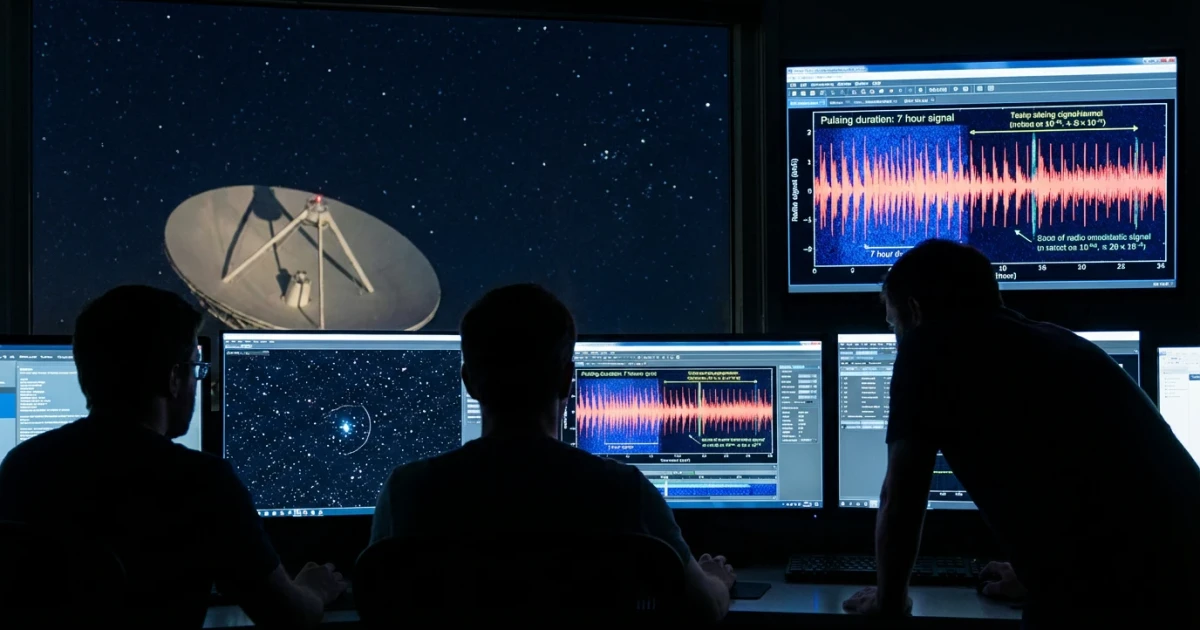
Astronomers have detected a powerful, continuous signal from deep space that lasted an astonishing seven hours, sparking intense speculation and new insights into the cosmos. The detection, hailed as one of the most unusual and prolonged cosmic radio signals ever observed, has prompted researchers to revisit longstanding theories about the origins of such phenomena.
Discovery: A Signal Unlike Any Other
The remarkable signal was picked up by astronomers using sensitive radio telescopes, who noted its unusually long duration compared to typical fast radio bursts (FRBs) that usually last only milliseconds or seconds. The seven-hour emission immediately stood out, leading to a flurry of investigation and international attention within the astronomical community.
- Duration: Seven continuous hours
- Signal strength: Significantly stronger than background noise
- Frequency: Within the radio spectrum, consistent with deep-space emissions
Chasing the Source: What Could Cause a Seven-Hour Signal?
While the source of such a long-lasting signal initially puzzled astronomers, emerging analysis has begun to shed light on possible explanations. The leading theories suggest the signal may originate from exotic astrophysical objects such as neutron stars or highly magnetized magnetars. These remnants of massive stars are known to emit periodic or continuous radio waves due to their intense magnetic fields and rapid rotation.
Unlike regular pulsars, which emit signals at intervals of milliseconds to seconds, few objects are known to emit uninterrupted signals for several hours, making this event highly unusual. This has prompted a detailed comparative analysis with previously catalogued radio events, but so far, none match the unique characteristics of this signal.
What Makes This Signal Unique?
Several factors distinguish this detection from past observations:
- The length of the emission far exceeds that of most known radio bursts
- The signal’s consistency suggests a stable, repeating source rather than a transient event
- No immediate optical or X-ray counterpart was detected, narrowing down possible origins
Theories and Implications: Piecing Together the Cosmic Puzzle
Given the signal's characteristics, astronomers are considering several possible origins:
- Magnetar activity: Some believe a highly magnetized neutron star could emit such a signal under rare, extreme conditions.
- Extragalactic source: The signal’s strength and lack of nearby counterparts suggest it could be coming from a distant galaxy.
- New class of radio transients: The event may point to a previously unknown type of astrophysical phenomenon.
The detection opens new avenues for research and could help scientists refine their understanding of how neutron stars and magnetars behave. It may also lead to the identification of new celestial phenomena, expanding our knowledge of the universe’s most energetic processes.
Looking Ahead: The Search Continues
With this discovery, astronomers are now scouring archival data and monitoring the sky for similar signals. Advanced radio telescopes and machine learning algorithms could help uncover more examples or even identify patterns that connect these events to other cosmic phenomena.
As research continues, the seven-hour signal stands as a reminder of how much remains unknown in the universe—and how each discovery brings us one step closer to unlocking its deepest mysteries.