Science
NASA Advances Mars Helicopter Rotor Technology
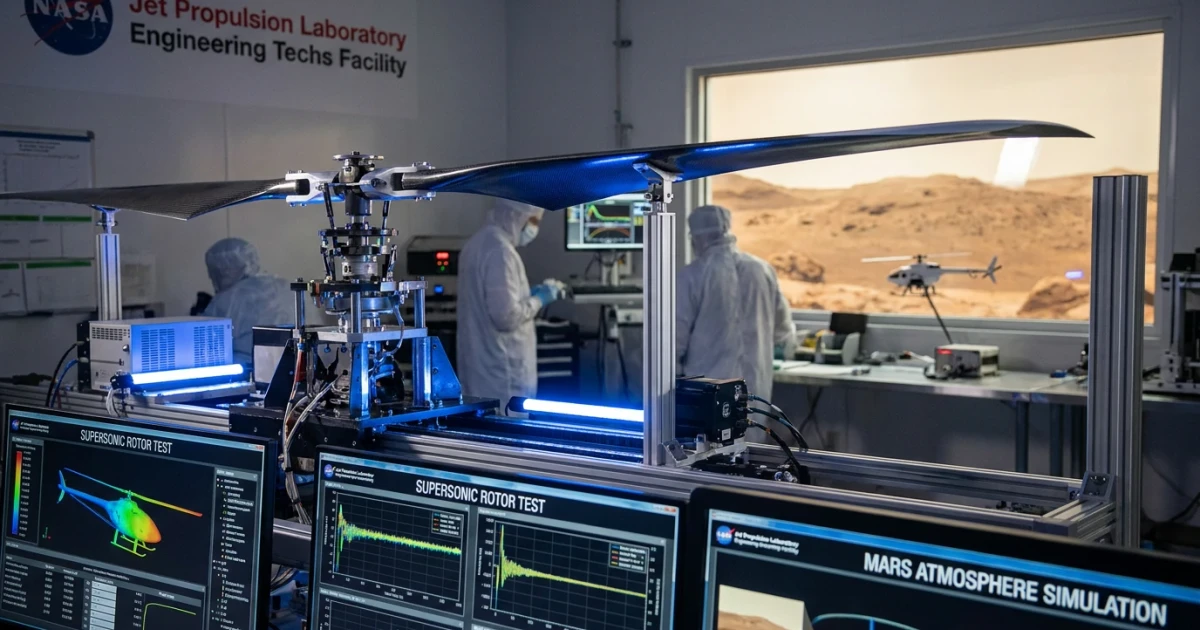
NASA’s Jet Propulsion Laboratory (JPL) has achieved a significant breakthrough in rotor technology, advancing the capabilities of Mars helicopters by successfully testing rotor blades that can operate at supersonic speeds. This innovation is poised to transform future missions to the Red Planet, enabling more ambitious aerial exploration and scientific investigation.
Supersonic Rotor Blades Tested
According to reporting by Ars Technica, JPL engineers have engineered and tested next-generation rotor blades that can withstand tip speeds exceeding Mach 1. This milestone was verified through a series of high-speed spin tests, confirming that the blades maintained structural integrity and aerodynamic performance even when surpassing the speed of sound.
- Tip speeds reached beyond Mach 1, a first for Mars aerial vehicle rotor blades
- Testing included rigorous evaluation of material strength, vibration, and performance at high rotational rates
- Advancement builds on the success of the Ingenuity Mars Helicopter, which used subsonic carbon fiber rotors
Engineering Challenges and Innovations
Flying on Mars presents unique engineering challenges, primarily due to its thin atmosphere—just about 1% as dense as Earth’s. To generate lift, helicopter rotors must spin much faster or be much larger than those used on Earth. The latest NASA technical report details how engineers designed these new blades with advanced materials and optimized their aerodynamic shape to endure the increased stresses of supersonic operation.
- Blades are constructed from high-strength carbon composites
- New geometry reduces shockwave formation and noise at high speeds
- Design was validated through wind tunnel and vacuum chamber experiments simulating Martian conditions
Implications for Future Mars Missions
This breakthrough could substantially expand the operational envelope of future Mars helicopters. With supersonic rotors, aerial vehicles will be able to:
- Carry heavier science payloads, including advanced cameras and instruments
- Fly at higher altitudes and for longer distances across Mars’ challenging terrain
- Support sample retrieval and site scouting for human missions
NASA’s JPL team has also filed a US patent for this high-speed rotor blade technology, underscoring its novelty and potential for use in both robotic and human exploration scenarios.
Building on Ingenuity’s Legacy
This development builds upon the pioneering Ingenuity Mars Helicopter, which demonstrated the feasibility of powered flight on another world. Ingenuity’s rotors, while highly effective, were limited to subsonic tip speeds. The new supersonic design opens the door for larger and more robust rotorcraft, capable of tackling new scientific objectives and supporting ambitious exploration strategies.
Looking Forward
NASA’s breakthrough in supersonic rotor technology represents a pivotal advancement in Mars exploration. As engineers continue to refine these designs and integrate them into future mission concepts, the potential for aerial robotics on the Red Planet will only grow. For readers interested in the technical details and test data, NASA has published a comprehensive engineering report and rotor system specifications for further exploration.
With each step forward, NASA is not only enhancing its robotic capabilities but also laying critical groundwork for future human missions and sustained exploration on Mars.