Science
NASA Confirms End of MAVEN Mars Mission After Months of Silence
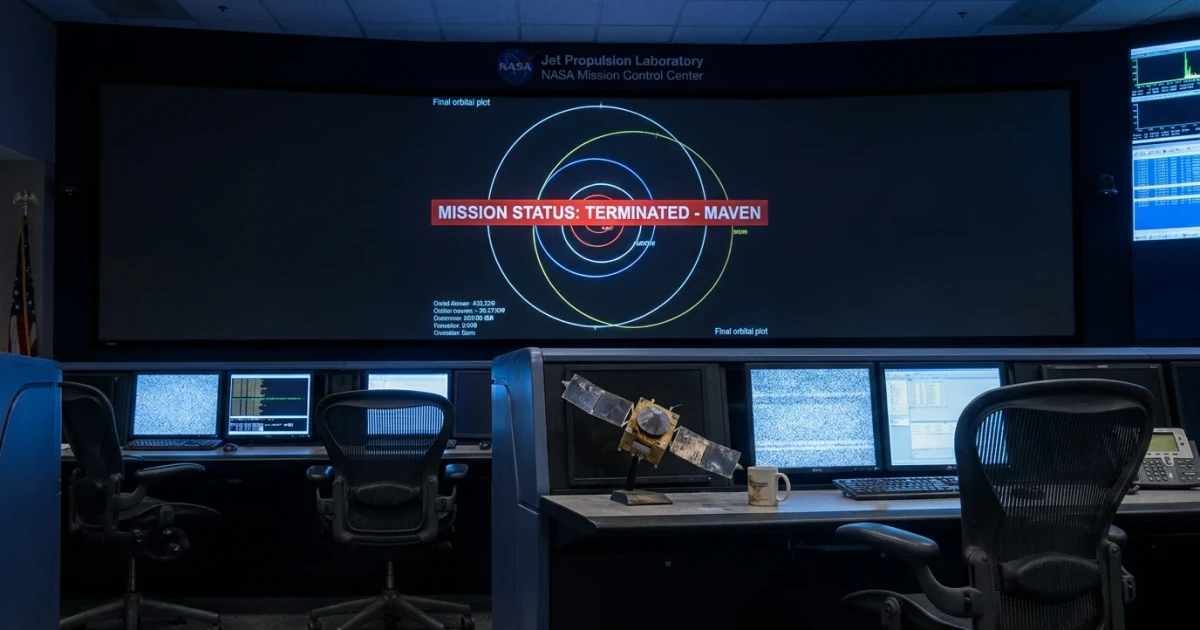
NASA has formally ended the MAVEN mission to Mars, declaring the spacecraft out of service after six months of radio silence. The announcement, made public on June 3, 2026, follows a prolonged period in which NASA engineers were unable to reestablish contact with the probe, signaling the close of a mission that profoundly expanded our knowledge of the Martian atmosphere and its evolution.
MAVEN's Final Chapter
MAVEN, short for Mars Atmosphere and Volatile EvolutioN, was launched in November 2013 and entered Mars orbit in September 2014. Charged with investigating the upper atmosphere of the Red Planet, it became a cornerstone of NASA's broader efforts to understand how Mars transformed from a once-habitable world to the arid planet we know today. According to the official mission status, MAVEN carried out its scientific objectives well beyond its planned primary mission, transmitting critical data back to Earth for over a decade.
Six Months of Silence
The spacecraft last communicated with mission controllers in late 2025. Despite multiple attempts to regain contact, NASA officially declared the mission lost after half a year of silence. This marks the conclusion of an era: MAVEN was one of the few remaining active orbiters at Mars, supporting both science and communications for other assets on the surface.
- MAVEN spent over 11 years in space, far exceeding its initial mission timeline
- The probe contributed vital atmospheric data used in over hundreds of scientific studies
- MAVEN also served as a communications relay for rovers such as Curiosity and Perseverance
Scientific Legacy
MAVEN's primary mission was to investigate how the Martian atmosphere escapes into space — a process considered key to understanding the planet's climatic shift. The spacecraft’s suite of instruments measured atmospheric composition, solar wind interactions, and the loss of gases like hydrogen and oxygen. NASA's MAVEN data archive remains a valuable resource for researchers worldwide.
Among its most notable findings, MAVEN confirmed that solar wind and radiation are responsible for stripping away much of Mars’ atmosphere over billions of years. This revelation helped explain how Mars, once potentially habitable, became the cold, dry world observed today. The mission’s data also informed planning for future human exploration and robotic missions by mapping the dynamics of the upper atmosphere and ionosphere.
Mission Timeline and Achievements
As detailed in the mission timeline, highlights from MAVEN’s 11-year journey include:
- First measurements of the Martian upper atmosphere’s structure and composition
- Discovery of auroras and unexpected variations in atmospheric loss rates
- Critical relay support for NASA’s surface missions
MAVEN’s robust design and efficient operations allowed it to survive well past its intended lifespan, setting a standard for long-duration Mars orbiters. The spacecraft’s technical specifications enabled it to adapt to changing mission priorities and continue delivering data long after its primary mission phase ended.
Looking Ahead
With MAVEN officially retired, NASA will shift its focus to ongoing and upcoming missions, such as the Mars Reconnaissance Orbiter and the Perseverance rover’s science campaigns. The loss serves as a reminder of the harsh conditions and challenges of deep-space exploration, but the legacy of MAVEN’s data will continue to shape Mars research for years to come.
Although NASA has said its final farewell to one of its most productive Martian explorers, the scientific discoveries unlocked by MAVEN’s decade-long mission will remain vital to our understanding of the Red Planet and its history.