Science
NASA Powers Down Voyager 1 Instrument to Extend Mission
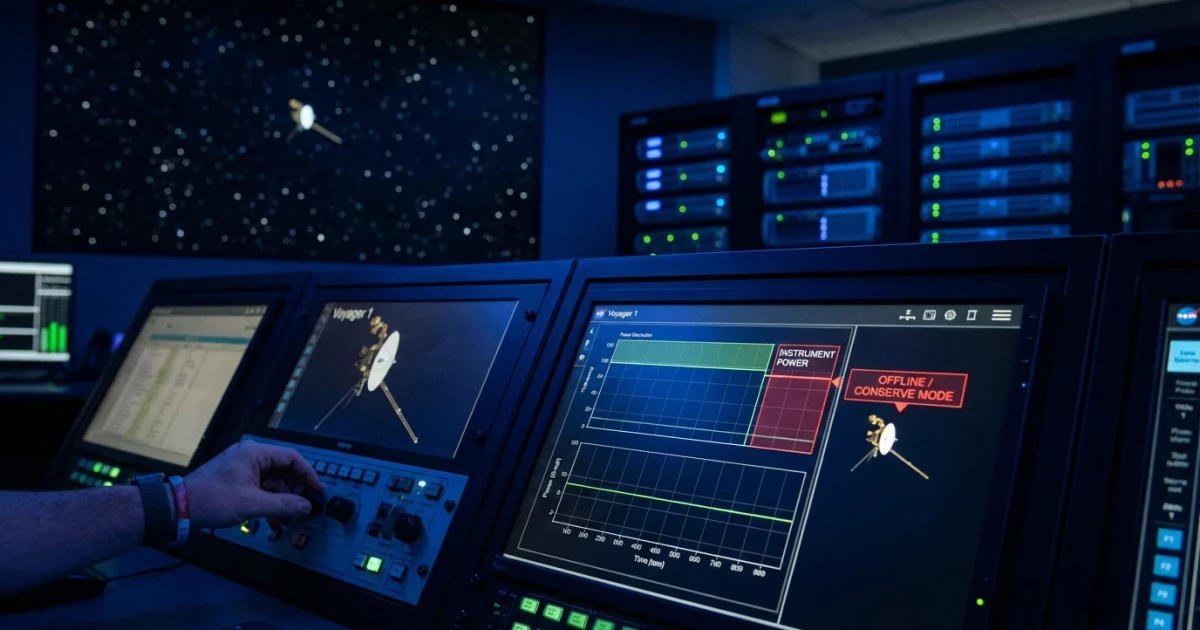
NASA has turned off one of the remaining scientific instruments aboard Voyager 1, a measure intended to conserve power and keep the pioneering spacecraft functioning far beyond its original mission timeline. The decision, announced by the NASA Jet Propulsion Laboratory (JPL), reflects the ongoing challenge of sustaining humanity’s farthest-traveled probe as it continues its historic journey through interstellar space.
Voyager 1’s Ongoing Legacy
Launched in 1977, Voyager 1 has been operating for nearly five decades, delivering groundbreaking data from the outer solar system and beyond. According to official mission timelines, the spacecraft completed its primary mission after flybys of Jupiter and Saturn, then continued into the extended Voyager Interstellar Mission, relaying unprecedented insights from the edge of the heliosphere and the space between stars.
- Voyager 1 is currently more than 15 billion miles from Earth, making it the most distant human-made object.
- Its power comes from three radioisotope thermoelectric generators, which steadily lose output over time.
- The spacecraft carries a suite of instruments, including cosmic ray detectors, plasma sensors, and magnetic field equipment, all designed to withstand the harsh conditions of deep space.
Managing Power in Deep Space
NASA’s recent action—powering down one of Voyager 1’s instruments—is part of a carefully managed process to maximize the mission’s longevity. As the power supply dwindles, engineers periodically shut down select instruments and heaters to redirect energy to critical subsystems and communications. The mission overview from NASA HEASARC notes that even after decades in space, Voyager 1 continues to send back valuable data about the environment outside the Sun’s influence.
Each instrument shutdown is a difficult choice. While it inevitably reduces the scope of scientific observations, it helps ensure that the spacecraft can remain operational, maintain contact with Earth, and preserve its most essential functions for as long as possible. As the team at JPL has emphasized, prioritizing power for communications and navigation increases the odds Voyager 1 will continue transmitting data further into interstellar space.
Scientific and Cultural Significance
Voyager 1’s contributions to science are unparalleled. Its discoveries include:
- Detailed images and data of the outer planets and their moons during its primary mission
- First-hand measurements of the interstellar medium, revealing the conditions outside our solar system
- Continuous monitoring of cosmic rays, magnetic fields, and plasma waves
Beyond science, Voyager 1 famously carries the Golden Record, a time capsule of Earth’s sounds and images intended for any potential extraterrestrial finders.
Looking Ahead: The Final Frontier
NASA’s decision to shut down additional instruments underscores the reality that Voyager 1 is in its twilight years. As its power supply continues to wane, more components will need to be powered down. Eventually, the spacecraft will lose the ability to communicate with Earth, marking the end of active operations but not its journey—Voyager 1 will continue silently drifting through the galaxy for millions of years.
For now, the mission remains a testament to human engineering and curiosity. Each new adjustment, including the recent instrument shutdown, is aimed at extending the spacecraft’s operational life and maximizing the scientific return from one of humanity’s most remarkable explorations.