Science
NASA Prepares for Roman Space Telescope Launch
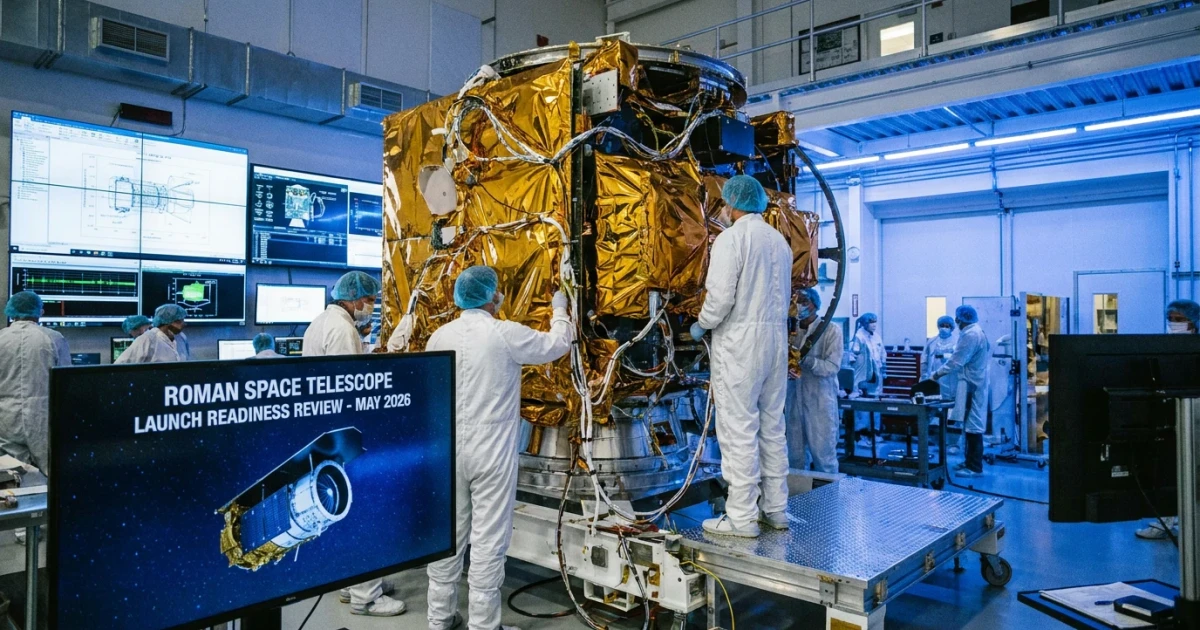
NASA’s Roman Space Telescope is on the cusp of launch, poised to open new frontiers in our understanding of the cosmos. Anticipation is high within the scientific community as this powerful observatory readies to survey vast portions of the sky, promising a leap forward in studies of dark energy, exoplanets, and cosmic evolution.
Unprecedented Survey Capabilities
The Roman Space Telescope, named after pioneering NASA executive Dr. Nancy Grace Roman, is equipped with a 2.4-meter primary mirror—the same size as the Hubble Space Telescope’s, but paired with a much wider field of view. According to NASA’s science overview, Roman will capture images covering 100 times more sky than Hubble at comparable resolution, enabling astronomers to conduct sweeping surveys that were previously out of reach.
The telescope’s Wide Field Instrument is designed to create detailed maps of the universe, while its Coronagraph Instrument will directly image exoplanets around nearby stars, offering a unique window into planetary systems beyond our own. Technical specifications, including advanced detectors and precision pointing systems, are detailed in the Roman observatory data.
Shedding Light on Dark Energy and Cosmic Acceleration
A major science objective of Roman is to probe dark energy, the mysterious force driving the accelerating expansion of the universe. By surveying billions of galaxies, Roman will map the universe’s structure and measure the effects of dark energy over cosmic time. This will help resolve fundamental questions about the fate of the cosmos and the nature of gravity on the largest scales.
- Roman’s wide-field imaging and spectroscopy will chart the positions and shapes of over a billion galaxies.
- The mission will use multiple techniques—such as supernova measurements and weak gravitational lensing—to independently test cosmological theories.
Researchers anticipate that Roman’s data, which will be archived and made public through the Roman Data Archive, will support discoveries for decades to come.
Hunting for Exoplanets and the Building Blocks of Life
Another key ambition for the Roman mission is the search for exoplanets. Its microlensing survey is expected to find thousands of new worlds, including planets similar in size and orbit to Earth. By monitoring the brightness of hundreds of millions of stars in the Milky Way, Roman’s sensitive instruments can detect the subtle signatures of planets passing in front of or behind their host stars.
Roman’s coronagraph will also test cutting-edge technology for direct imaging of exoplanets. This technology demonstration will help pave the way for future missions aiming to find and characterize habitable planets around Sun-like stars.
Collaboration and Future Impact
The European Space Agency and numerous research institutions worldwide are contributing to the Roman mission, reflecting its global significance. As described in NASA’s feature overview, the mission is expected to complement and extend the discoveries of the Hubble and James Webb space telescopes, offering new insights into the unseen universe.
- Roman’s public data releases will enable astronomers everywhere to pursue new research questions.
- Technical documentation, data tools, and community support are available via the Roman Science Support Center.
- Mission data and simulation products can be accessed through NASA’s open data portal.
Looking Ahead
With its combination of large-scale surveys, advanced technology, and open data policies, the Roman Space Telescope is expected to reshape our view of the universe. As the astronomy community awaits the first observations, the mission stands as a testament to decades of scientific planning and international cooperation, promising to unlock answers to some of the most profound mysteries in science.