Science
NASA Telescope Captures X-ray Bubble Around Sun-like Star
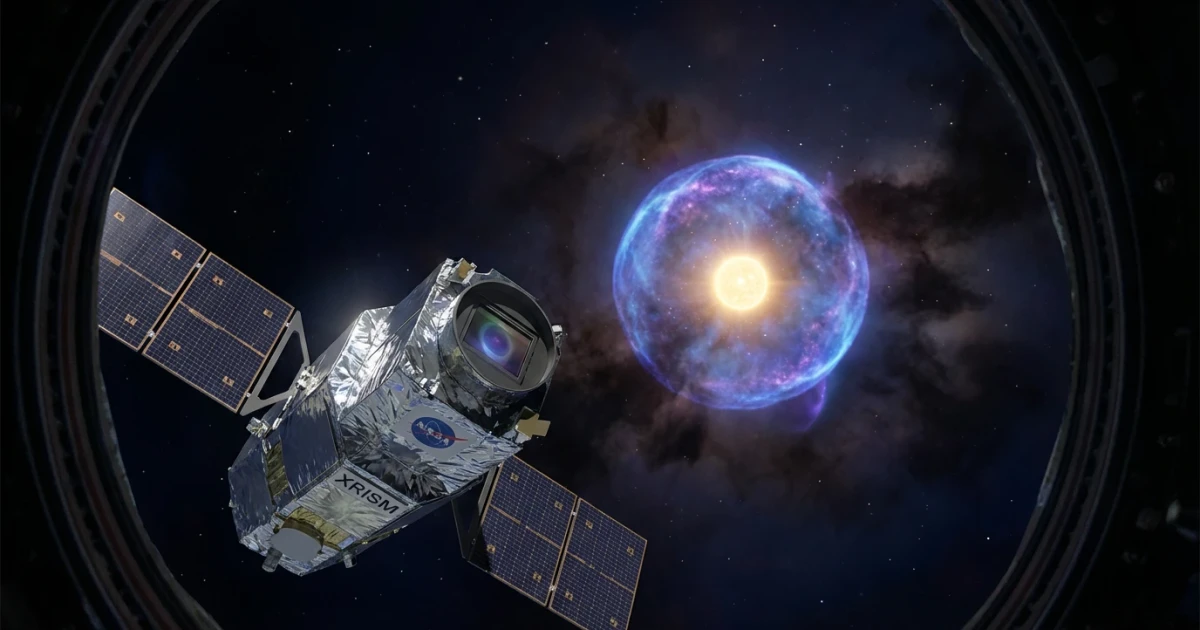
NASA’s XRISM space telescope has delivered a milestone achievement by capturing the first clear X-ray image of a bubble blown by a sun-like star. This discovery marks a significant advance in our understanding of how stars shape their cosmic environments and sheds light on the dynamics of stellar winds.
Breakthrough in Stellar Imaging
The XRISM mission (X-Ray Imaging and Spectroscopy Mission), a collaborative effort between NASA and the Japan Aerospace Exploration Agency (JAXA), is equipped with cutting-edge instruments designed to observe the universe in X-ray wavelengths. The latest observation, highlighted by Space, showcases the telescope’s ability to resolve detailed structures surrounding stars similar to our Sun.
For the first time, astronomers have obtained a clear X-ray view of a sun-like star’s wind blowing a bubble into the surrounding interstellar medium. These bubbles, composed of hot, ionized gas, are crucial in the recycling of matter and energy in galaxies, but until now, their X-ray signatures remained elusive.
What the Image Reveals
The X-ray image reveals a glowing, spherical shell of hot gas expanding outward from the star. This phenomenon, known as a stellar wind bubble, is formed when strong winds from the star collide with the surrounding interstellar material. The shock heats the gas to millions of degrees, causing it to emit X-rays detectable by XRISM’s sensitive instruments.
- The observation provides evidence that stars like our Sun can drive energetic winds strong enough to carve out massive cavities in space.
- These structures play a pivotal role in the life cycle of stars and the evolution of galaxies, influencing star formation and the distribution of elements.
- Data from the mission is now available to the public via the NASA HEASARC archive, allowing researchers worldwide to explore the details.
Scientific Impact and Future Exploration
Stellar wind bubbles have long been theorized by astronomers, but the direct observation in X-rays provides new opportunities for quantitative analysis. According to the mission overview from JAXA, XRISM’s high-resolution spectrometers can measure the temperature, composition, and dynamics of the hot gas in unprecedented detail.
This breakthrough paves the way for understanding how our own Sun’s wind might influence the solar system’s outer boundaries and offers a template for studying similar phenomena around other stars. Detailed analysis, such as that outlined in the recent arXiv preprint, highlights the importance of X-ray observations in tracing the flow of energy and matter from stars into the galaxy.
Access to Data and Ongoing Research
Researchers and enthusiasts can access the raw and processed data from this observation through the XRISM Data Archive. The catalog of X-ray observations of sun-like stars provides a broader context for comparing this discovery with past surveys and models.
What Comes Next?
The success of this observation demonstrates the power of next-generation X-ray telescopes to unravel the complexities of stellar evolution and galactic ecology. As XRISM continues to survey the sky, astronomers anticipate more discoveries that will refine our models of how stars interact with their environments and contribute to the cosmic ecosystem.
For the public and scientific community alike, the first clear X-ray image of a sun-like star blowing a bubble represents a leap forward in exploring the invisible universe—and a testament to international collaboration in space science.