Science
NASA Tests Lithium Plasma Thruster for Mars Missions
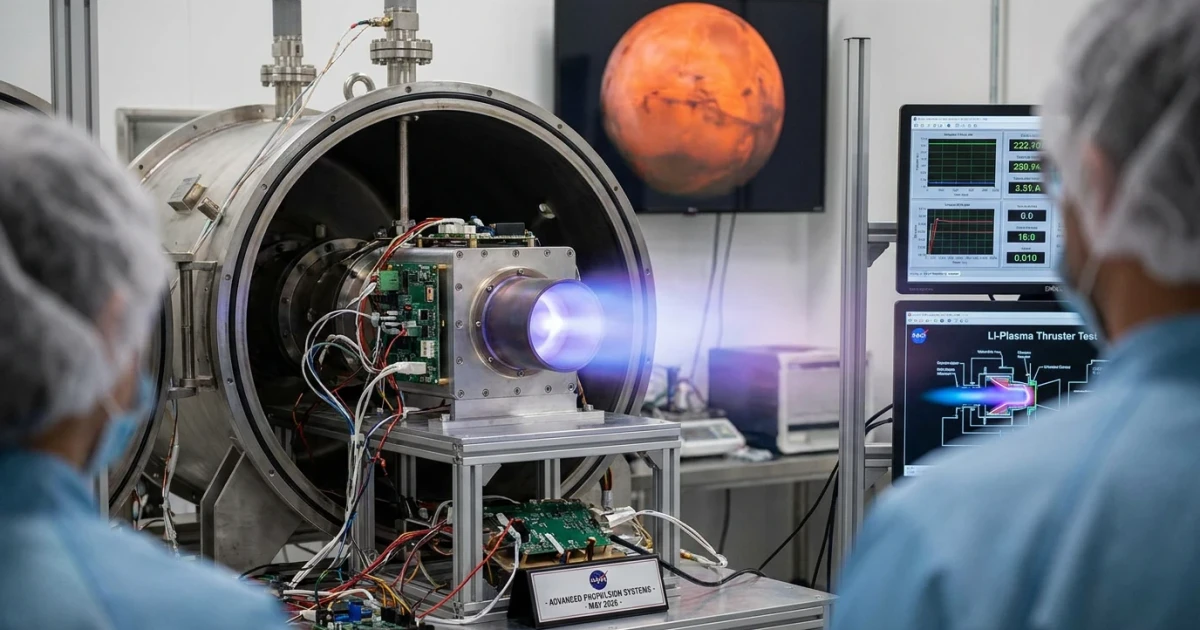
NASA has successfully tested a lithium-fed plasma thruster, a development that could dramatically improve the efficiency and range of future missions to Mars and beyond. The new engine, powered by lithium plasma, represents a significant advancement in electric propulsion technology, which is increasingly seen as a critical component for deep space exploration.
Breakthrough in Electric Propulsion
The recent test, highlighted by Futurism and confirmed by NASA's official communications, demonstrated the operation of a plasma thruster that uses lithium as its propellant. Unlike traditional chemical rockets, which rely on explosive combustion, plasma thrusters accelerate ions using electromagnetic fields, resulting in higher exhaust velocities and greater fuel efficiency. Lithium is chosen for its low atomic mass and high ionization energy, making it an ideal candidate for plasma propulsion systems.
NASA’s lithium plasma thruster builds on decades of research into solar electric propulsion and Hall-effect thrusters, but with the added performance benefits of lithium-fed plasma. According to the agency’s project overview, this engine can generate thrust while using far less propellant than conventional methods, a vital advantage for long-duration missions where mass and efficiency are paramount. Details on the technical specifications and testing milestones are available on the official NASA project page.
Implications for Mars Exploration
One of the primary motivations behind developing lithium plasma propulsion is to enable crewed missions to Mars. Traditional chemical rockets require enormous amounts of fuel and limit the payloads that can be transported over interplanetary distances. Electric propulsion, particularly with lithium, offers a way to reduce transit times and increase the amount of cargo and scientific equipment that can be sent to the Red Planet.
- Plasma thrusters can operate continuously for months or years, making them suitable for the long journeys required by Mars missions.
- The higher efficiency translates to either faster trips or the ability to transport heavier payloads with the same amount of fuel.
- NASA’s experience with missions like Deep Space 1, which tested ion propulsion, is now informing the next generation of propulsion systems.
Technical Advantages and Testing Results
During the recent test, the lithium plasma thruster demonstrated stable operation and achieved thrust levels suitable for the kind of deep space missions envisioned by NASA. While full performance data has yet to be released, early results suggest that the engine meets key benchmarks for efficiency and durability. Engineers are continuing to analyze the test data to refine designs and prepare for future in-space demonstrations.
According to Futurism’s coverage, the successful ignition and sustained firing of the thruster is a major milestone. The lithium plasma engine’s capabilities are expected to exceed those of previous xenon-based ion thrusters, thanks to lithium’s superior properties in plasma generation and handling.
The Road Ahead
NASA plans to continue development and testing of plasma propulsion technologies in preparation for upcoming missions to Mars and potentially the outer solar system. The success of the lithium plasma thruster could pave the way for larger, more ambitious spacecraft designs, as well as the possibility of round-trip journeys to Mars with reusable vehicles.
As the space agency moves forward, the integration of advanced electric propulsion systems will be essential for the future of human and robotic exploration. For more in-depth technical details and ongoing updates, readers can explore NASA’s solar electric propulsion overview and follow the latest research on lithium plasma thruster performance.
With these advances, the dream of sustainable, efficient travel to Mars is moving closer to reality—one plasma burst at a time.