Science
NASA to Launch Nuclear-Powered Mars Mission with Skyfall Helicopters
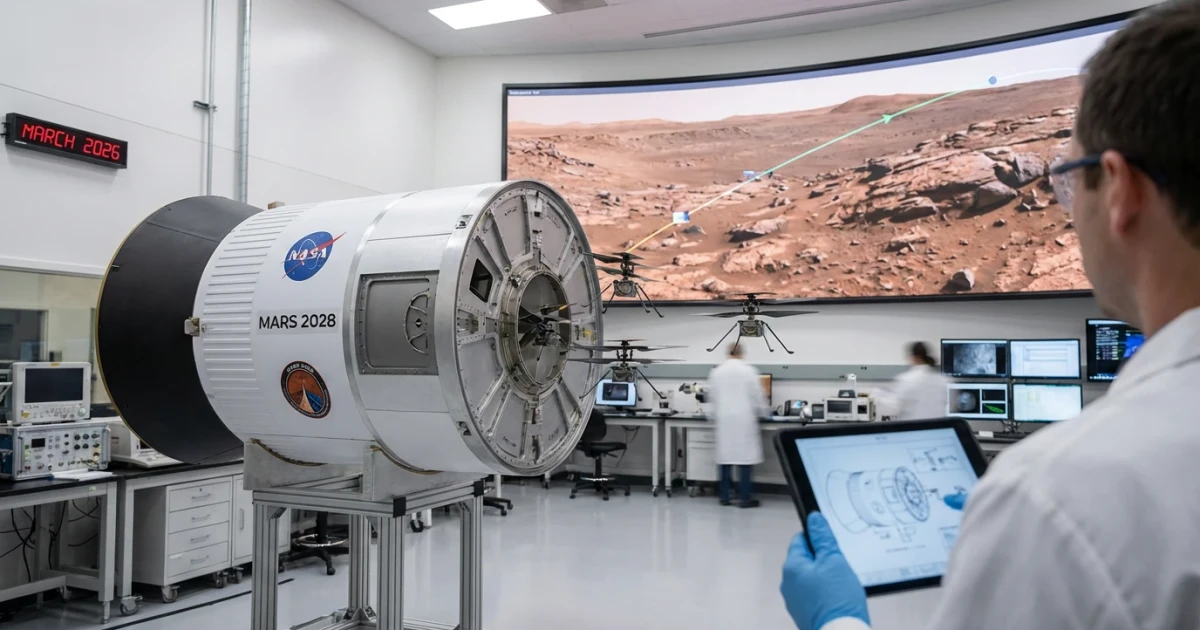
NASA has announced a major milestone in interplanetary exploration: the agency will launch its first nuclear-powered interplanetary spacecraft to Mars in 2028. The mission aims to deliver next-generation Skyfall helicopters to the Martian surface, building on the success of previous rotorcraft technology and marking a new chapter in Red Planet exploration.
Mission Overview
The upcoming mission will employ a state-of-the-art nuclear electric propulsion system, which provides more efficient and sustained thrust compared to conventional chemical rockets. NASA's official Mars Sample Return mission records note that nuclear propulsion can significantly reduce travel time to the Red Planet and increase the payload capacity, enabling the transportation of heavier scientific instruments and advanced technology like the Skyfall helicopters.
- The 2028 mission will mark the first use of a nuclear electric propulsion system for interplanetary travel.
- It will deliver multiple Skyfall helicopters to various sites on Mars, targeting regions that are challenging for traditional rovers.
- The nuclear-powered spacecraft is expected to provide continuous power, overcoming limitations posed by solar energy in Mars' dusty and harsh environment.
Skyfall Helicopters: A Leap in Aerial Exploration
The Skyfall helicopter concept expands on technology initially proven by the Ingenuity helicopter, which performed dozens of successful flights on Mars. Skyfall is designed for longer range, greater payload capacity, and more robust scientific operations. According to NASA's project documentation, each helicopter is equipped with advanced sensors, sample collection tools, and autonomous navigation systems.
- Skyfall helicopters can fly farther and higher than their predecessors, reaching new terrains like deep canyons, cliffs, and craters.
- The drones are designed to operate independently or in coordination with Mars rovers, relaying data and scouting ahead for future missions.
- Payloads include high-resolution cameras, spectrometers, and atmospheric sensors to analyze the Martian environment in unprecedented detail.
Nuclear Propulsion: A Game-Changer for Space Travel
NASA's adoption of nuclear electric propulsion is a significant leap for deep-space missions. Peer-reviewed analysis in the research literature highlights that nuclear systems can offer up to twice the efficiency of chemical rockets, translating to faster travel and greater mission flexibility. The agency's official program details ongoing research, including the development of robust reactors and power management systems suitable for the harsh conditions of interplanetary space.
The nuclear-powered spacecraft will also serve as a testbed for technologies that could one day support crewed missions to Mars and beyond, providing reliable energy for life support, communications, and scientific operations.
Looking Forward
NASA's 2028 mission represents a convergence of advanced propulsion and aerial robotics, opening new possibilities for Mars exploration. The integration of nuclear-powered spacecraft and Skyfall helicopters could greatly expand the range, speed, and scientific return of future missions, with the potential to uncover critical insights about Mars' geology, climate, and the possibility of past life.
As the mission moves forward, scientists and engineers are closely monitoring development milestones and testing platforms to ensure readiness for launch. Success in 2028 could set the stage for more ambitious projects, including Mars sample return and eventual human exploration.