Science
NASA’s Psyche Probe Captures Striking Mars Image During Gravity Assist
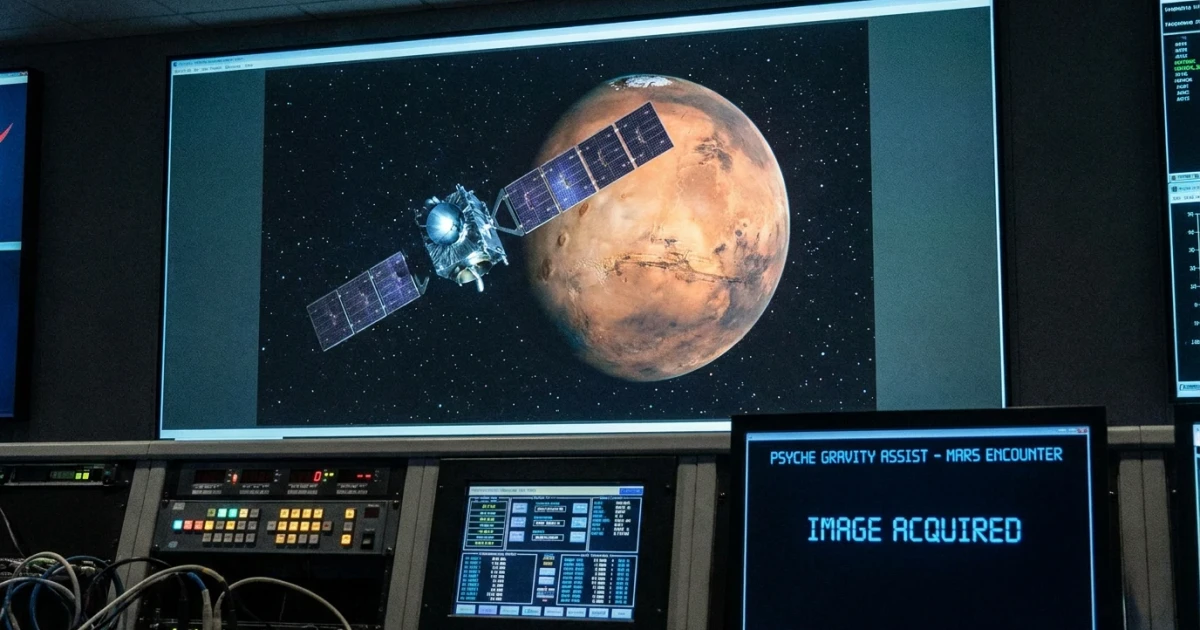
NASA’s Psyche spacecraft has delivered a dramatic new perspective on Mars, capturing an image that, at first glance, could be mistaken for a solar eclipse. The photo, taken as the probe performed a close flyby of the Red Planet, showcases Mars as a striking silhouette—an image that is drawing attention not only for its aesthetic qualities but also for its scientific significance.
Milestone on the Path to the Asteroid Belt
The Psyche mission, launched by NASA in 2023, is currently en route to the metallic asteroid 16 Psyche, located in the main asteroid belt between Mars and Jupiter. To reach its distant target, the spacecraft is using a gravity assist maneuver at Mars, a technique that leverages the planet’s gravitational field to increase the probe’s speed and alter its trajectory—an efficient method for conserving fuel and fine-tuning its path through space.
The recent image, released by NASA, shows Mars appearing as a dark disk against a background of space. While it may resemble a solar eclipse to casual observers, the view is actually the result of the probe’s unique vantage point as it approached and passed by the planet. The event marks a significant operational milestone for the mission, confirming both the spacecraft’s health and its precise navigation through the solar system.
Why the Gravity Assist Matters
The gravity assist at Mars is a critical part of the Psyche mission’s flight plan. By swinging close to Mars, the probe gains additional velocity—enabling it to cover the vast distance to its asteroid target without requiring large amounts of propellant. This maneuver, which has been used in previous deep space missions, also provides mission teams with an opportunity to test and calibrate the spacecraft’s instruments and navigation systems in a real-world flyby scenario.
- The Psyche probe’s journey will cover approximately 3.5 billion kilometers before it reaches its destination.
- The spacecraft’s science instruments will remain active throughout the cruise, gathering valuable data on the interplanetary environment and on Mars itself during the flyby.
- This maneuver ensures that Psyche will arrive at the asteroid with the correct velocity and approach angle for a successful orbital insertion.
The Science and the Spectacle
While the Mars image is visually compelling, it also carries scientific value. According to mission documentation, the Psyche flyby provides an opportunity to test the probe’s cameras and sensors in a dynamic environment, ensuring they are fully calibrated for the asteroid encounter. Data collected during the Mars pass are being analyzed to support ongoing mission planning and navigation refinement.
For the public, the image offers a rare view of Mars from a location in space not often captured by previous missions. Unlike typical orbital images, this photo was taken from a spacecraft on an interplanetary trajectory, highlighting the versatility and reach of NASA’s robotic explorers.
Looking Ahead to 16 Psyche
The ultimate goal of the mission is to explore the asteroid 16 Psyche—a body believed to be the exposed metallic core of an early planetesimal. Scientists hope that by studying Psyche, they can gain new insights into the formation of planetary cores and the early history of our solar system. The spacecraft is scheduled to arrive at the asteroid in 2029, where it will spend nearly two years conducting detailed mapping and analysis using its suite of scientific instruments.
In the meantime, the successful Mars flyby and the release of this striking image underscore the mission’s progress and the ingenuity of the teams supporting NASA’s exploration objectives. As the probe continues on its journey, both scientists and the public can look forward to more discoveries—and more unique views from the frontier of our solar system.