Science
NASA's Psyche Spacecraft Makes Mars Flyby
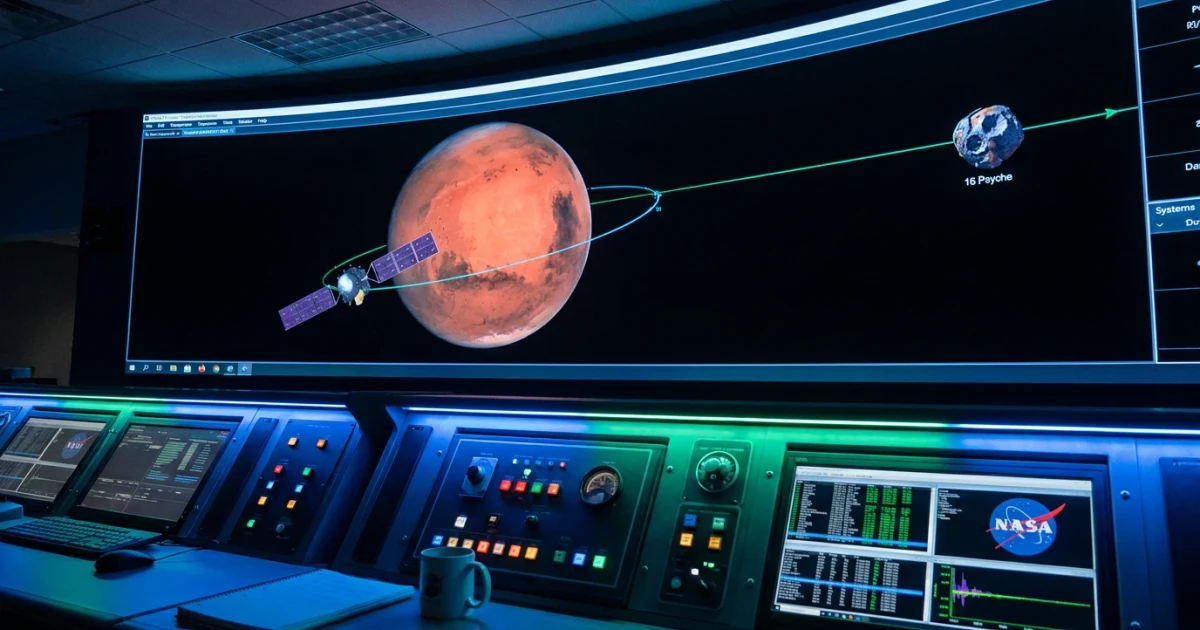
NASA’s Psyche spacecraft has successfully completed a flyby past Mars, marking a significant milestone in its historic journey toward the metal-rich asteroid 16 Psyche. The maneuver, reported by Yahoo and AP News, positions the probe for its next phase: a deep-space trajectory aimed at unlocking secrets of planetary formation and composition.
Milestone Mars Flyby
The flyby, which occurred as scheduled, allowed the Psyche mission to harness Mars’ gravity for a crucial assist, accelerating the spacecraft toward its distant target. This technique, known as a gravitational slingshot, is a common method used in interplanetary travel to conserve fuel and optimize flight paths.
- Psyche’s Mars flyby is one of the mission’s key planned milestones, as detailed in the official mission timeline.
- The encounter positions the spacecraft for its multi-year journey, with arrival at asteroid 16 Psyche projected for August 2029.
- This maneuver also provides an opportunity for the navigation and science teams to calibrate instruments and validate autonomous guidance systems.
The Rare Metal Asteroid Target
The destination, asteroid 16 Psyche, is unique among known asteroids: it’s believed to be composed largely of nickel and iron, resembling the exposed core of a protoplanet. According to NASA and Arizona State University, studying what Psyche may reveal could revolutionize our understanding of planetary cores, including Earth’s.
- 16 Psyche is one of the largest objects in the asteroid belt, measuring about 220 kilometers (137 miles) in diameter.
- Its composition distinguishes it from typical rocky or icy asteroids, making it a prime candidate for studying early solar system processes.
- The mission aims to determine whether 16 Psyche really is a planetary core, and how it came to be exposed.
Psyche Spacecraft and Scientific Goals
The Psyche spacecraft is equipped with a suite of instruments designed to analyze the asteroid’s surface, magnetic properties, and chemical makeup. As it travels, the probe will rely on advanced autonomous navigation and artificial intelligence systems to manage its long-distance voyage, as discussed in NASA’s technical analysis of AI-guided navigation.
- The probe carries imagers, spectrometers, and magnetometers for comprehensive data collection.
- Autonomous systems will handle communication delays and navigation in deep space.
- Researchers expect to gather insights into planetary differentiation and the history of metal-rich bodies.
Looking Ahead: Next Steps for Psyche
With the Mars flyby completed, Psyche will continue on its four-year journey toward the asteroid belt. Along the way, mission controllers will monitor the spacecraft’s health and trajectory, ensuring it remains on course for its ambitious scientific goals.
The successful Mars flyby demonstrates the mission’s technical prowess and sets the stage for what many scientists believe could be one of the most revealing explorations of our solar system’s fundamental building blocks. As the probe closes in on its rare target, anticipation builds for the data that could illuminate how planets—and their cores—take shape.
For more information on mission progress and scientific objectives, readers can explore NASA’s spacecraft details archive and Arizona State’s Psyche science portal.