Science
New Dinosaur Species Found With Huge Horn and Taste for Fish
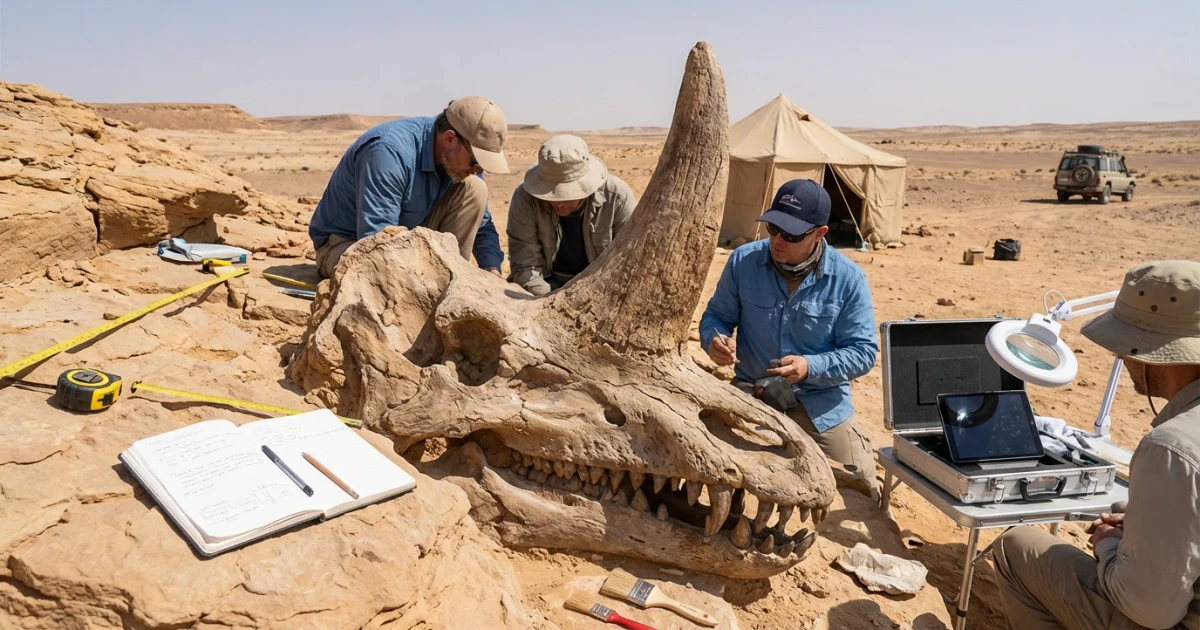
Paleontologists have announced the discovery of a new dinosaur species in the Sahara, notable for its massive horn and specialized fish-eating adaptations. The find, made by a University of Chicago-led research team, sheds light on the diversity of predatory dinosaurs in Africa during the Late Cretaceous period and offers fresh evidence of unique evolutionary paths among carnivorous dinosaurs.
Discovery in the Sahara
The previously unknown dinosaur was uncovered in what is now Niger, an arid region that once hosted vast river systems teeming with life. The fossil remains, which include a prominent horn on the skull, were excavated from sedimentary rocks known to date to the Cretaceous period, around 95 million years ago. According to reporting from NPR, the research team was led by University of Chicago paleontologist Paul Sereno, who has contributed to several major discoveries in the region over the past three decades.
Striking Anatomy and Fish-Eating Adaptations
The standout feature of the new species is its huge, blade-like horn, believed to have been used for display, combat, or possibly even species recognition. The skull also shows adaptations for a piscivorous (fish-eating) diet. Paleontologists identified elongated jaws, conical teeth, and a jaw joint allowing wide opening—features well-suited for catching slippery prey. This combination of traits suggests the dinosaur occupied a unique ecological niche among the predatory dinosaurs of its era.
- The dinosaur is classified within the abelisaurid family, a group known for bizarre skull ornaments and predatory habits.
- Fossil evidence points to a length of roughly 20 feet and an estimated weight of nearly 2 tons.
- It lived alongside massive crocodile-like reptiles and other large theropods, indicating a complex food web in the region’s ancient river systems.
Paleontological Significance
The discovery adds to the growing list of African dinosaurs that challenge the notion of a globally uniform dinosaur fauna in the Cretaceous. As highlighted in recent paleontological research, African ecosystems appear to have fostered unique dinosaur lineages, likely due to the continent’s long geographic isolation.
The new species also provides valuable data on the evolution of abelisaurids, a group better known from South America, India, and Madagascar. The researchers’ analysis, detailed in peer-reviewed journals, notes that the Sahara fossil shares anatomical traits with its relatives elsewhere, but the horn and jaw structure are distinct, hinting at local adaptations.
Digital Fossil Data and Future Study
To support ongoing research and public exploration, digital scans and 3D models of the fossil remains have been made available through repositories such as MorphoSource. These resources allow scientists worldwide to study the specimen’s morphology in detail and compare it with other known dinosaurs in the Paleobiology Database.
Looking Ahead
This latest find highlights the Sahara’s status as a treasure trove for dinosaur discoveries and underscores the importance of international collaboration in paleontology. As more fossils are uncovered and analyzed, scientists expect to reveal further surprises about the diversity and adaptation of dinosaurs in Africa’s ancient landscapes. For readers interested in dinosaur evolution, ecology, and the latest fossil finds, this discovery offers an exciting glimpse into the prehistoric past—and a reminder of how much there still is to learn.