Science
New Findings Sharpen Hubble Tension Debate
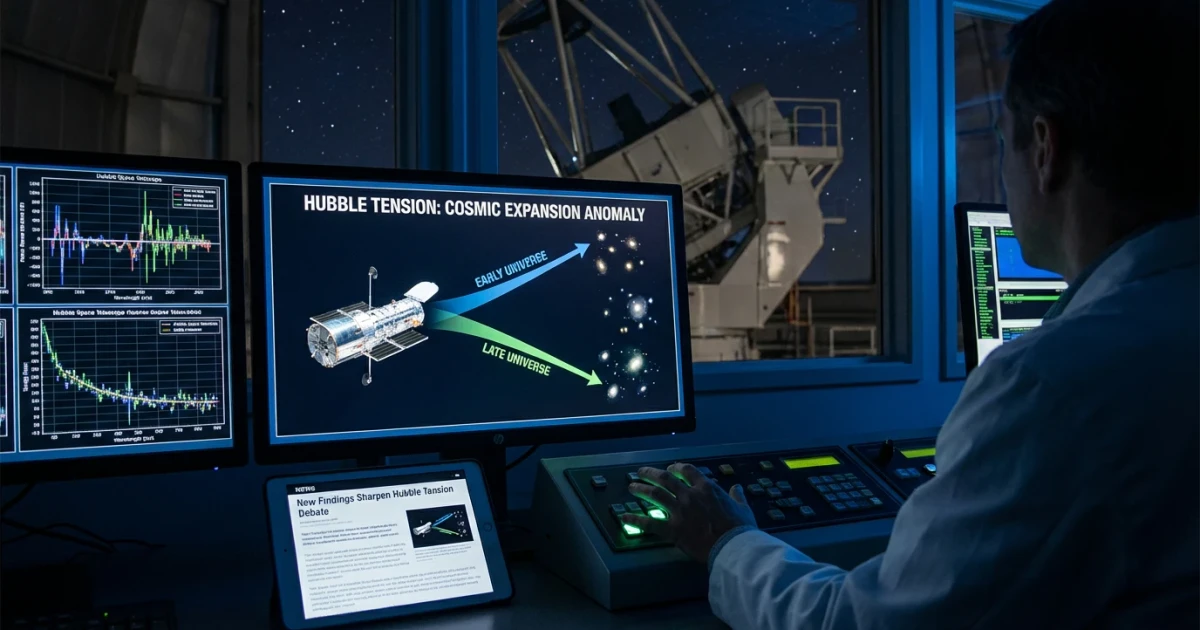
Scientists have definitively ruled out the possibility that a single faulty measurement is behind the persistent mismatch in the universe’s expansion rate, known as the Hubble tension. This finding refines our understanding of the cosmos but deepens the mystery about the forces shaping its growth.
What Is the Hubble Tension?
The Hubble constant measures how fast the universe is expanding. Two leading methods—observing nearby supernovae and galaxies (the local universe), and analyzing the cosmic microwave background (CMB)—consistently yield values that disagree by several percent. This discrepancy, called the Hubble tension, has become one of cosmology’s most pressing puzzles.
- Local measurements, such as those using Cepheid variable stars and supernovae, give a higher value for the Hubble constant.
- Early-universe measurements, derived from CMB data collected by missions like Planck, yield a lower value.
- The two approaches disagree by more than can be explained by random error—raising the possibility of new physics or unknown systematics.
Ruling Out ‘One Bad Measurement’
As reported by Big Think, recent studies have thoroughly examined the possibility that the Hubble tension is the result of a single flawed measurement in the local universe data. By cross-checking observations from independent teams and telescopes, researchers have confirmed the robustness of each step in the process. This means the mismatch cannot be dismissed as a statistical fluke or a problem with one dataset.
These results align with conclusions from international collaborations, such as H0LiCOW, which have used alternative gravitational lensing methods to independently determine the Hubble constant. Their findings also support the view that the tension is not caused by overlooked errors in the local measurements.
Implications for Cosmology
With measurement error largely ruled out, the focus turns to new potential explanations:
- Unknown Physics: The tension may be a sign that our current understanding of the universe’s composition or evolution is incomplete. Theorists have proposed modifications to dark energy, new types of neutrinos, or early-universe phenomena as possible solutions.
- Subtle Systematic Errors: While a single erroneous measurement is unlikely, scientists continue to search for more subtle biases that could affect entire classes of observations.
NOIRLab and other observatories emphasize that the expansion rate in the local universe is now measured with unprecedented precision. As new data from upcoming missions arrives, such as the Hubble Space Telescope and next-generation CMB experiments, scientists hope to further clarify the source of the tension.
What Happens Next?
The search for the true cause of the Hubble tension is intensifying. As Big Think highlights, “one bad measurement” can now be dismissed, focusing the debate on fundamental physics and the possibility that the universe itself may be stranger than previously thought.
For readers interested in exploring the underlying data and research, comprehensive tables and plots can be found in the H0LiCOW key results, the NASA LAMBDA CMB data portal, and the ESA Planck Legacy Archive.
The mystery of the Hubble tension remains unsolved, but with each new study, scientists are narrowing the possibilities and opening the door to deeper discoveries about the universe’s fundamental workings.