Politics
New polls show Democrats competitive in key Senate battlegrounds

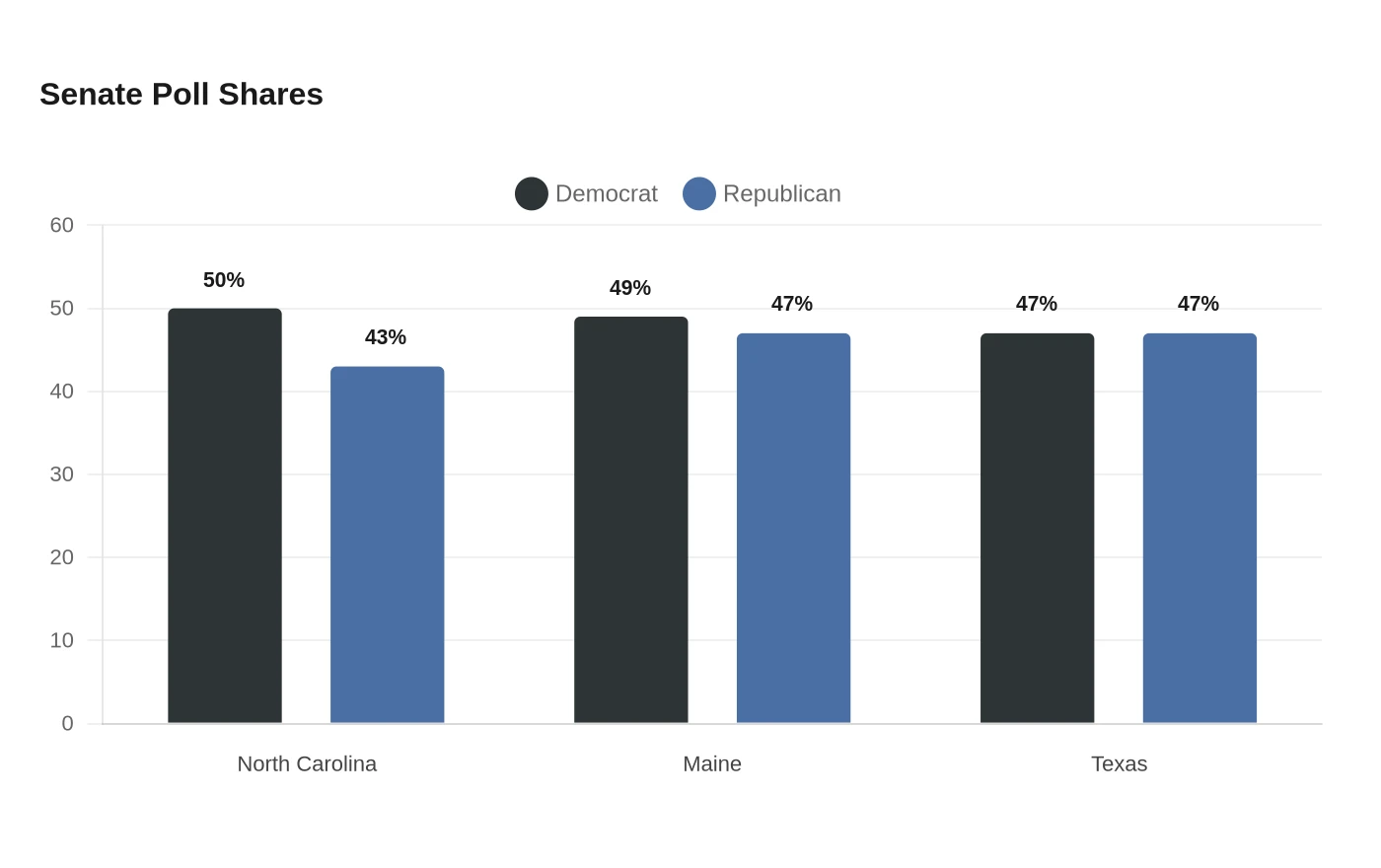
Democrats held narrow or outright leads in several Senate battlegrounds, but the math for taking control of the chamber remained punishing, with party leaders still needing to net four seats. The New York Times and Siena polling found Roy Cooper ahead of Michael Whatley 50% to 43% in North Carolina, Graham Platner ahead of Susan Collins 49% to 47% in Maine, and James Talarico tied with Ken Paxton at 47% in Texas.
The same polling showed Democrats close but still behind in Iowa, Alaska and Ohio. Josh Turek trailed Ashley Hinson 46% to 48% in Iowa, Mary Peltola was down 45% to 47% against Dan Sullivan in Alaska, and Sherrod Brown trailed Jon Husted 47% to 50% in Ohio. That left Democrats competitive in six battlegrounds, yet still short of the gains they would need if the election were held today.

The broader numbers pointed to a volatile national mood, not a clean partisan realignment. Only 36% of respondents approved of Donald Trump’s handling of the cost of living, 33% approved of his handling of gas prices, and 39% backed his handling of the Iran war. Decision Desk HQ’s aggregate also showed Democrats with a 4-point advantage on the generic congressional ballot, reinforcing the sense that the national environment was not running strongly against the party.
Separate surveys showed how individual states can diverge from the national picture. A Catawba College-YouGov poll released June 25 found Cooper leading Whatley 48% to 34% in North Carolina, with the pollster tying Cooper’s early advantage to name recognition and Trump’s endorsement of Whatley. In that same survey, 54% opposed sending U.S. troops into Iran and 61% said Trump had no clear plan or no plan at all for Iran.

Ohio offered another warning sign for Republicans and Democrats alike. An AARP poll conducted by Fabrizio Ward and Impact Research from June 14 through 16 found Amy Acton leading Vivek Ramaswamy 47% to 44% and Brown leading Husted 48% to 45% among 800 likely voters, both within the poll’s 3.5-point margin of error. AARP has argued that voters 50 and older remain the key swing bloc in midterm elections.
The larger historical backdrop is still daunting for Democrats. GOP strategists have pointed to the fact that 68 of the past 69 Senate races mirrored the presidential result, with Susan Collins’s 2020 victory in Maine the lone exception. With 35 states holding Senate primaries this cycle and the general election set for November 3, 2026, the map still favors Republicans unless Democrats can turn close races into actual pickups.
Sources
- [1]nytimes.com
- [2]thehill.com
- [3]wcnc.com
- [4]apnews.com