Entertainment
Nolan’s The Odyssey, his most ambitious film, shot entirely on IMAX
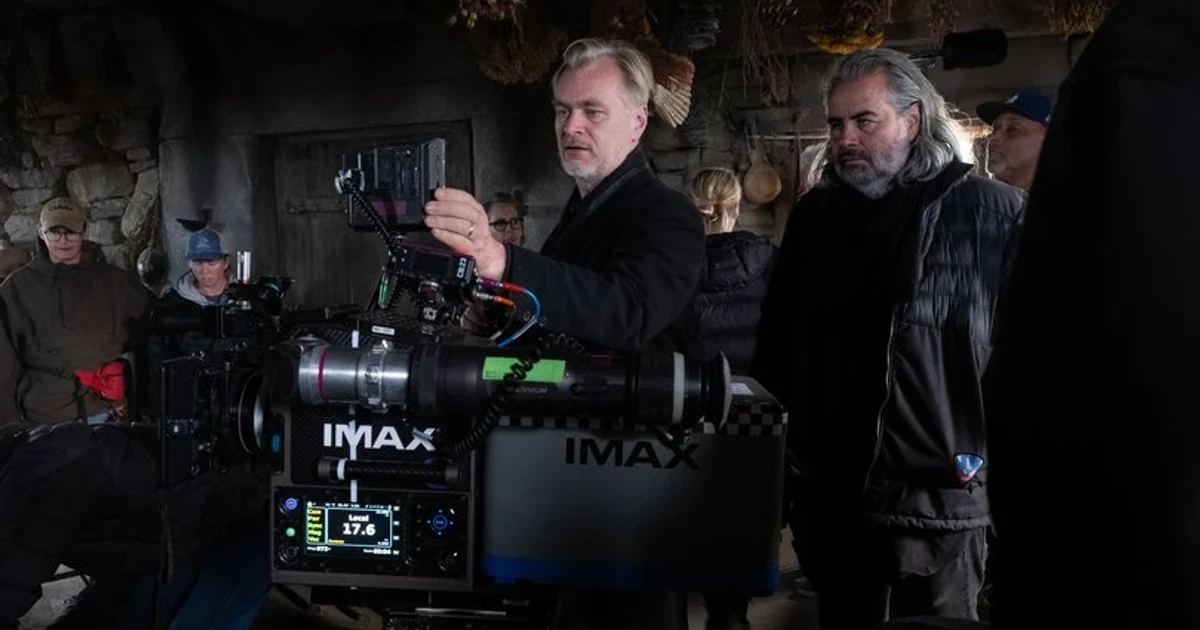
Christopher Nolan has turned The Odyssey into a referendum on what original studio filmmaking can still do at the highest level. The film opens in theaters on July 17, 2026, and Nolan has framed it as the kind of project he only gets by acting as if each movie might be his last, then building something large enough to justify the bet.
The scale Nolan chose
The production is built around a 3,000-year-old epic, Homer’s story of Odysseus’s 10-year journey home after the Trojan War, but Nolan is not treating it like museum material. He has said he wants audiences inside the story rather than watching from outside, and he cast Matt Damon as Odysseus to anchor that ambition in a star who has already worked with him on Interstellar and Oppenheimer.
That sense of finality runs through Nolan’s career as a 55-year-old filmmaker whose blockbusters have won 18 Academy Awards and grossed more than $6 billion. The 60 Minutes transcript says The Odyssey is his 13th film in 28 years, and that he writes his own screenplays, a reminder that his scale comes from authorship as much as from budget or spectacle. In a franchise market that rewards familiar brands, Nolan still gets to make films that begin with one director’s script and one director’s threshold for risk.
Why this film became his largest gamble
The Odyssey did not emerge from a casual interest in Homer. TIME reported that Nolan had been dreaming about the material for more than 20 years, and that he once had talks to direct Troy in 2004 before that project fell through. The intervening years gave him a different path to the story: after Oppenheimer grossed nearly $1 billion and won seven Oscars in 2023, Nolan said that success gave him the leverage to pursue a large-scale studio version of Homer’s epic.
That context matters because it shows how prestige filmmakers still win big inside a cautious industry. Nolan’s leverage did not come from branding alone, but from a record of making original films that travel globally and still land with awards voters. Oppenheimer proved that a historical drama with a difficult subject, a long running time, and a serious tone could clear both the box office and the Oscars, giving Warner and Universal the kind of proof Hollywood now demands before backing an expensive original vision.
An IMAX production built around constraint
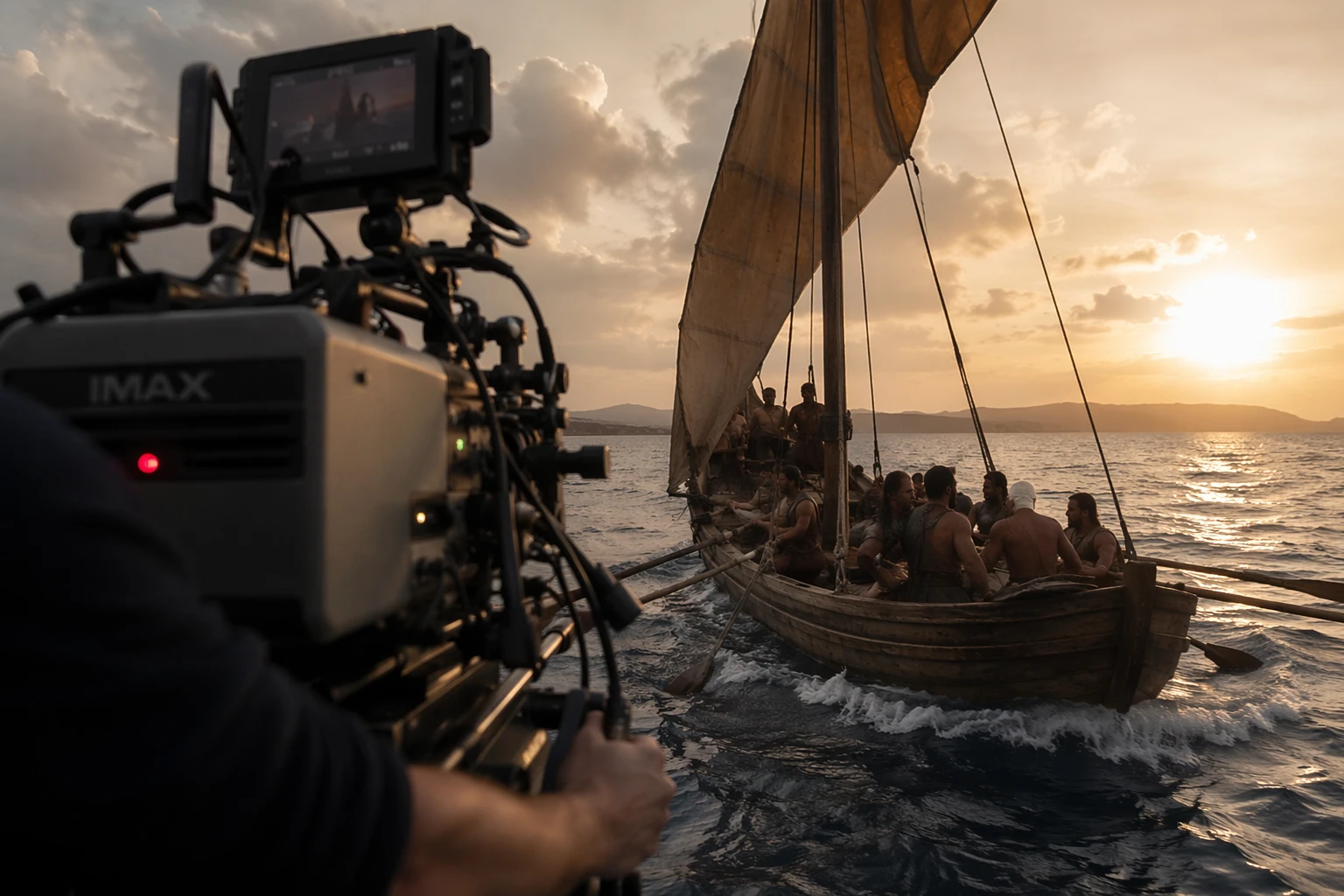
The film’s most striking technical fact is also its cleanest industrial signal: CBS says The Odyssey is the first feature film ever shot entirely on IMAX film. That choice sounds simple until the mechanics appear. IMAX camera magazines only allow about 2.5 to 3 minutes of continuous shooting before reloading, the cameras are noisy enough to threaten dialogue recording, and the format creates eyeline problems that had to be solved with mirror systems and special housing to reduce sound.
Variety reported that Nolan used the 60 Minutes interview to show the editing process, literally cutting and gluing IMAX frames by hand. That detail is more than a throwback. It shows that for Nolan, the format is not a marketing label but a working method, one that forces precision from cast and crew and shapes how scenes are staged, lit, and cut.
The result was not a contained soundstage exercise. CBS says the film was shot over 91 days across Greece, Iceland, Morocco, Italy and Scotland, and that the production used 2 million feet of footage. Those numbers point to a shoot built across landscapes that can carry geography on screen, from ancient coastlines to colder, more severe terrain, with the footage volume reflecting how much material a project like this can consume when every setup has to earn its place.
Matt Damon and the pressure of Nolan’s process

Damon’s role as Odysseus gives the film a commercial center, but his comments underline the cost of Nolan’s method. He said the film was the hardest movie he has ever done, and Nolan told him from their first meeting that the movie would be “really hard.” That exchange fits a director whose reputation rests partly on making difficulty part of the design rather than an afterthought.
Damon’s third collaboration with Nolan matters for another reason: it shows how the director builds trust over time and then asks his actors to enter projects that are physically and technically demanding. Interstellar and Oppenheimer already placed Damon inside Nolan’s preferred system, where large ideas are matched with exacting production rules. The Odyssey appears to push that relationship further by putting the actor at the center of a film that is both mythic and mechanically unforgiving.
What the project says about studio filmmaking now
Nolan’s career has become a case study in how studios still gamble on original vision when the math is difficult but the track record is strong. His blockbusters have already won 18 Academy Awards and grossed more than $6 billion, and Oppenheimer gave him an especially powerful proof point: nearly $1 billion in box office and seven Oscars for a film about a physicist and the atomic age. That combination is rare enough to buy freedom.
The Odyssey is the clearest expression of that freedom yet. It is not a sequel, not a remake of a recent hit, and not a franchise installment built from a library of pre-sold characters. It is a director using one of cinema’s oldest stories, a cast led by Matt Damon, and the full weight of IMAX film to argue that originality can still command the largest stage in Hollywood when it is backed by a filmmaker with the box office history to force the conversation.
Sources
- [1]cbsnews.com
- [2]variety.com
- [3]time.com