Technology
Nvidia says new liquid-cooled data center cuts water and power use

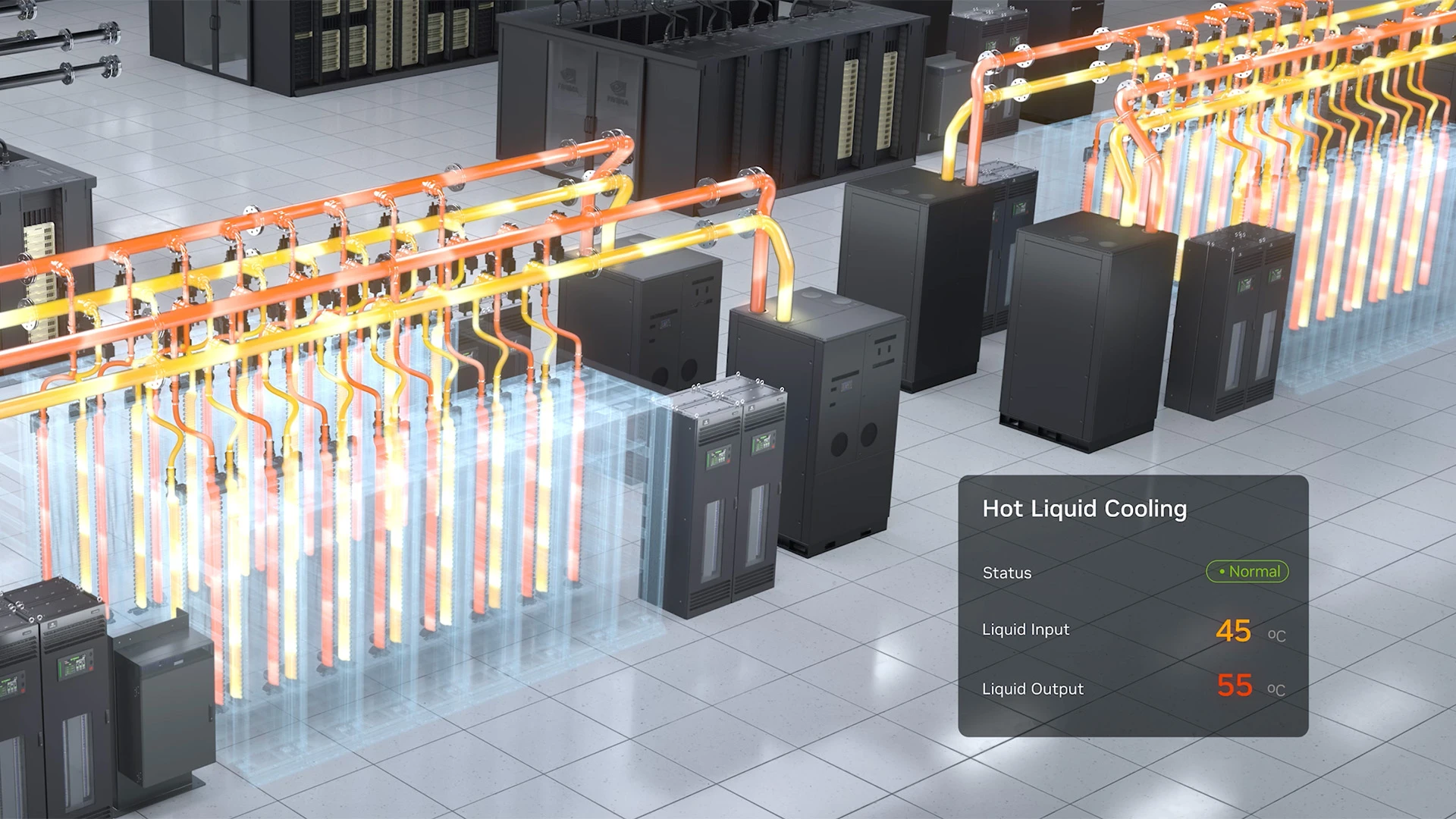
Nvidia is pitching a new answer to one of the loudest objections to the AI buildout: the water and power demands of sprawling data centers. The company says its Rubin generation reference design is the world’s first AI infrastructure to achieve 100% liquid cooling, with every chip and networking component cooled entirely by liquid in a closed loop, and that its DSX AI factory reference design has zero water consumption.
That claim lands in the middle of a national fight over where the costs of AI fall. For neighborhoods and towns that have pushed back against data centers over water, power and heat, the key question is not whether Nvidia can cool a facility more efficiently, but whether the burden is truly disappearing or simply moving somewhere less visible.
Ali Heydari, Nvidia’s director of data center cooling and infrastructure, said the company has “eliminated massive amounts of power usage and pretty much all water usage.” Nvidia says dry-cooler-based designs use no evaporative water cooling except for maybe about 1% of the year in some climates when chillers may be needed. The company also says the design can keep coolant at about 45 C, or 113 F, and avoid water-heavy cooling towers in favorable climates.

The environmental stakes are large. Nvidia and related coverage cite a conventional cooling-tower figure of roughly 2.6 million gallons of water per megawatt per year, which is why the company frames its liquid-cooled system as a near-total cut in facility cooling water use. Nvidia also says cooling has historically accounted for up to 40% of a data center’s electricity consumption, and that a 50-megawatt hyperscale facility could save more than $4 million a year in cooling-related energy and water costs by switching to liquid-cooled infrastructure.
But the trade-off is not gone, only recast. Critics and environmental advocates say that even if direct water use at the facility drops sharply, AI infrastructure still drives huge electricity demand, and some of that power is generated with systems that consume water upstream. Broader data-center water impacts remain under scrutiny as the industry pushes toward gigawatt-scale AI factories, supported by 800 VDC infrastructure and a larger co-designed stack of power delivery, networking, cooling and software.
Nvidia’s message is that the data center itself, not a single GPU server, should be treated as the unit of compute. For communities living with the consequences of that expansion, the next question is whether lower on-site water use is enough to ease the pressure on local grids, local water systems and the places asked to absorb AI’s physical footprint.
Sources
- [1]theverge.com
- [2]blogs.nvidia.com
- [3]nvidia.com
- [4]nvidianews.nvidia.com
- [5]edgen.tech
- [6]eesi.org
- [7]datacenters.google