Business
Oil prices jump 7% as Trump ends Iran ceasefire
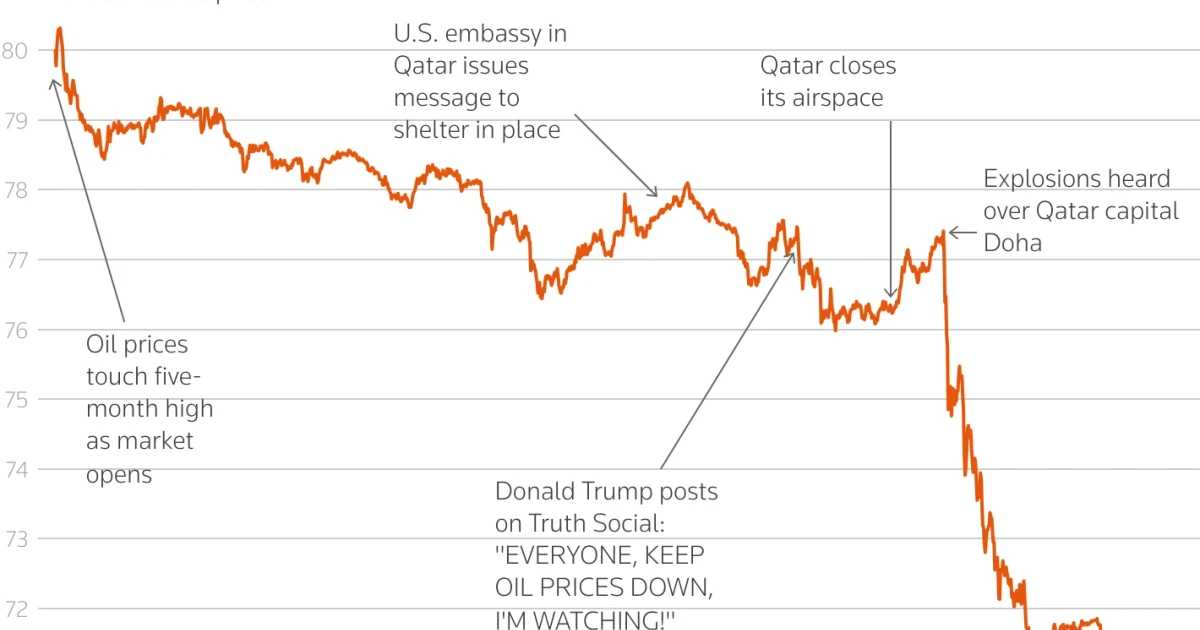
Oil prices jumped more than 7% after President Donald Trump said the Iran ceasefire was over, pushing Brent crude to $79.48 a barrel and jolting global markets. The Dow Jones Industrial Average fell 745 points, or 1.4%, and the S&P 500 dropped 0.8% as traders moved back to the risk that fighting in the Middle East could disrupt shipping through the Strait of Hormuz. Trump allowed talks to continue even as he ended the ceasefire, but the market reacted to the possibility that the truce could collapse again.
The renewed fear centers on a narrow waterway with outsized economic power. The International Energy Agency says the Strait of Hormuz is the primary export route for oil from Saudi Arabia, the United Arab Emirates, Kuwait, Qatar, Iraq, Bahrain and Iran. It also says a prolonged disruption could remove much of the world’s spare oil production capacity from the market, most of it held by Saudi Arabia. That is why even a brief escalation can move crude quickly: when the route is at risk, traders price in tighter supply before any barrels actually go missing.
Joseph Majkut, who leads the Energy Security and Climate Change Program at the Center for Strategic and International Studies, has described the ceasefire as partial and precarious, with episodic attacks still occurring. CSIS said the conflict has created dramatic new risks for global energy security and that maritime traffic through the Strait was brought to a near standstill earlier in the crisis. In CSIS analysis from March 6, Brent oil prices topped $92 a barrel, up 28% from the previous Friday’s close, after the first eruption of war in the Mideast Gulf. Earlier in the war, Brent reached nearly $120 a barrel before easing back.
On July 8, Brent was trading near $79.66 a barrel and West Texas Intermediate around $74.46, both sharply higher on the day. That kind of move can spread fast through the U.S. economy. Higher crude usually raises gasoline and diesel costs first, then feeds into airline fuel bills, shipping rates and, if the shock lasts, inflation pressure for households already facing a higher cost of living. CSIS said prolonged disruption in the Strait could cause larger and more lasting oil price increases, a warning that matters because each added dollar in crude can ripple through travel, freight and store shelves long before policymakers can respond.
The IEA has been monitoring the conflict closely because disruption to oil and gas flows through the Strait threatens both energy security and affordability. If shipping remains constrained and the fighting deepens, the latest price jump may prove to be only the first step.
Sources
- [1]cbsnews.com
- [2]barchart.com
- [3]csis.org
- [4]iea.org
- [5]tradingeconomics.com