Technology
OpenAI says GPT-5.4 helped improve a drug-making reaction
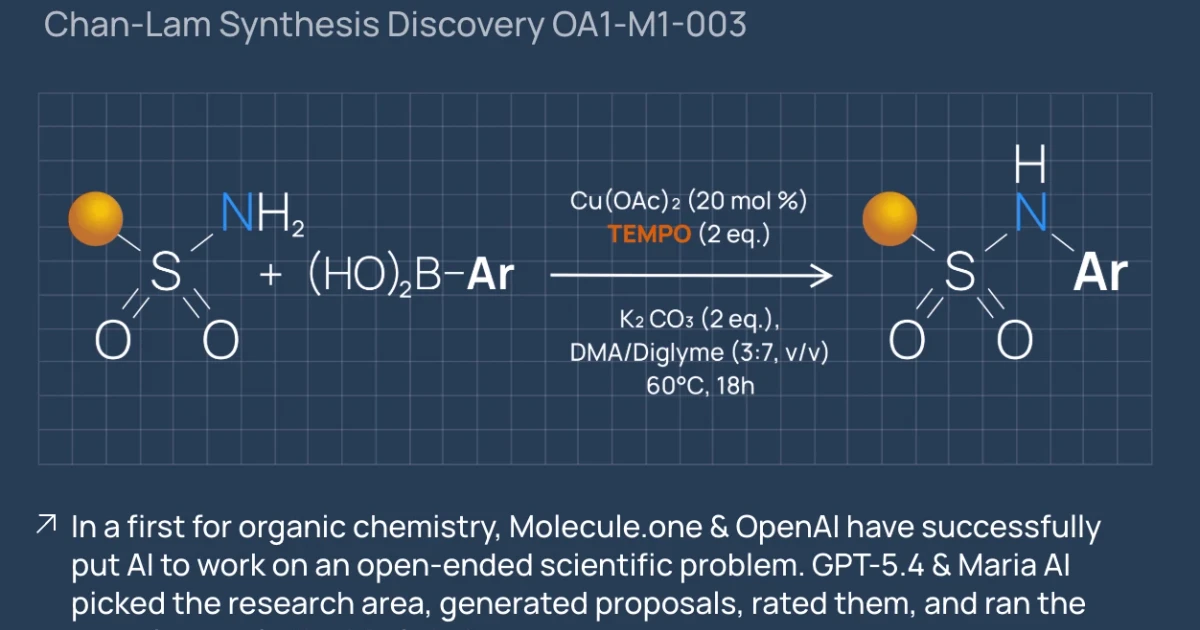
OpenAI is trying to move its models from paper-reading to bench work. On June 17, the company said a near-autonomous AI chemist using GPT-5.4 improved a challenging reaction in medicinal chemistry, a narrow but meaningful gain in the kind of drug-making workflow where small improvements can save time, money and failed lab runs.
The result matters because medicinal chemistry is often stalled by yield, selectivity, speed and reproducibility. OpenAI framed the work as more than a search engine for hypotheses: the company said the system helped researchers push past a stubborn bottleneck in an actual reaction, where every extra round of testing can cost expensive lab time. OpenAI also linked the demonstration to a broader life-sciences push aimed at fragmented workflows that move between literature, databases, experimental data and shifting hypotheses.
That broader effort now includes LifeSciBench, which OpenAI launched the same day as an expert-authored, expert-reviewed benchmark for real-world life science research tasks and decisions. Public summaries describe the benchmark as 750 tasks across seven workflows and seven biological domains, with the best model reaching about 36 percent. That score is a reminder that even the strongest systems still struggle when the work demands judgment, not just recall.
OpenAI has also positioned GPT-Rosalind as a frontier reasoning model for biology, drug discovery and translational medicine. The company says it is optimized for scientific workflows across chemistry, protein engineering and genomics, and available in research preview in ChatGPT, Codex and the API for qualified customers through its trusted access program. OpenAI said it is already working with Amgen, Moderna, The Allen Institute and Thermo Fisher Scientific on GPT-Rosalind workflows.
The new chemistry result fits that strategy. OpenAI says GPT-5.4 is its most capable and efficient frontier model for professional work, and that in Codex and the API it offers native computer use and up to 1 million tokens of context. Those features matter in agentic settings where a model has to compare options, handle tool use and keep track of long, multi-step projects rather than offer a one-off answer.
Molecule.one said the project used GPT-5.4 and its Maria AI system to pick the research area, generate proposals, rate them and run experiments in Maria Lab. The company described the collaboration as a first for organic chemistry on an open-ended scientific problem, combining AI, lab automation and data in a near-autonomous workflow.
The larger lesson is not that AI chemists are replacing medicinal chemists. It is that the systems are starting to take on pieces of the experimental cycle that once sat entirely with humans. The real test now is whether these tools can consistently narrow the search, improve the quality of experiments and speed the path through a process that, in the United States, still takes roughly 10 to 15 years from target discovery to regulatory approval.
Sources
- [1]openai.com
- [2]molecule.one