Technology
OpenAI upgrades ChatGPT health responses with GPT-5.5 Instant
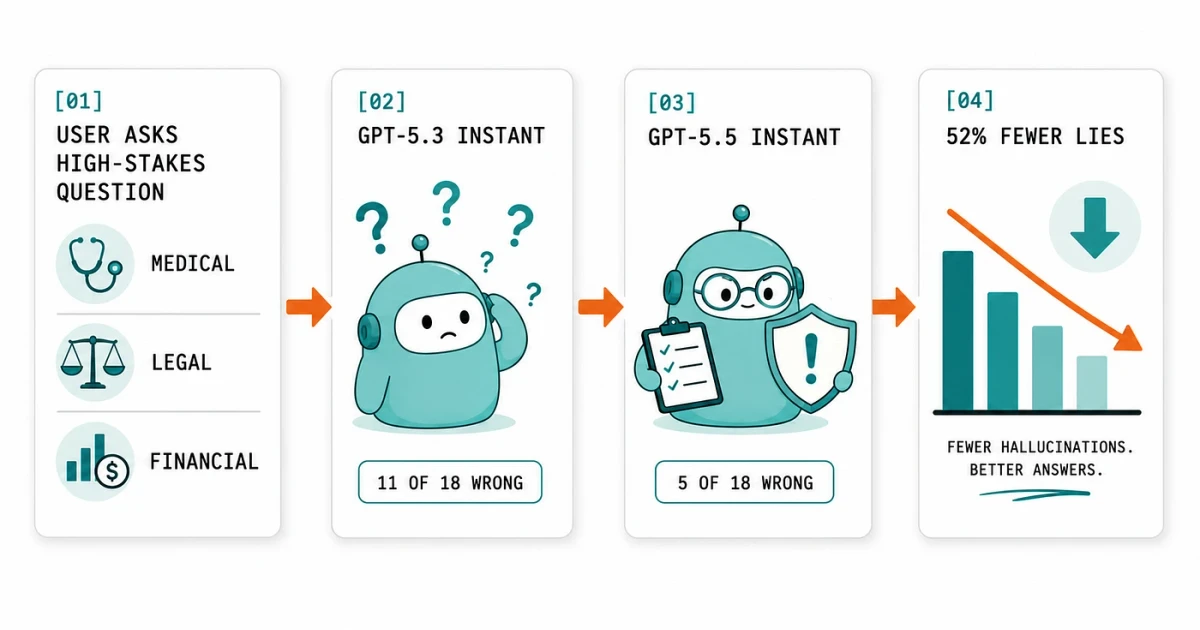
OpenAI is pushing ChatGPT deeper into medical triage with GPT-5.5 Instant, saying the model is better at spotting when a symptom may require urgent care, asking for missing context and explaining uncertainty in plain language. The company is betting that clearer answers will help millions of people sort through lab results, insurance questions and appointment prep without overstating what an AI can safely judge.
The scale is already large enough to matter. OpenAI said more than 230 million people each week turn to ChatGPT for health and wellness questions, and in January the company said more than 40 million people a day were using it for healthcare questions, with more than 5% of all ChatGPT messages globally about healthcare. That makes health one of the product’s biggest everyday uses, and it raises the stakes for any mistake that could delay real care or create false reassurance.
OpenAI said GPT-5.5 Instant performs at a level comparable to its frontier Thinking models on some of the company’s hardest health evaluations. It said the gains come from model improvements and physician-led evaluation work, including a global network of doctors that helps define good behavior, identify failure modes and set realistic standards for health conversations. To measure progress, OpenAI used HealthBench and HealthBench Professional, which rely on physician-written rubrics, 5,000 multi-turn conversations and a foundation built with 262 physicians who have practiced in 60 countries. A separate physician panel reviewed 3,500 model and physician-written responses, and OpenAI said GPT-5.5 Instant scored higher than both older model outputs and physician-written answers in that review.

The company is also widening access. The new health improvements are available to all free ChatGPT users, subject to usage limits, and OpenAI’s help center says free-tier users have limited GPT-5.5 access within a five-hour window, with caps that can vary by market and system conditions. That matters because the people most likely to rely on ChatGPT for quick guidance may be the same users least likely to have immediate access to a doctor.
OpenAI has been building out a broader health stack around the consumer chatbot. In January it launched ChatGPT Health on web and iOS for Free, Go, Plus and Pro users in supported countries, excluding the EEA, Switzerland and the United Kingdom, and said health chats, files and memories are not used to train foundation models. It has also rolled out ChatGPT for Healthcare to institutions including AdventHealth, Baylor Scott & White Health, Boston Children’s Hospital, Cedars-Sinai Medical Center, HCA Healthcare, Memorial Sloan Kettering Cancer Center, Stanford Medicine Children’s Health and the University of California, San Francisco. In April, OpenAI introduced ChatGPT for Clinicians and later said it would make that version free for verified U.S. physicians, nurse practitioners, physician assistants and pharmacists.
The trust problem remains as important as the product gain. A February 2026 study led by researchers at the University of Oxford found large language models can give inaccurate and inconsistent medical advice and may pose risks in real decision-making. That is why OpenAI’s emphasis on escalation, uncertainty and physician review matters: the safest use case is not diagnosis by chatbot, but a better-informed handoff to the right human judgment at the right time.
Sources
- [1]openai.com
- [2]help.openai.com
- [3]ox.ac.uk