Business
Oracle posts record cloud revenue as AI demand drives backlog surge
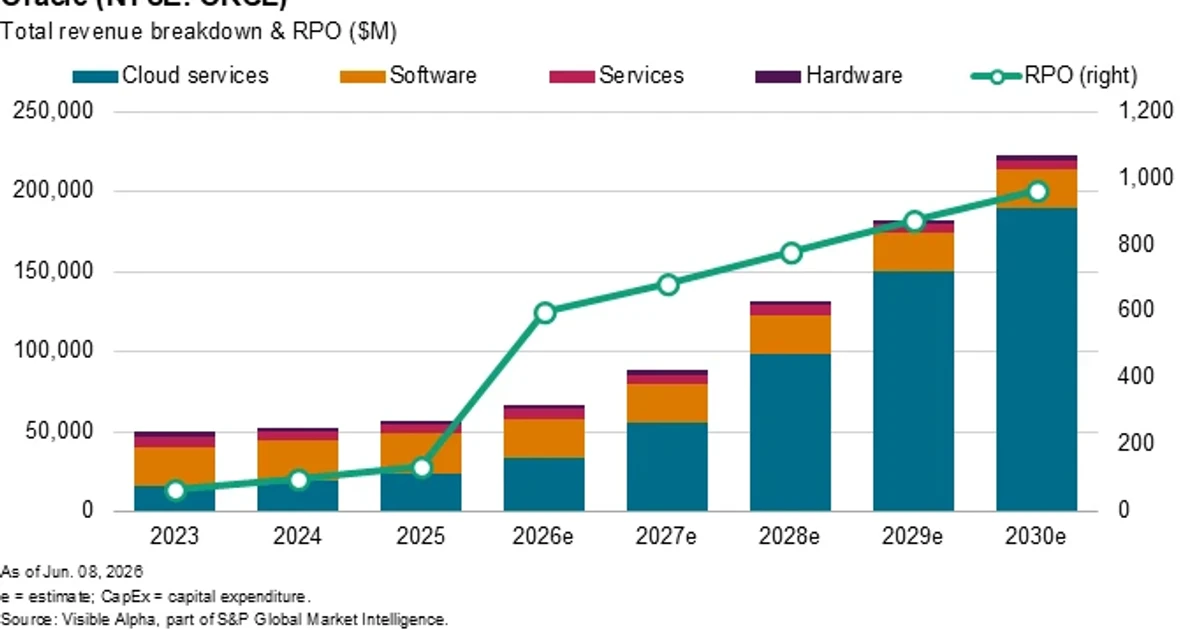
Oracle posted a record quarter for cloud demand, with fiscal fourth-quarter revenue rising 21% to $19.2 billion and total cloud revenue climbing 47% to $9.9 billion. The biggest signal came from its remaining performance obligations, which jumped by $85 billion in the quarter to a record $638 billion, underscoring how much AI-related work is sitting in Oracle’s pipeline.
Cloud infrastructure remained the engine of the business. Revenue in that segment surged 93% to $5.8 billion, while cloud applications revenue rose 10% to $4.1 billion. The shift away from older software was visible elsewhere in the results: software revenue fell 2% to $6.8 billion as customers kept moving from on-premise systems to the cloud. Oracle reported fiscal fourth-quarter GAAP earnings of $1.45 a share and non-GAAP earnings of $2.11 a share, while full-year revenue reached a record $67.4 billion, up 17%.
The company is pairing that growth with an aggressive spending plan that is now testing investor patience. Oracle said it expects to raise about $40 billion in fiscal 2027 through debt and equity financing, including the previously announced $20 billion at-the-market equity issuance. That follows $43 billion in debt financing and $5 billion in equity financing in fiscal 2026, while capital expenditures climbed to $55.7 billion, above the company’s earlier $50 billion target. Reuters reported that fiscal 2027 capital spending could reach as much as $95 billion, with about $70 billion coming from Oracle and another $20 billion to $25 billion expected to be repaid by customers.

Oracle kept its fiscal 2027 revenue guidance at $90 billion, but raised its adjusted earnings outlook to $8.05 a share. Even with those projections, the market focused on the cost of the buildout. CNBC reported that Oracle shares fell 10% in extended trading as investors weighed higher borrowing needs, heavier capital spending and the possibility that AI infrastructure will take longer to generate returns. Chief financial officer Hilary Maxson said gross margins will step down as the company ramps up data-center projects, a reminder that growth is arriving with pressure on profitability.
Oracle’s pitch is that it is building capacity quickly enough to compete in the AI era, with first-quarter fiscal 2027 delivery approaching one gigawatt. The company also has major data-center deals tied to customers including Meta Platforms and OpenAI, and its Stargate campus in Texas is expected to be more than three-quarters complete within 90 days. But the abandoned plan to expand a flagship data center in Abilene, Texas, after financing talks and demand forecasts shifted, showed how quickly the economics of the AI race can change.
Sources
- [1]news.google.com
- [2]investor.oracle.com
- [3]cnbc.com
- [4]money.usnews.com
- [5]reuters.com