Science
Particle Accelerator Unlocks Secrets of Lost Ancient Greek Star Catalog
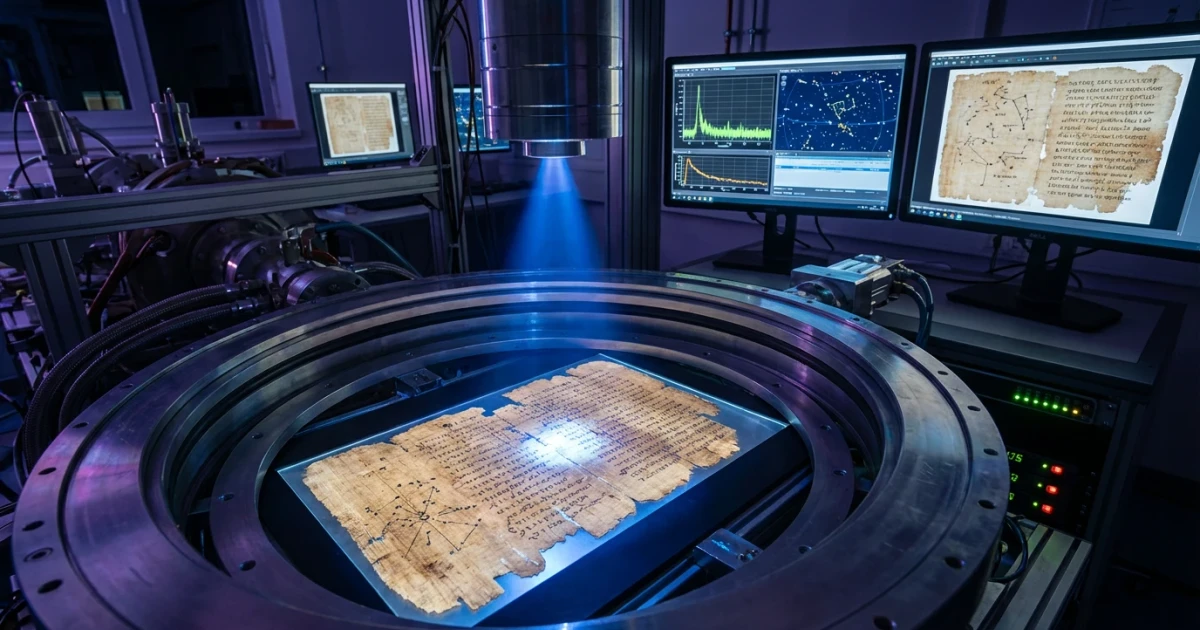
In a groundbreaking fusion of modern technology and ancient wisdom, researchers have successfully decoded a long-lost Ancient Greek star catalog using a particle accelerator. This remarkable achievement not only revives astronomical knowledge from over two millennia ago but also highlights the enduring legacy of classical science.
Ancient Star Catalog Rediscovered
The star catalog, believed to have been compiled by Greek scholars, was lost to history for centuries. Its existence was known primarily through references in ancient texts, but the actual content remained elusive. Scholars long speculated about the catalog’s details and its potential influence on subsequent astronomical works.
Cutting-Edge Techniques Meet Classical Scholarship
The breakthrough came when scientists turned to a particle accelerator—a tool more commonly associated with physics experiments than archaeology or astronomy. By using high-energy beams, researchers were able to non-invasively examine ancient manuscripts and artifacts that contained layers of overwritten text, a phenomenon known as a palimpsest. This method allowed them to reveal the faded or erased star catalog entries without damaging the fragile materials.
Key Discoveries from the Decoded Catalog
- Identification of Star Positions: The catalog provided precise coordinates for several prominent stars as observed in Ancient Greece, offering insight into historical celestial mapping techniques.
- Mathematical Methods: Analysis suggests Greek astronomers employed advanced mathematical calculations for their time, indicating a sophisticated understanding of the night sky.
- Influence on Later Astronomy: The recovered information shows parallels with later astronomical works, suggesting that this catalog may have served as a foundation for subsequent astronomers in the Mediterranean and beyond.
Why the Discovery Matters
This achievement is more than a triumph of technology; it represents a bridge between past and present scientific inquiry. The use of a particle accelerator demonstrates how interdisciplinary collaboration can unlock new chapters of human history. It also provides rare, direct evidence of how ancient civilizations systematically observed and recorded the cosmos.
Looking Forward: Implications for Science and History
The decoding of the lost Greek star catalog is expected to inspire further research into the origins of astronomy and the transmission of knowledge across cultures. As scientists continue to refine non-invasive imaging techniques, more hidden documents may come to light, offering fresh perspectives on the intellectual achievements of the ancient world.
For those intrigued by the intersection of science and history, this discovery underscores the enduring value of preserving and studying ancient texts. As researchers piece together the astronomical knowledge of the past, they deepen our understanding of how humanity has long sought to chart the stars above.
Sources
- [1]Ground News