Science
Photonic Devices Offer New Pathways for Artificial Memory
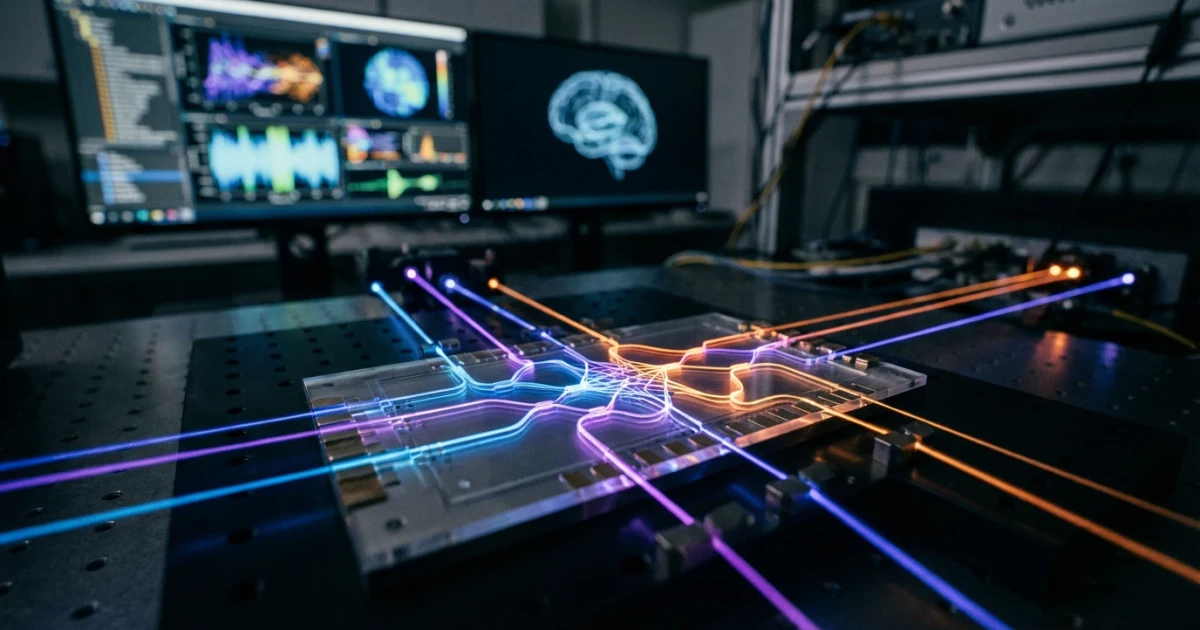
Researchers are pioneering photonic devices that use light to mimic the brain’s memory functions, opening new frontiers in artificial intelligence and computing. Recent developments highlight the ability of these devices to process and store information in ways that closely resemble human neural activity, leveraging the unique properties of photons to achieve greater speed and energy efficiency than traditional electronic systems.
Light-Powered Artificial Memory
As detailed by Phys.org, scientists are demonstrating how photonic devices—technology that manipulates light to emulate neural memory—can perform computations inspired by the brain. Unlike conventional electronics, which rely on electrons moving through silicon circuits, these devices use photons to transmit and process information. This fundamental shift enables not only faster data transfer rates but also a significant reduction in energy consumption, a critical factor as artificial intelligence systems become more complex and data-intensive.
Mimicking Synaptic Behavior
The core innovation lies in the ability of photonic devices to replicate synaptic plasticity, the process by which neural connections strengthen or weaken over time—a cornerstone of learning and memory in the human brain. By manipulating the intensity or phase of light within specially designed materials, researchers have created artificial synapses that can adjust their state in response to optical inputs, similar to how biological synapses respond to electrical signals.
- Light-based synapses can store and recall information with high fidelity.
- These systems show promising performance metrics in terms of speed and scalability.
- Photonic memory devices can be integrated into neural network architectures for advanced AI applications.
Advantages Over Traditional Electronics
Traditional memory devices, such as flash or DRAM, rely on charge storage and suffer from limitations in speed, lifetime, and energy use. In contrast, photonic memory systems operate at the speed of light and can be less susceptible to heat and electromagnetic interference. This makes them particularly attractive for next-generation artificial intelligence hardware where real-time learning and rapid recall are essential.
Researchers cited by Phys.org emphasize that the use of light not only provides speed but also enables parallel information processing—multiple data streams can be encoded in different colors or phases of light, dramatically increasing bandwidth.
Implications for Artificial Intelligence and Beyond
The ability of photonic devices to learn and remember in ways similar to biological systems could accelerate advances in AI, particularly in fields that require rapid pattern recognition, adaptive learning, and low-power operation. According to the NIST Quantum Photonics Program, ongoing research is exploring how these devices could eventually be scaled up for use in large-scale neural networks, potentially transforming data centers, robotics, and even quantum computing.
While the technology is still emerging, early prototypes demonstrate that photonic memory is not just a theoretical possibility, but a practical pathway toward more brain-like artificial systems.
Looking Ahead
As efforts continue to optimize the materials and architectures for photonic synapses, experts anticipate rapid progress in both device performance and real-world applications. The integration of light-based memory components could signal a new era where artificial intelligence systems are faster, more efficient, and closer to truly mimicking how the human brain works. Readers can follow further developments and access datasets on the NIST Quantum Photonics Program site and explore recent research on photonic AI devices for deeper insights.