Science
Physicists Observe Darkness Outpacing Light in Laser Experiment
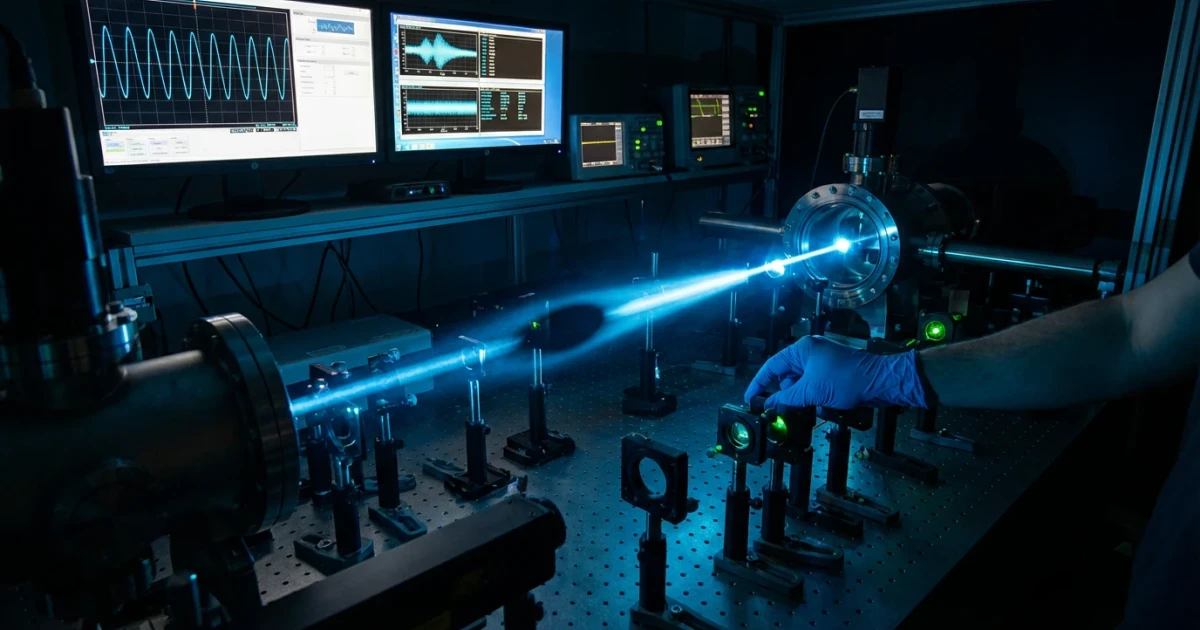
Physicists have reported a striking new observation: pinpricks of darkness—temporary shadows created within a laser beam—moving faster than the speed of light. This finding, confirmed by recent experiments, provides surprising insights into the nature of light and darkness, while remaining consistent with Einstein’s theory of relativity.
Unpacking the Experiment: Darkness on the Move
The research team created a controlled setting where tightly focused laser beams produced tiny shadows, or “pinpricks of darkness,” by obstructing the path of light with a thin wire. High-speed cameras and precise measuring equipment tracked these darkness spots as they traversed the beam’s cross-section. According to the peer-reviewed study in Physical Review Letters, the darkness spots were observed moving at speeds exceeding the universally recognized speed of light in a vacuum—approximately 299,792 kilometers per second.
- The darkness spots, or “negative” pulses, appeared to travel at so-called superluminal speeds.
- These effects were observed in the context of wave propagation—specifically, how changes in light intensity move through a medium.
- The experiment builds on prior work that has shown superluminal effects in wave phenomena, such as wave propagation in special materials.
Why Doesn't This Break Relativity?
The apparent paradox—something moving faster than light—does not actually violate Einstein’s special relativity. That theory sets an upper limit for the speed at which information or matter can travel, not for the movement of non-material phenomena like shadows, spots, or signal peaks. As explained by Physics Magazine, the key is that the darkness spots themselves do not carry energy or information independently; they are a result of how the light is interrupted and re-forms around obstacles.
- The superluminal darkness is an artifact of the wave’s properties, not a physical object or carrier of information.
- Any attempt to use these darkness spots to send a message would ultimately be limited by the underlying speed of light.
Broader Implications and Context
This discovery adds to the growing body of research on superluminal phenomena in optics and wave mechanics. Over the past decades, scientists have observed similar effects in specialized materials and with certain types of wave packets, though none have challenged the core principles of causality and relativity.
- The experiment offers new tools for exploring the boundaries of wave behavior in physics.
- It provides a visually compelling example of how absence—in this case, darkness—can behave in ways that seem counterintuitive but are fully explained by established theories.
- Applications may include advances in optical communications, imaging, and further tests of quantum and classical wave theories.
Looking Forward
As research continues, physicists hope to expand these experiments to more complex systems and materials, probing the limits of how light, darkness, and information interact. For now, the observation of superluminal darkness serves as a reminder of the subtlety and richness of the physical world—where even a fleeting shadow can teach us something profound about the universe’s fundamental rules.