Entertainment
Porcelain bowls sing in Céleste Boursier-Mougenot’s New York installation
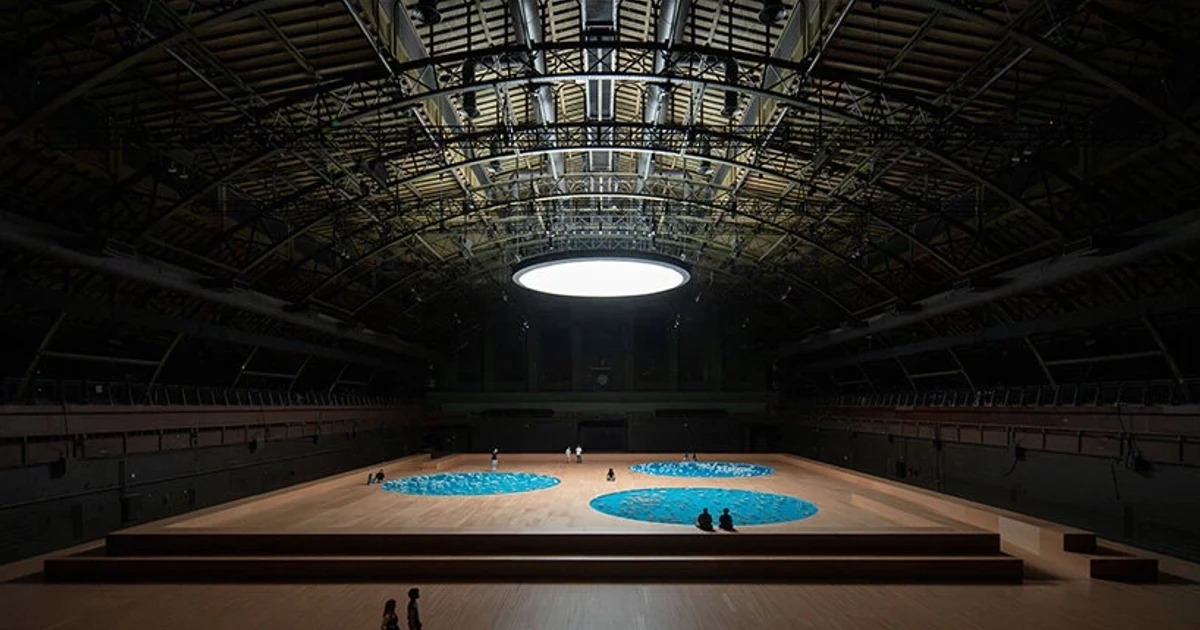
Porcelain bowls drift across shallow water, meet at random, and release small chiming notes that expand through the 55,000-square-foot Wade Thompson Drill Hall. In Céleste Boursier-Mougenot’s Clinamen at the Park Avenue Armory, the sound is not composed in the traditional sense, but generated by motion itself, letting the room settle into a slow, shifting form of listening.
A room built for drift
The Armory’s presentation is the largest iteration to date of the artist’s ongoing aquatic and musical work, and scale matters here because the piece depends on distance, echo, and uncertainty. Five circular basins hold hundreds of ceramic bowls, which float, collide, and separate as currents move them across the water’s surface. The result is a constant but never identical texture of sound, a field of microtonal tones that changes with each small bump, turn, and eddy.
Clinamen works because it asks visitors to wait for something barely repeatable. There is no single climax, no fixed melody, and no instruction beyond observation, which makes the installation feel unusually aligned with a public mood shaped by screens, alerts, and rapid switching. The piece offers a different rhythm: one in which attention is rewarded not by speed, but by patience.
Why the title matters
The title clinamen refers to the unpredictable motion of atoms, a concept that fits the installation’s chance-driven behavior. The work does not pretend to impose order on the bowls, only a set of conditions under which order and disorder keep negotiating with one another. That makes the piece feel less like an object to be viewed than a system to be entered.
At the Armory, that system plays out inside a hall better known for accommodating large-scale spectacles than for quiet absorption. The contrast helps explain the work’s power: the drill hall’s vastness gives the smallest sounds room to breathe, while the basin setup keeps the action low and horizontal, close to the body and the ear. In a city where cultural offerings often compete with one another for immediate attention, this installation gains force by withholding urgency.
From a Paris apartment to a New York landmark
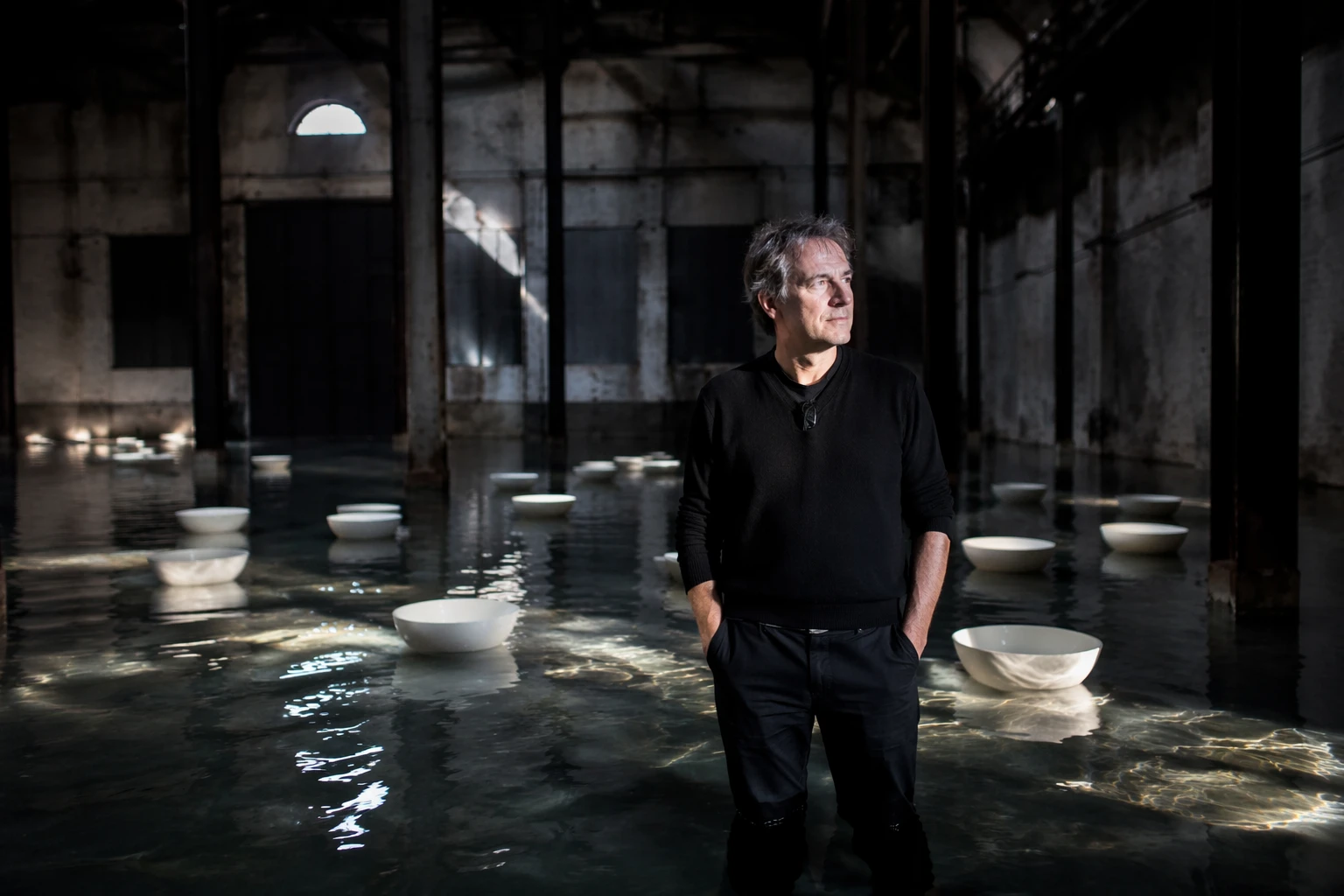
Clinamen began in 1997, first conceived by Boursier-Mougenot in his Paris apartment. That intimate origin is part of what makes the work feel conceptually elegant even as it expands in scale: the piece grew out of a domestic setting, then migrated into institutions without losing its reliance on basic materials, water, ceramic bowls, gravity, and chance.
Its first presentation in 1997, under the title untitled (series I-1,2,3,4), took place at Galerie Pour La Vie of the CAPC Musée de Bordeaux. Later versions carried the work into larger and more ambitious settings, including a 2025 installation at the Bourse de Commerce, where an 18-meter-diameter basin extended the piece’s floating, resonant logic into another monumental interior. The New York version continues that trajectory, but the Armory’s hall gives the work a new social meaning: it is not only bigger, but also more public, more architectural, and more visibly tied to the question of what institutions now want culture to do.
The experience inside the hall
What makes Clinamen compelling is not just the mechanics of the bowls, but the pacing of the encounter. The sound arrives in fragments, then fades; a cluster of collisions may build into a brief shimmer, then dissolve back into near silence. Because the bowls are constantly repositioned by water movement, the installation never settles into repetition for long, so listening becomes an act of staying present instead of trying to anticipate what comes next.
That quality is part of why contemplative art has become such a visible institutional bet. Museums and large venues are increasingly presenting works that slow visitors down rather than push them through a fast sequence of images. In a media environment built around speed and saturation, installations like this offer an alternate public experience: one that values atmosphere, duration, and the physical act of paying attention.

What the Armory is signaling
The Park Avenue Armory is not treating the installation as a minor side project. Public support for the presentation includes the New York State Council on the Arts and the New York City Department of Cultural Affairs, a reminder that contemplative work still sits inside a civic framework, not outside it. The institution also held an artist talk with Boursier-Mougenot on June 10, 2026, underscoring that the piece is being presented not just as a visual-and-sonic environment, but as a live argument about how art is heard and experienced.
The calendar details matter because this is an event as much as an installation. The Armory lists the run from June 10 to August 2, 2026, while its event page also presents the exhibition across the early-summer season; either way, the installation occupies a substantial stretch of the summer and invites repeat visits. That extended duration suits a work built on small variations, since one visit can never fully stand in for another.
Why it resonates now
Clinamen lands at a moment when many audiences are looking for forms of culture that do not demand instant comprehension. Its appeal comes from a rare combination of formal restraint and sensory richness: the piece is quiet, but not empty; minimal, but not thin; slow, but never static. The floating bowls keep making their own weather, and the hall keeps carrying their sound.
That is why the installation feels larger than its materials. It turns porcelain, water, and space into a public case for attention itself, and it does so without sermonizing. The work simply keeps moving, and in that motion it makes stillness feel newly valuable.