Science
Quantum theory may work without imaginary numbers, physicists say

Physicists at Heinrich-Heine University Düsseldorf and the German Aerospace Center have published a paper arguing that quantum mechanics can be formulated without imaginary numbers at all. The study, “Quantum Mechanics Based on Real Numbers: A Consistent Description,” appeared in Physical Review Letters on June 18, 2026 as Phys. Rev. Lett. 136, 240202, and the American Physical Society marked it as an Editors’ Suggestion.
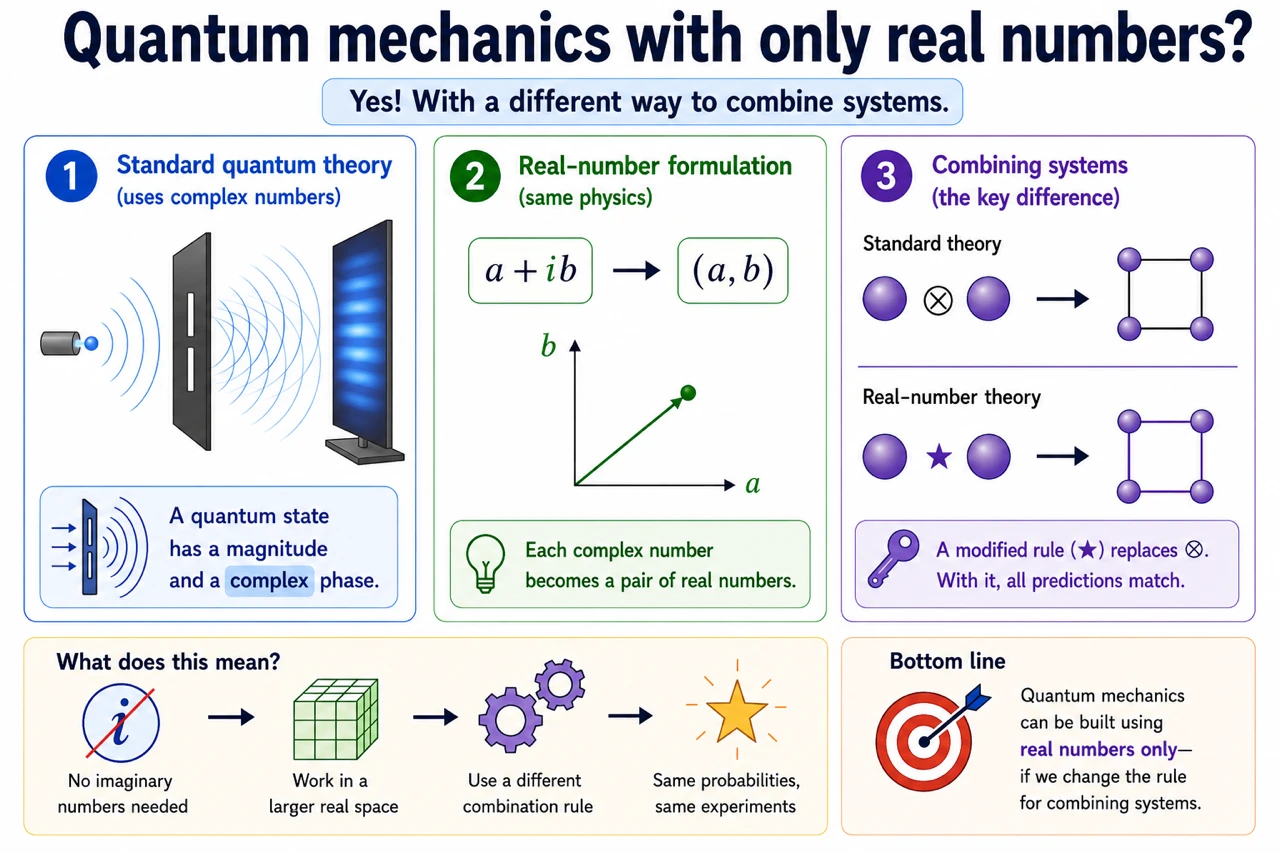
The authors, Pedro Barrios Hita, Anton Trushechkin, Hermann Kampermann, Michael Epping and Dagmar Bruß, say a physically motivated postulate about composite quantum systems lets them build a real-number version of the theory that still reproduces predictions for all multipartite quantum experiments. That is a narrower claim than overturning quantum physics itself: the work does not argue that the theory is wrong, only that one of its most familiar mathematical conventions may not be essential.
Imaginary numbers have long been woven into the standard language of quantum mechanics, where they help express phase, interference and probability amplitudes. The new paper pushes back on the idea that this mathematical machinery is the only way to describe the quantum world, and it does so by focusing on composite systems, where multiple particles or subsystems are linked together in a single experiment. The authors’ argument is that the real-valued formulation can still match the outcomes physicists care about in those multipartite settings.
The paper lands in the middle of an active foundational dispute. In 2021, a Nature paper argued that real-number quantum theory could be experimentally falsified in network scenarios. In 2022, an optical quantum-network experiment reported quantum correlations that violated the constraints of real quantum theory by more than 4.5 standard deviations. The new PRL paper is framed as a response to that line of criticism, contending that complex numbers are a matter of convenience rather than necessity once a suitable postulate about composite systems is adopted.
For physicists, the significance is not a cosmetic change in notation. If quantum theory can be recast in real numbers while preserving the predictions of multipartite experiments, the result could sharpen debate over which parts of the theory are truly fundamental and which are features of the standard formalism. It may also influence how researchers think about quantum computation and engineered quantum systems, where the mathematical structure of the model can shape how problems are represented and solved. Even nearly a century after the theory’s rise, the new result suggests that some of its deepest assumptions are still open to revision.
Sources
- [1]sciencedaily.com
- [2]journals.aps.org
- [3]link.aps.org
- [4]physics.aps.org
- [5]nature.com