Health
Quebec leads Canada in medically assisted deaths as debate intensifies

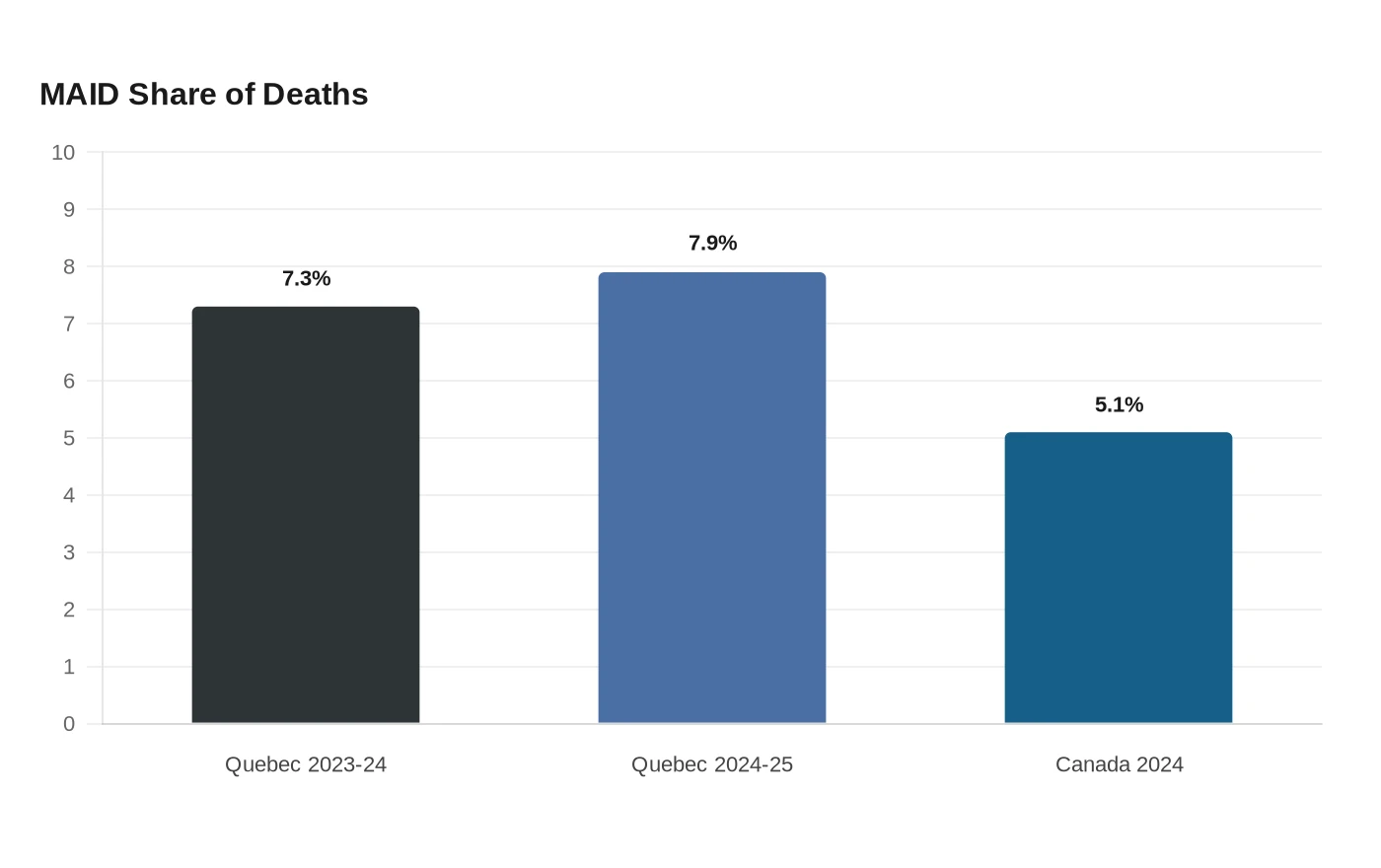
Quebec’s embrace of medically assisted dying now stands as one of the clearest signs of how far the province has moved from the Roman Catholic order that once shaped its public life. In 2024-2025, 6,268 people received medical aid in dying, a total that accounted for 7.9% of all deaths in Quebec and rose 9% from the previous year.
That trajectory did not begin in the clinic or the courtroom. It traces back to the Quiet Revolution of the 1960s, when Quebec rapidly modernized and the Church’s grip on education and public life sharply diminished. In a province that once treated Catholic authority as a central social force, many Quebecers now frame control over the timing and circumstances of death as an individual right.

The legal structure followed that cultural shift. Quebec adopted the Act Respecting End-of-Life Care in June 2014, and it came into force on December 10, 2015. The law created the independent Commission sur les soins de fin de vie to oversee how the framework was applied. The Gouvernement du Québec says medical aid in dying is part of end-of-life care and can be requested by eligible patients under specific conditions, including in institutions, palliative-care hospices and at home.

The province’s own commission says Quebec remains the world leader in medically assisted deaths. Its 2024-2025 report covers April 1, 2024 to March 31, 2025, and shows the share of deaths involving MAID rising from 7.3% in 2023-2024. Canada as a whole recorded 16,499 MAID deaths in 2024, equal to 5.1% of all deaths nationally, under a Criminal Code framework that Health Canada says has allowed the practice since 2016.
The political and moral dispute has not subsided. Catholic leaders have strongly opposed MAID in Catholic health organizations, and the Roman Catholic Archdiocese of Montreal challenged Quebec’s requirement that palliative care homes offer the procedure. On March 1, 2024, Quebec Superior Court Justice Catherine Piché ruled that Quebecers’ right to choose their medical care, including doctor-assisted death, outweighed the claimed religious-freedom infringement. For supporters, the numbers reflect a settled public choice. For critics, they raise a harder question: whether Quebec’s rising use of MAID reflects consensus, or gaps in access to palliative and end-of-life care.
Sources
- [1]nytimes.com
- [2]quebec.ca
- [3]csfv.gouv.qc.ca
- [4]canada.ca
- [5]cbc.ca
- [6]britannica.com
- [7]cccb.ca