World
Record heatwave in Europe exposes deadly toll of climate change

France placed up to 72 of its 96 mainland departments under the highest red-alert category as temperatures hit a national average maximum of 37.8 C on June 22, forcing the Eiffel Tower and the Louvre to suspend operations temporarily. Schools closed, transport networks strained, and meteorologists warned the event could rival the deadly 2003 French heatwave, which caused about 14,800 excess deaths.
World Weather Attribution scientists found the Western Europe heatwave would have been “virtually impossible” without human-caused climate change, and soaring night-time temperatures were 100 times more likely than they were two decades ago. Britain recorded a record-high June temperature during the heat, and among more than 800 European cities analyzed, 45% recorded or were forecast to record their highest late-June heat-stress levels. In France, some nights stayed above 20 C for more than a week, with others near 30 C, a pattern that is especially dangerous because the body cannot recover overnight.

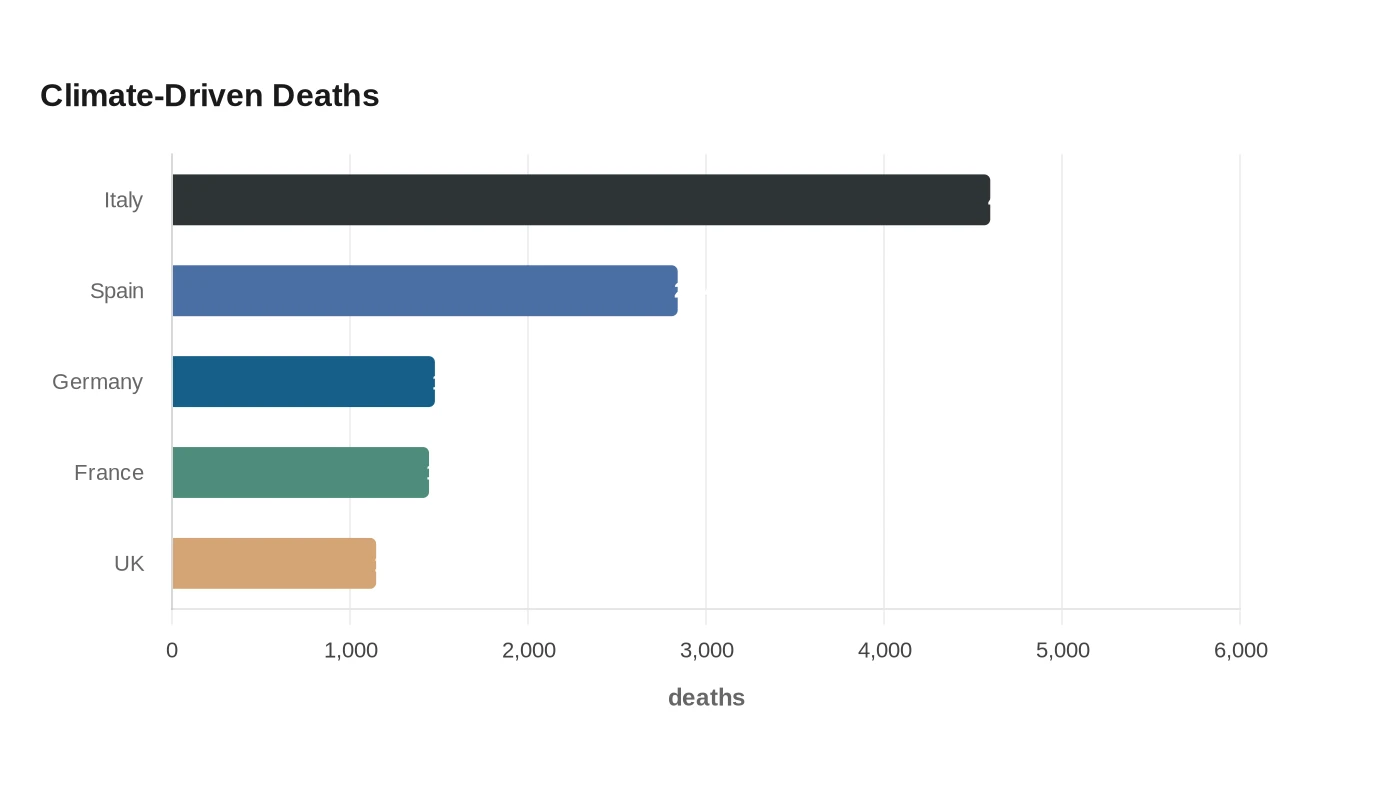
A rapid analysis of summer 2025 by the London School of Hygiene & Tropical Medicine and Imperial College London estimated that climate change drove 16,500 additional heat-related deaths across 854 European cities, about 68% of an estimated 24,400 deaths. People aged 65 and over accounted for 85% of those deaths. The same study put the climate-driven toll at 4,597 in Italy, 2,841 in Spain, 1,477 in Germany, 1,444 in France and 1,147 in the UK, with London alone linked to 315 excess deaths. Another rapid analysis of a July 2025 heatwave estimated about 2,300 deaths across 12 cities, including about 1,500 directly linked to human-caused warming.
In France, Marine Le Pen has called for mass AC installations, while Green Party figures have pushed back, arguing it is not a long-term climate fix. That dispute has become a live issue as France heads into a new electoral cycle, and it is unfolding against a stark equipment gap: about 20% of homes across Europe have air conditioning, compared with nearly 90% in the United States, with the UK around 5% and Germany about 3%.
The heat has also exposed grid limits. A nuclear power plant in southern France had to close because of the heat, as cooling demand rose while power plants and grids became less efficient and some thermal and nuclear stations cut output because cooling water was too warm or scarce.
Sources
- [1]nytimes.com
- [2]usnews.com
- [3]lshtm.ac.uk
- [4]cnbc.com
- [5]technologyreview.com
- [6]firstpost.com