Health
Remote work deepens loneliness as productivity gains endure

Working from home has delivered flexibility and, in many industries, measurable productivity gains. It has also widened a quieter public-health problem: isolation. Federal and workplace data now show a pattern that is hard to ignore, with fully remote employees reporting the highest loneliness and younger workers bearing much of the strain.
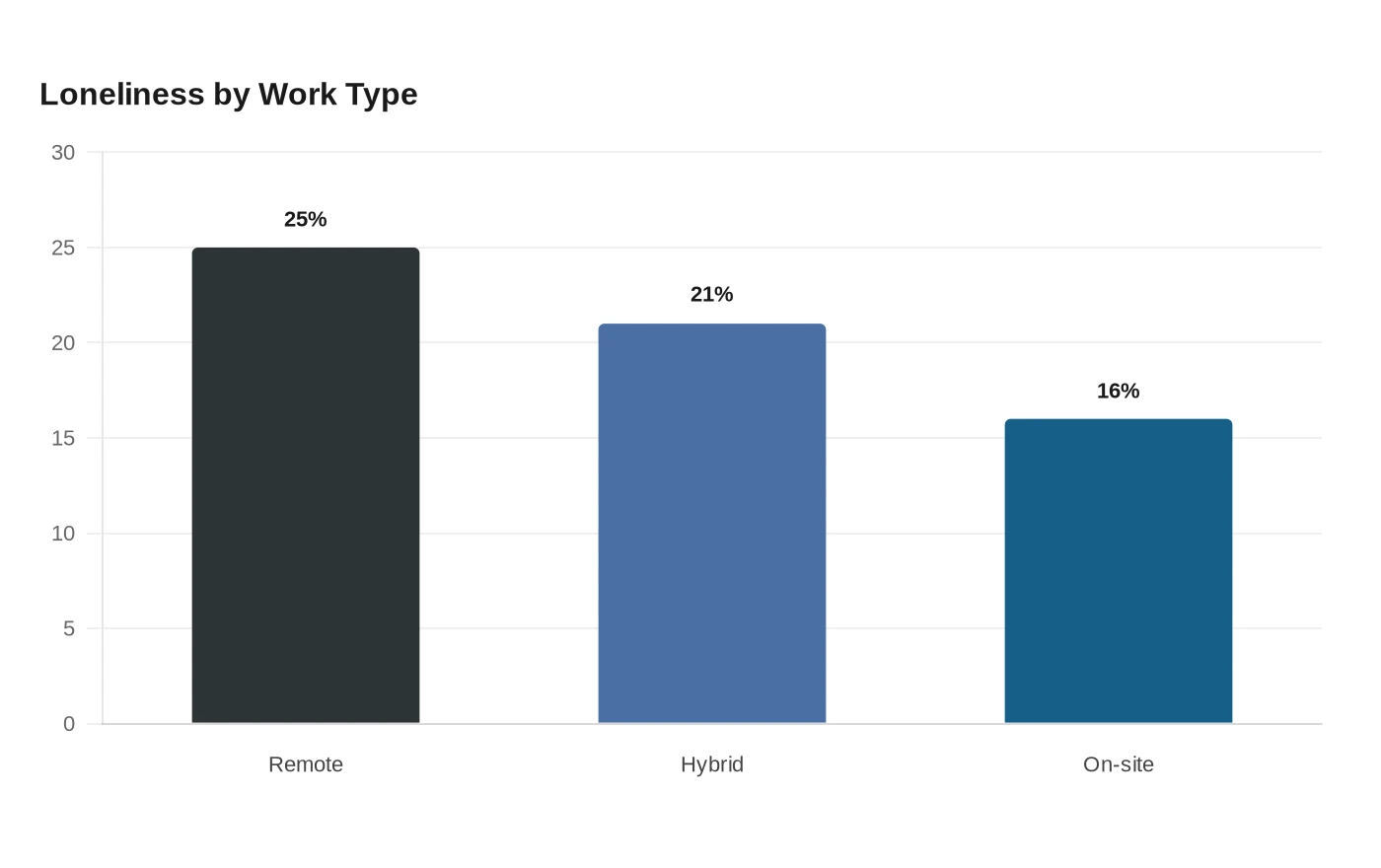
The Centers for Disease Control and Prevention defines loneliness as feeling alone, disconnected or not close to others, and it treats social connection as a key health factor. That framing matters because Gallup reported on June 12, 2024, that 25% of fully remote employees worldwide felt lonely a lot the previous day, compared with 21% of hybrid workers and 16% of on-site workers. Gallup’s 2024 workplace reporting also found that younger employees experienced loneliness more often than workers age 35 and older.

The American Psychological Association’s 2024 Work in America survey pointed in the same direction. Younger workers were more likely to say they felt stressed, lonely and undervalued, underscoring that the burden of isolation is not spread evenly across the labor force. The data suggest that the most detached workers are often the least established, with less workplace power and fewer built-in relationships to absorb the distance.

At the same time, the case against remote work is not straightforward. The U.S. Bureau of Labor Statistics said telework increased in prevalence across the economy during the pandemic and continued to grow at the start of 2024. It also found that remote work increased dramatically across major industries between 2019 and 2021, and that productivity growth across 61 private-business industries was positively associated with a higher share of remote workers. That does not prove remote work caused the gains, but it does show that flexibility and output can rise together.
Gallup’s May 8, 2025 reporting sharpened the tradeoff. Fully remote workers were the most likely to be engaged at work globally, at 31%, compared with 23% of hybrid workers and 19% of on-site workers. Even so, Gallup said their wellbeing was lower. Taken together, the evidence points to a policy and management challenge, not a simple verdict: remote work can sustain engagement and productivity, but for many workers, especially younger ones, it can also deepen loneliness in ways employers and public-health officials can no longer treat as incidental.
Sources
- [1]nytimes.com
- [2]cdc.gov
- [3]gallup.com
- [4]apa.org
- [5]bls.gov