Technology
Report warns schools to preserve human skills as AI spreads
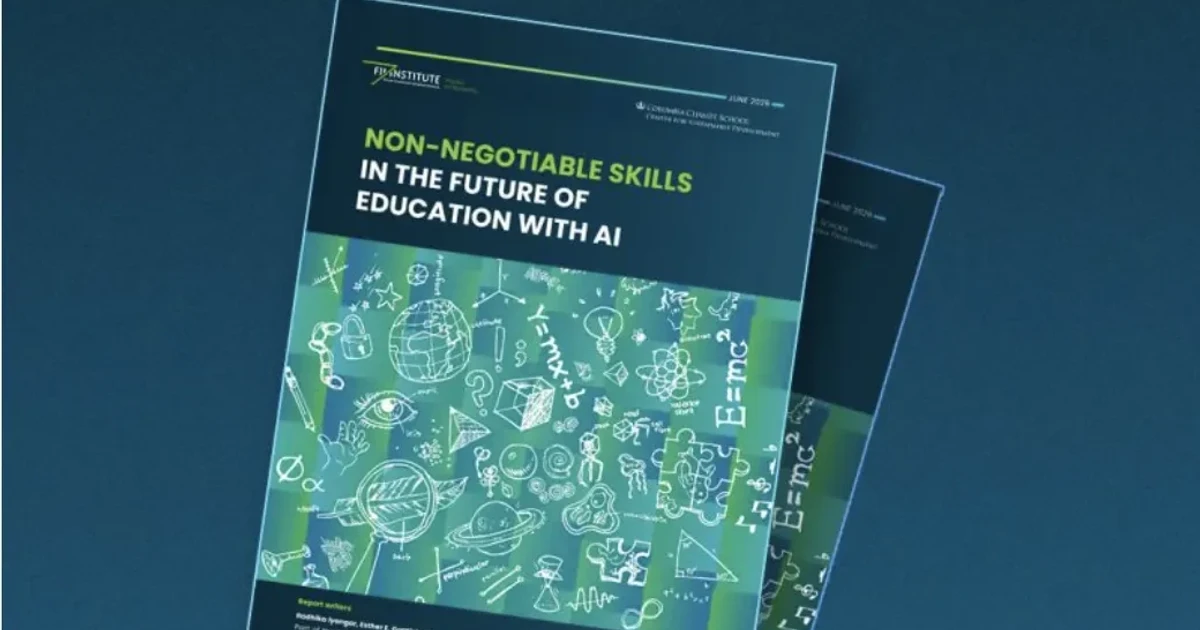
As artificial intelligence moves deeper into classrooms and offices, a new warning from the Future Investment Initiative asks a harder question than whether schools should adapt: which human skills do educators and employers actually mean when they say they must be preserved?
The report, titled Non-Negotiable Skills in the Future of Education with AI, says education systems should protect critical thinking, independent judgment, creativity, ethical reasoning, empathy, reflection and collaboration. Its central argument is direct: those are capacities AI cannot, and should not, replace. Developed with Columbia University’s Center for Sustainable Development at the Earth Institute, the report frames the task for schools as preservation and strengthening, not retreat.

That matters because the pressure is already visible in daily life. In classrooms, students are increasingly expected to use AI tools for drafting, research and study support, while teachers are being pushed to decide how to evaluate original thinking when software can generate polished answers in seconds. In workplaces, employers are moving just as fast, using AI to speed up routine tasks and shifting the human value of workers toward judgment, leadership and collaboration in messy, high-stakes settings where automation is no substitute for responsibility.
Columbia’s Center for Sustainable Development said on June 11 that the report explores the human capabilities education systems must continue to protect and strengthen. The timing is intentional. The FII Priority Europe 2026 Summit opens in Rome on June 17 and runs through June 19 at the Rome Cavalieri, A Waldorf Astoria Hotel, under the theme Europe Reimagined: Capital, Sovereignty & Strategic Autonomy.

The report lands in a broader policy debate that is moving faster than regulation. UNESCO has warned that public generative AI tools are advancing more quickly than national regulatory frameworks, leaving many education systems unprepared to validate the tools and leaving users’ data privacy exposed. That gap makes the FII report more than an academic statement. It is a call for governments and school systems to decide what should still be taught by people, measured by people and valued by people.

The labor market is sending the same signal. The World Economic Forum’s 2025 Future of Jobs Report says employers expect 39% of workers’ core skills to change by 2030, and 50% of workers have already completed training as part of long-term learning strategies, up from 41% in 2023. In that context, the real challenge is not simply adding AI literacy to the curriculum. It is preventing schools from narrowing education to technical competence alone, and making sure the next generation can still reason, adapt, collaborate and lead when the tools change again.
Sources
- [1]arabnews.com
- [2]fii-institute.org
- [3]csd.columbia.edu
- [4]weforum.org
- [5]unesco.org.uk