Business
Russia cuts key rate modestly as inflation and war risks linger
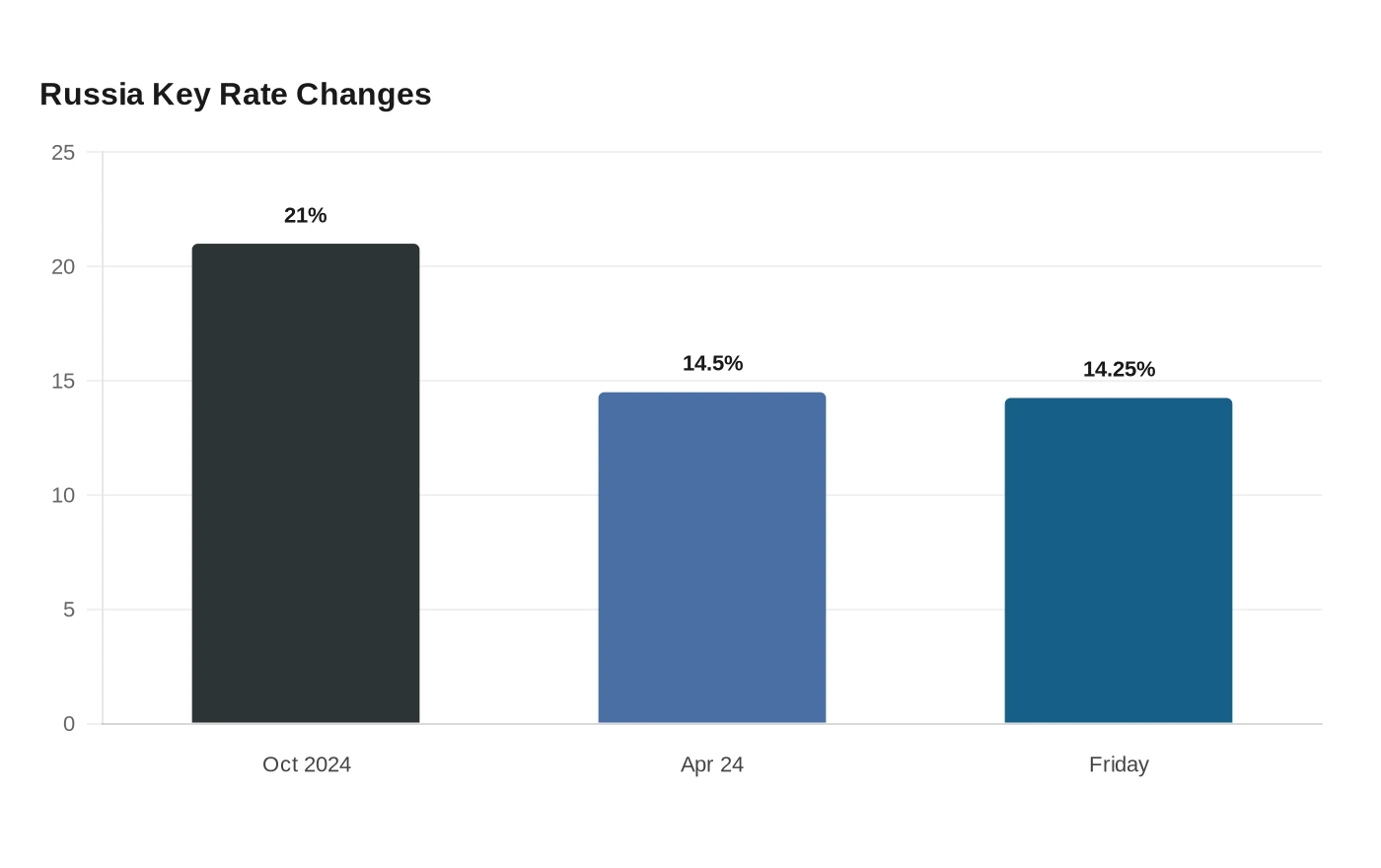
Russia’s central bank trimmed its key rate by 25 basis points to 14.25% on Friday, a smaller move than markets had expected and a sign that policymakers still see little room to ease aggressively. The cut extends a long unwind from the 21.00% peak reached in October 2024, but it also shows how tightly the Bank of Russia is still balancing growth support against inflation risk as the war in Ukraine, sanctions and state spending continue to distort the economy.
The central bank said economic growth remained moderate after a temporary decline at the start of 2026, while lending growth had accelerated in recent months. It also said underlying price growth stayed in the 4% to 5% annualized range, even as annual inflation stood at 5.6% as of June 15. Seasonally adjusted current price growth slowed to 2.1% annualized in April and May from 8.7% in the first quarter, and core inflation averaged 4.2% in April and May versus 6.2% in the previous quarter. Even so, the bank kept its 2026 inflation forecast at 4.5% to 5.5%, still above its 4% target.
Governor Elvira Nabiullina said the move was more cautious because pro-inflationary risks had risen significantly. She pointed to the likelihood of a more expansionary fiscal path over the next three years, faster borrowing growth and a spike in fuel prices that could push June inflation higher. She also said it may take time for supply to recover, underscoring that shortages and bottlenecks are still shaping price pressures. The April 24 meeting had already cut the key rate by 50 basis points to 14.50%, and the central bank’s earlier forecast assumed the average rate for 2026 would stay in a 14.0% to 14.5% range, leaving only limited scope for additional easing.
Analysts had expected a larger 50-basis-point cut, so the smaller move was a clear signal that the Kremlin’s economic room is narrower than the headline rate path suggests. With wartime spending still heavy, fuel markets strained and fiscal policy expected to be more accommodative than previously assumed, the bank is treating lower inflation as fragile rather than durable. The result is a cautious easing cycle, not a pivot to easy money, and one that suggests Russia’s monetary policy remains constrained by the demands of war as much as by the arithmetic of inflation.
Sources
- [1]money.usnews.com
- [2]cbr.ru
- [3]publicnow.com
- [4]tradingeconomics.com
- [5]intellinews.com