Science
Sahara Meteorite Sheds Light on Early Solar System
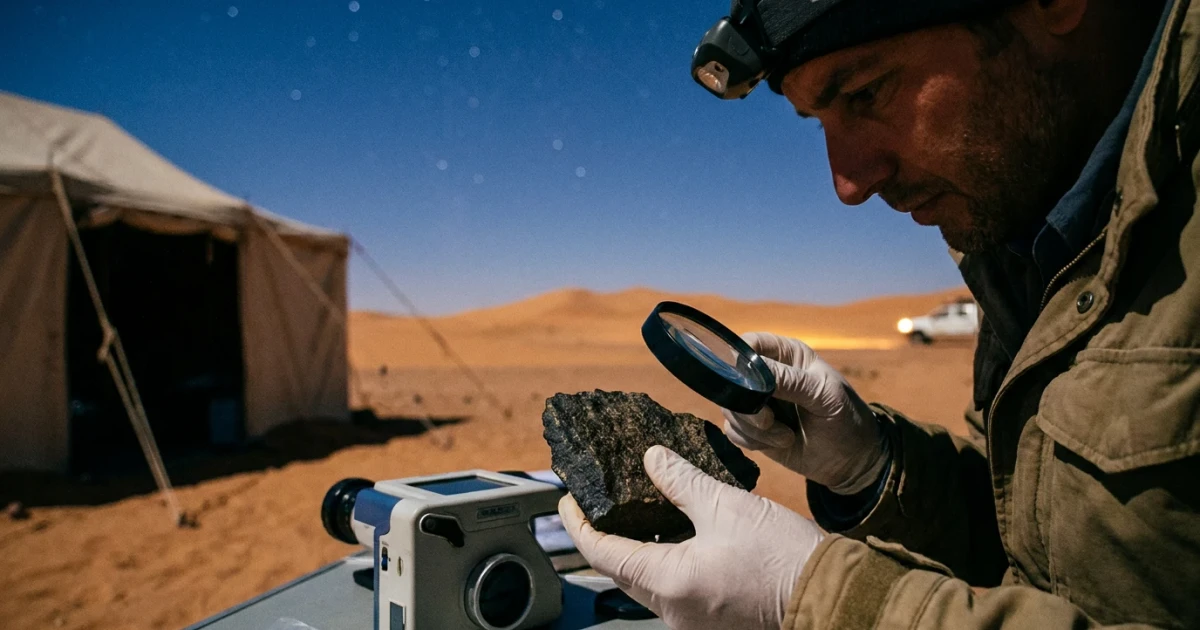
A rare meteorite discovered in the Sahara desert has sparked new interest among planetary scientists, offering what some now believe may be the first tangible evidence of a lost planetary world from the solar system’s formative years. Identified as Erg Chech 002, this specimen is helping researchers reconstruct the complex history of planetary formation and differentiation.
Discovery and Classification
The Erg Chech 002 meteorite was found in the Algerian Sahara, one of the planet’s most prolific regions for meteorite discoveries. According to the Meteoritical Bulletin Database, the meteorite is classified as an achondrite, meaning it originated from a differentiated planetary body—one that had undergone melting and separation into distinct layers, much like Earth.
Its unique mineralogical and isotopic signatures, described in recent peer-reviewed research, suggest Erg Chech 002 is not just a fragment of any asteroid, but likely a remnant of a large, now-vanished protoplanet that formed early in the solar system’s history.
Evidence for Early Planetary Differentiation
Analysis of Erg Chech 002’s isotopic ratios and mineral content reveal striking similarities with other rare Saharan meteorites. In particular, its aluminum-26 content—a radioactive isotope that decays relatively quickly—indicates rapid heating and differentiation, a process believed to have occurred in the first few million years after the solar system began to form. This supports findings from a recent study showing evidence for early planetary differentiation in Sahara meteorites.
- Erg Chech 002 exhibits unusually high concentrations of aluminum-26, which fueled internal melting.
- The meteorite’s mineralogy points to formation in a large body, not a small asteroid.
- Isotopic data matches models of solar system formation, suggesting it came from a planetesimal formed in the first 2 million years.
These findings imply that Erg Chech 002 could be material from a planet-sized object that was destroyed or ejected during the tumultuous early era of the solar system. The meteorite’s composition, with detailed datasets available for further study, is distinct from most other known meteorites.
Implications for Solar System History
Planetary scientists believe this discovery fills a significant gap in our understanding of solar system evolution. While most meteorites found on Earth originate from relatively undifferentiated asteroids, Erg Chech 002’s characteristics suggest it is a rare survivor from an era when large bodies formed, differentiated, and were later shattered in collisions or gravitational upheavals.
According to Space, researchers are now considering the possibility that many such planetesimals existed, but were lost through violent processes that shaped the current configuration of planets and asteroids. The study of Erg Chech 002 may provide clues about the nature and fate of these early worlds.
Ongoing Research and Future Questions
The meteorite’s discovery opens new avenues for research, with scientists seeking to compare its isotopic and mineralogical signatures to other rare meteorites. Further investigation of its geochemical data may clarify its origins and help answer lingering questions about the timeline and processes of planetary differentiation.
As analytical techniques improve and more samples are studied, Erg Chech 002 may well become a cornerstone in reconstructing the solar system’s earliest history. Its existence hints at a wider diversity of early planetary bodies than previously thought, and underscores the importance of meteorite research for understanding the birth and evolution of planets.
Conclusion
The Erg Chech 002 meteorite’s discovery in the Sahara desert represents a breakthrough in planetary science, offering direct evidence of a lost world from the dawn of the solar system. As research continues, its unique characteristics may help scientists unlock the secrets of planetary formation and differentiation, providing a clearer picture of how our cosmic neighborhood came to be.