Science
Scientists Detect Wind from Milky Way’s Black Hole
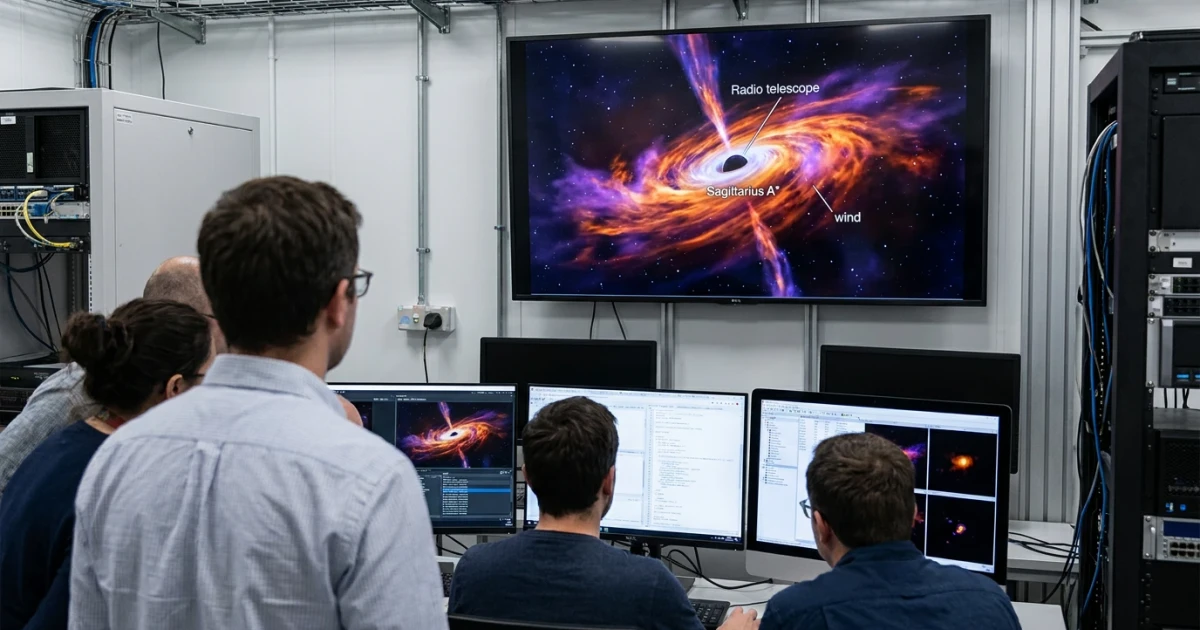
For the first time, astronomers have detected wind emanating from the Milky Way’s supermassive black hole, Sagittarius A*, marking a breakthrough in the decades-long quest to observe this phenomenon directly. The discovery, announced by researchers and covered by Space, delivers long-sought evidence of energetic outflows from the center of our galaxy, a process that has been theorized for over 50 years.
Breakthrough After Decades of Search
The search for black hole-driven winds within the Milky Way has challenged astronomers since the 1970s. While similar outflows had been observed in active galaxies elsewhere in the universe, direct evidence from our own galaxy’s core remained elusive. The recent findings, described by Space, confirm that Sagittarius A* is indeed generating a powerful wind, finally answering a central question about the behavior of our galaxy’s nucleus.
- Sagittarius A* is a supermassive black hole weighing about four million times the mass of the Sun.
- Previous attempts to identify outflows from Sagittarius A* were hampered by dust, gas, and the complex environment at the galactic center.
- The newly detected wind confirms that even relatively quiet black holes like Sagittarius A* can influence their surroundings.
Observational Evidence and Significance
The breakthrough was made possible by advances in X-ray astronomy and high-resolution observations. According to the Chandra X-ray Observatory, the wind was identified as a distinct outflow of material traveling away from Sagittarius A*, carrying energy and matter into the surrounding galaxy. This outflow is believed to play a vital role in regulating star formation and the evolution of the Milky Way’s central region.
The discovery provides critical insight into the feedback mechanisms that shape galaxies. Wind from black holes can sweep up gas, limit the growth of new stars, and alter a galaxy’s structure over millions of years. With Sagittarius A* now confirmed as an active participant in this process, astronomers can better compare our galaxy to its more energetic neighbors across the universe.
Impact on Galactic Evolution Studies
Understanding how Sagittarius A* influences its environment is essential to unraveling the history and future of the Milky Way. Astronomers use data from multiple observatories, including ESO and the Event Horizon Telescope, to piece together the complex interaction between black holes and their host galaxies.
- Winds and outflows help regulate the amount of gas available for star formation.
- Observing these processes in our own galaxy provides a local laboratory for testing theoretical models developed from more distant galaxies.
- The findings will inform future research on black hole feedback and galactic dynamics.
Looking Ahead
The confirmation of wind blowing from Sagittarius A* opens new avenues for research into the center of the Milky Way. As instrumentation and observational methods continue to improve, astronomers expect to uncover further details about the nature and impact of these outflows. The direct detection of a black hole wind in our own galaxy stands as a milestone, offering both a sense of closure to a half-century quest and a foundation for new discoveries to come.