Science
Scientists Puzzle Over Sun’s Mysteriously Hot Atmosphere
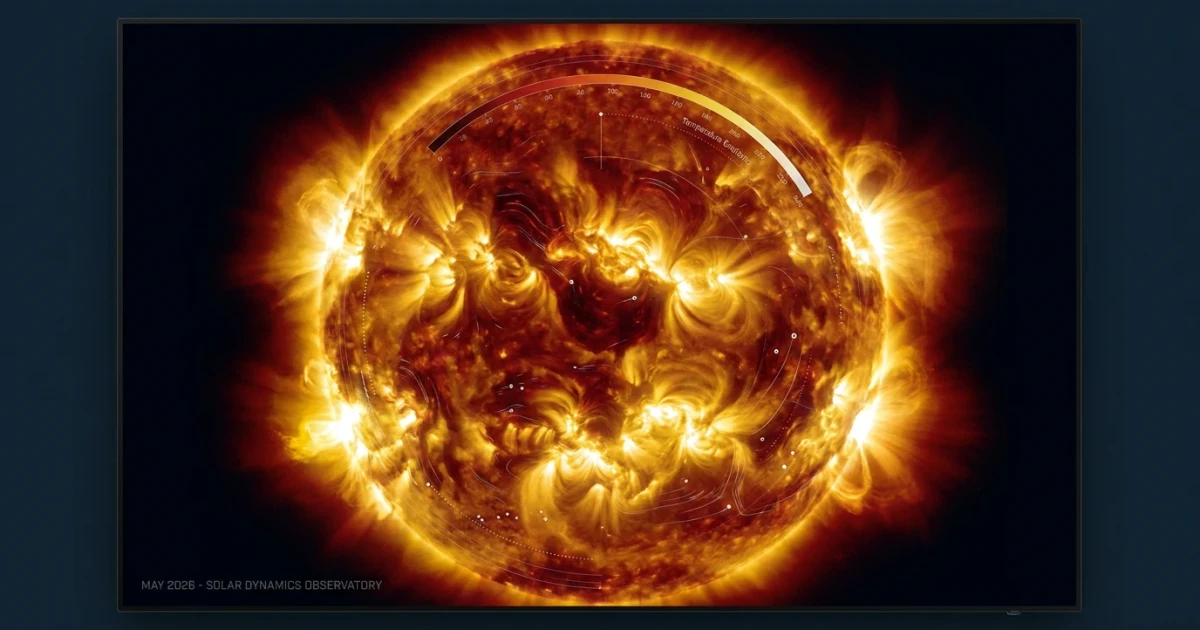
The Sun’s surface temperature is about 5,500 degrees Celsius, yet its outer atmosphere—the solar corona—soars to over a million degrees. This perplexing phenomenon has baffled physicists for decades, with no single theory able to fully account for how a relatively cooler layer heats one above it to such extremes.
The Coronal Heating Mystery
According to comprehensive review articles on the solar corona, the temperature jump between the Sun’s surface and its atmosphere defies intuitive logic. The photosphere—the visible surface—emits energy at around 5,500°C, while the corona, extending millions of kilometers into space, reaches temperatures in excess of 1,000,000°C. This gradient has been confirmed by a range of observational missions, including NASA’s Solar Dynamics Observatory (SDO) and ESA’s Solar Orbiter (Solar Orbiter mission), which provide high-resolution imagery and temperature profiles of the Sun's atmosphere.
- Photosphere: ~5,500°C (NASA Open Data)
- Corona: >1,000,000°C (SDO Data Access)
Current Theories and Ongoing Research
Despite decades of investigation, the exact mechanism driving this temperature inversion remains unresolved. Leading hypotheses include:
- Magnetic reconnection: Sudden reconfiguration of magnetic fields releases vast amounts of energy, heating the corona. NASA’s SDO mission has observed such events, supporting their role in coronal heating.
- Wave heating: Acoustic and magnetic waves generated in the photosphere propagate upward, dissipating their energy in the corona. According to a recent research review, wave-driven turbulence could explain some coronal heating, but observational evidence is mixed.
Each model explains part of the puzzle, but none fully resolves why the corona’s temperature is so dramatically higher than the Sun’s surface.
Technological Advances in Solar Observation
Modern missions such as NASA’s IRIS and the European Space Agency’s Solar Orbiter are pushing the boundaries of solar science. These spacecraft are equipped with instruments capable of capturing the Sun’s atmosphere in unprecedented detail, providing fresh data for theorists to analyze.
Key Data Points
- Temperature profiles from NASA Open Data show sharp increases in the transition region between the chromosphere and corona.
- SDO and IRIS missions capture high-frequency magnetic activity linked to possible heating events.
- Solar Orbiter’s close passes provide new imagery of coronal structures.
Why It Matters
Understanding coronal heating is not just an academic exercise. The corona influences space weather—solar storms that can disrupt satellites, power grids, and communications on Earth. Improved knowledge of the Sun’s atmospheric dynamics could help predict and mitigate these effects.
Looking Forward
While the mystery persists, ongoing missions and collaborative research continue to refine our understanding of the Sun. The hope is that with advancing technology and deeper analysis of observational data, physicists will eventually unravel why the Sun’s atmosphere is so much hotter than its surface—a question that remains one of solar science’s most enduring puzzles.