Science
Scientists Recreate the Universe’s First Moments in Lab Simulations
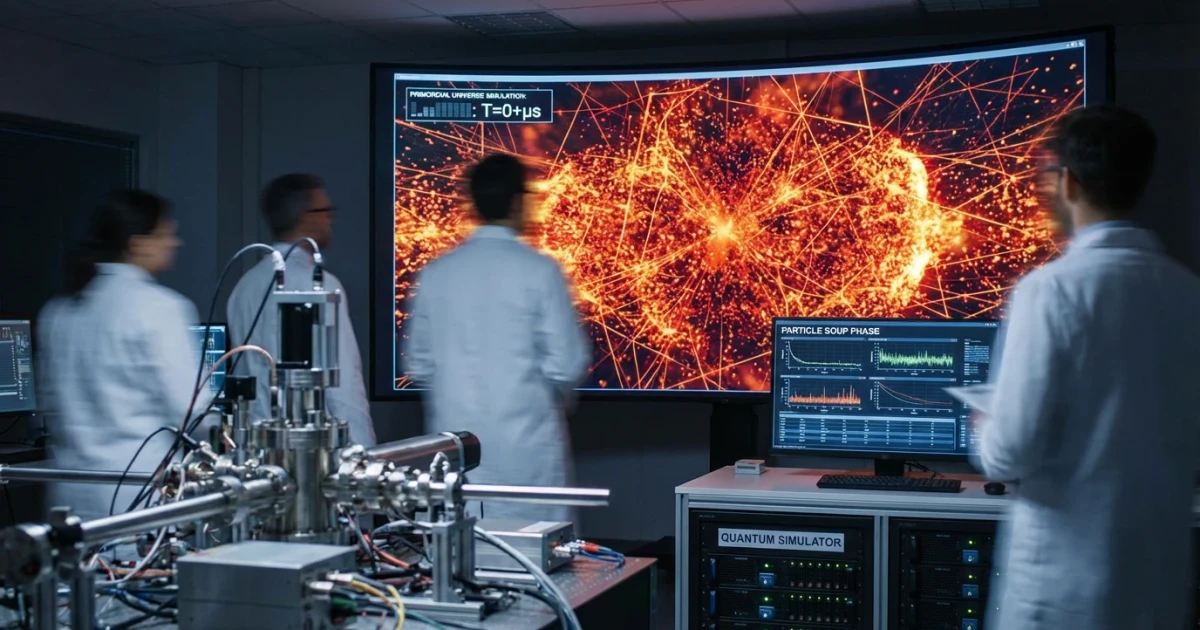
Physicists have taken a groundbreaking step toward understanding the origins of our universe, successfully simulating the immediate aftermath of the Big Bang and revealing a chaotic, superheated state akin to a 'cosmic soup.' The research, highlighted by ScienceAlert, provides new insights into the first microseconds of the universe’s existence and the exotic matter that filled it.
The Universe’s Fiery Beginnings
For decades, cosmologists have theorized that the universe began in a state of extreme temperature and density. Just after the Big Bang, matter existed not as atoms or even protons and neutrons, but as a turbulent plasma of fundamental particles. This early phase, known as quark-gluon plasma, is believed to be the primordial state from which all matter in the universe eventually emerged.
- During the first microseconds after the Big Bang, the universe was so hot that quarks and gluons—the building blocks of protons and neutrons—could float freely in a dense, fluid-like state.
- This primordial soup was billions of degrees hotter than the core of our Sun, according to experimental data from CERN’s ALICE experiment.
- As the universe expanded and cooled, these particles began to combine, forming the matter that we see today.
Simulating the Unimaginable
In the recent study reported by ScienceAlert, physicists used advanced computer simulations based on quantum chromodynamics (QCD)—the theory describing the strong force between quarks and gluons—to recreate conditions just after the Big Bang. These simulations allowed researchers to observe how the early universe’s matter behaved and evolved as it cooled.
The findings align with experimental results from particle collider experiments, such as those at CERN, where scientists smash heavy ions together at nearly the speed of light to briefly recreate quark-gluon plasma. The ALICE collaboration has published extensive data on these collisions, offering valuable benchmarks for simulation accuracy.
Why “Soup” Is the Perfect Analogy
Researchers found that the early universe was not a uniform gas but behaved more like a hot, thick fluid—hence the “soup” analogy. This substance was highly interactive, with quarks and gluons constantly colliding and exchanging energy. The phase structure of this matter continues to be a focus of both theoretical and experimental investigation.
- The plasma rapidly expanded and cooled, ultimately allowing particles to "freeze out" and form the building blocks of atoms.
- Simulations suggest the transition from quark-gluon plasma to ordinary matter was not instantaneous, but a complex process with subtle changes in density and temperature.
Observational Evidence and Data
While these conditions cannot be directly observed, remnants of the early universe are captured in the cosmic microwave background (CMB). NASA’s CMB data reveals tiny fluctuations in temperature and density, serving as a fossil record of the universe’s infancy. These observations, combined with laboratory and simulation results, provide a more complete picture of how the universe evolved from its “soup-like” state to the cosmos we know today.
What’s Next for Early Universe Research?
With new simulations and ongoing experiments, physicists are getting closer to answering key questions about the universe’s birth. Future work aims to refine these models and link them more closely with both collider data and cosmological observations. As computing power increases and experimental techniques advance, our understanding of the universe’s first moments will only deepen.
The simulation of the Big Bang’s aftermath is a milestone in cosmology, offering not just a glimpse into the distant past but also clues about the fundamental laws that govern everything we see. As researchers continue to unravel the mysteries of the early universe, the analogy of a primordial “soup” remains a powerful image—capturing both the complexity and unity of our cosmic origins.