Politics
Senate Rejects Bid to Limit Trump's Military Action
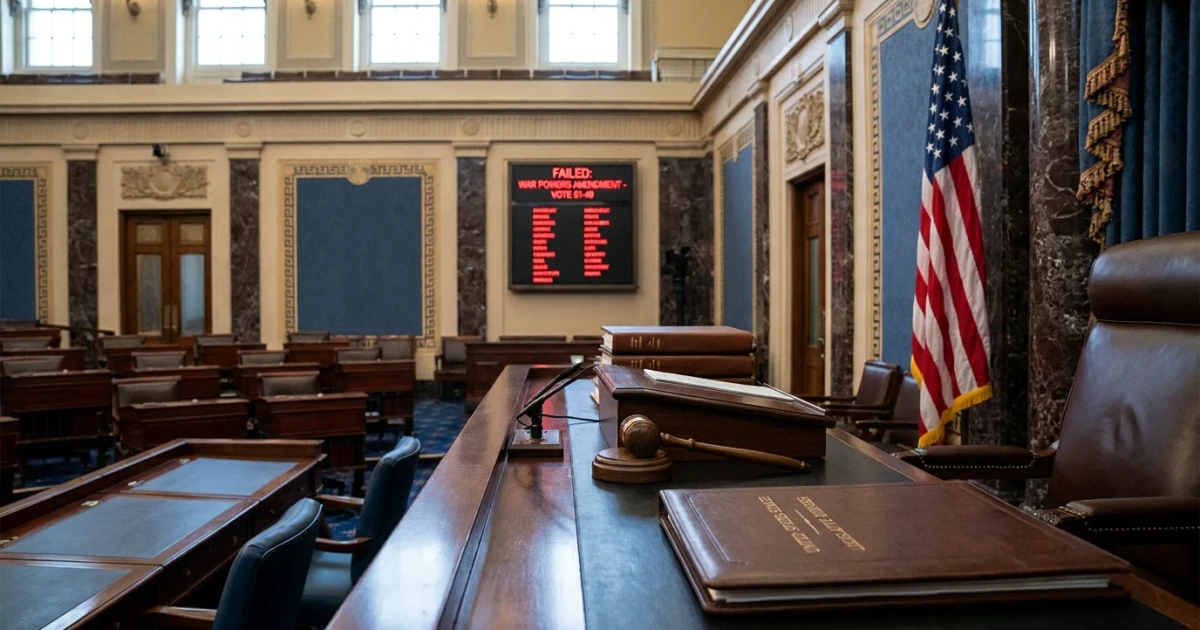
The U.S. Senate has failed to advance legislation intended to restrict President Donald Trump’s ability to take military action against Iran, according to coverage from teleSUR English and data from official Congressional records. The outcome highlights persistent divisions within Congress over war powers and the president’s authority to deploy military force.
Senate Effort to Rein in Presidential Authority Falters
The Senate vote centered on Senate Bill 5353, a measure designed to limit the president’s ability to engage in military operations against Iran without explicit congressional approval. The bill was part of a broader legislative push in early 2020 to assert Congress’s constitutional role in authorizing armed conflict, following heightened tensions between the United States and Iran.
- Senate Bill 5353 sought to clarify and enforce existing requirements under the War Powers Resolution, which mandates notification and consultation with Congress before significant military action.
- According to the official Senate roll call vote, the measure failed to secure the necessary majority, with most Republicans opposing the bill and most Democrats supporting it.
- The final vote tally reflected a sharp partisan divide, demonstrating the ongoing struggle between the legislative and executive branches over war-making powers.
Background: War Powers and Recent Tensions
The push to limit President Trump’s military authority came in the wake of the January 2020 U.S. drone strike that killed Iranian General Qasem Soleimani. The strike, which escalated tensions in the Middle East, led to renewed debate in Congress about the scope of the president’s powers under the War Powers Resolution. This 1973 law was enacted to check the president’s ability to commit U.S. forces to hostilities without congressional consent.
TeleSUR English reported that the Senate’s failure to block the Trump administration’s military action underscores the challenges lawmakers face in reasserting their constitutional authority. The bill’s defeat means the administration retains broad discretion to undertake military operations against Iran without a new congressional mandate.
Public Opinion and Congressional Oversight
Public opinion on military action against Iran has remained divided. Pew Research Center data found that Americans were nearly evenly split on whether the strike against Soleimani was justified, reflecting broader uncertainty about the use of force in U.S. foreign policy.
Despite these divisions, the Senate’s action—or inaction—has significant implications for the balance of power between Congress and the White House. The Congressional Research Service notes that while the War Powers Resolution provides a legal framework for congressional oversight, presidents from both parties have often interpreted its provisions in ways that preserve executive flexibility.
What Comes Next?
With the defeat of Senate Bill 5353, Congress’s ability to limit unilateral military action remains primarily political rather than legal. Lawmakers may continue to introduce similar measures or seek other avenues for oversight, but the legislative hurdles are substantial. As tensions with Iran persist, the question of war powers is likely to remain a flashpoint in congressional-executive relations.
For readers seeking more information, the full text of the Senate bill and detailed roll call vote data are available for examination. Background on the War Powers Resolution can be found through the Legal Information Institute and related Congressional Research Service reports.
The Senate’s decision reflects an ongoing struggle over how—and by whom—America’s most consequential foreign policy decisions are made.