World
Senegal farmers add fish to rice fields to fight parasitic snails
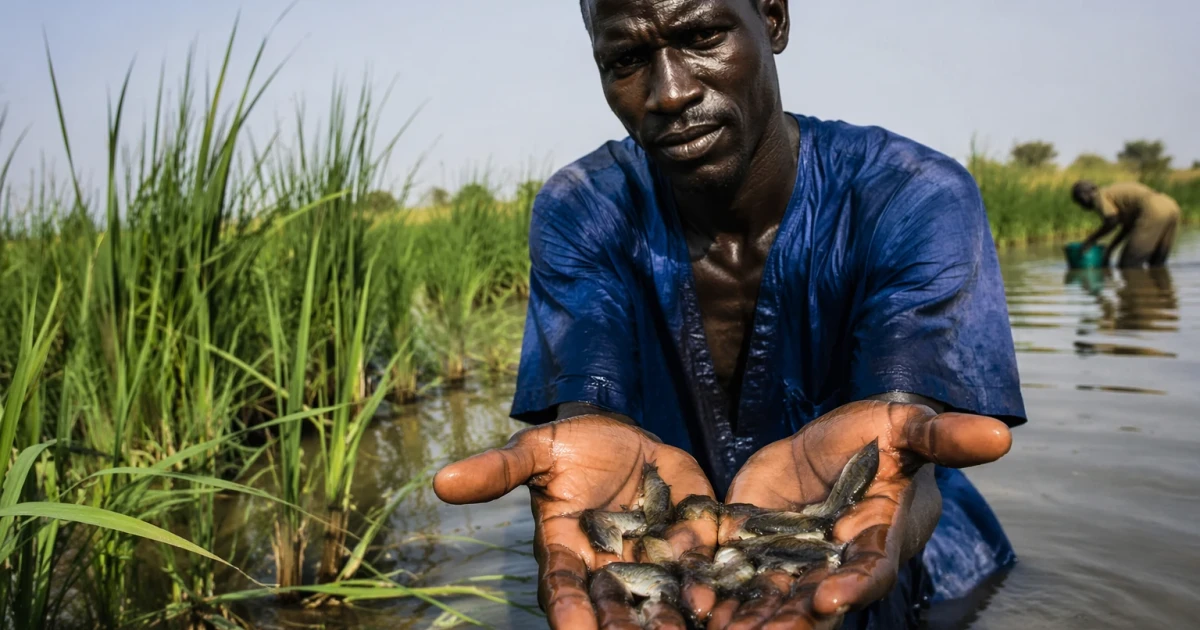
Fish are being released into Senegal’s rice paddies in an effort to cut parasitic snails, lift harvests and add a second source of income for farm families. Researchers say the model could also blunt one of rural West Africa’s most persistent disease pressures, schistosomiasis, which is spread by freshwater snails and affects more than 220 million people worldwide.
The Senegal River Basin, where irrigation canals and standing water support rice production, has long been a hotspot for the parasite. In a 2025 PLOS Global Public Health study, scientists surveyed rice fields and canals across the basin from 2022 to 2023 and found human schistosome-shedding snails in both rice-growing and non-growing seasons. The same work showed that local fish, including Heterotis niloticus and Hemichromis species, consumed substantial numbers of Biomphalaria pfeifferi and Bulinus snails, pointing to a natural predator that could lower farmers’ occupational exposure while they work in flooded fields.
The latest field trials pushed the idea further. A 2026 Nature Sustainability paper reported that rice-fish co-culturing in Senegal, using native Nile tilapia and African bonytongue, reduced disease-carrying snails and increased rice yields by more than 25 percent in pilot plots. Stanford and University of Notre Dame researchers involved in the project said the approach may also reduce fertilizer needs and bring in cash through fish sales, an important hedge in regions where rice income is often tied to a single harvest and one market price.
The health stakes extend beyond adult farmers. Using data from more than 400 households in rural Senegal, researchers found that children of rice farmers had higher schistosomiasis prevalence than children of non-farmers, underscoring how exposure moves through families as well as fields. Stanford’s January 2026 summary of the disease said more than 250 million people require treatment each year, but drug campaigns alone do not stop reinfection when people keep returning to contaminated water.
That is why the project’s backers, including teams tied to Stanford, Notre Dame and the Stanford Sustainability Accelerator, are framing rice-fish farming as a low-input system with unusually broad returns. The Senegal River Basin already has the dams, canals and water flows that make rice cultivation possible, and Stanford researchers note that rice farming in Senegal has surged over the past decade. Earlier work in the country also tested river prawns as snail-eating predators, showing that biological control has been explored here for years. The current push now aims to turn that science into a scalable tool for food security, rural income and disease control in one of the region’s most vulnerable farming zones.
Sources
- [1]npr.org
- [2]journals.plos.org
- [3]news.stanford.edu
- [4]news.nd.edu
- [5]nature.com