Technology
Sheffield researchers use reinforcement learning to improve quantum error correction
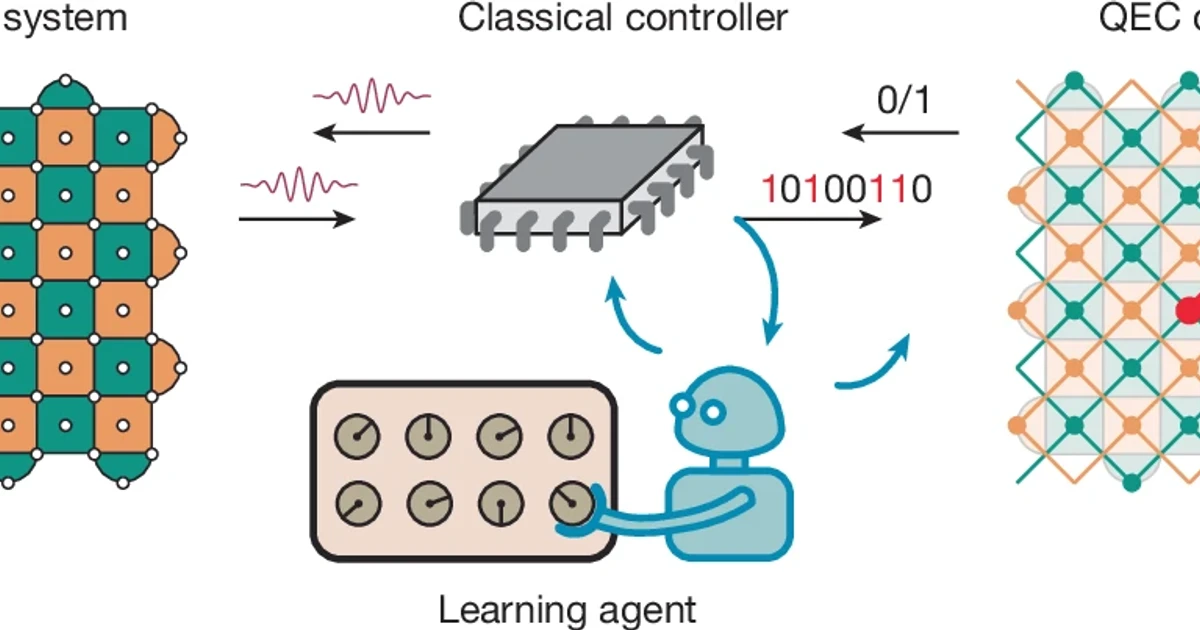
Sheffield researchers used reinforcement learning to keep quantum error correction adjusting itself while computation continued, instead of halting a machine for recalibration. The approach tackled one of the field’s hardest practical problems: environmental drift that can degrade quantum operations over time.
The Nature paper recast error correction as having a dual role. Its error-detection events were used to protect the logical quantum state and, at the same time, to feed a reinforcement-learning agent that continuously steered physical control parameters. That mattered because the usual response to drift is to stop the computation and recalibrate, a workaround that becomes unworkable as future quantum algorithms run longer.
The researchers also sidestepped a deeper scaling problem. A summary of the work said direct optimization of the logical error rate was too expensive at high code distance, so the system trained on a surrogate objective instead. One report on the paper said the method was built to handle more than 2,000 control parameters in a distance-seven error-correcting code, a sign of how aggressively the control problem grows as quantum systems get larger.
The work sat inside a broader Sheffield ecosystem that has been building around quantum technologies. The University of Sheffield’s Quantum Centre described itself as a university-wide collaboration of more than 50 researchers whose work spans quantum computing, communication, sensing and imaging. Within that group, Dr Yingkai Ouyang listed quantum error correction, quantum metrology and quantum information theory among his research interests, and the centre launched a Quantum + AI interest group in May 2025 to bring the two fields closer together.
The Sheffield effort also landed in a research line already moving fast elsewhere. Earlier Nature papers had shown real-time quantum error correction beyond break-even, high-accuracy error decoding for quantum processors and the discovery of quantum-error-correction codes and circuits with machine learning. Google’s Willow chip, announced in December 2024, marked another major step toward large-scale error-corrected quantum computing. Even so, the Sheffield method remained a laboratory advance, not a commercially useful quantum machine, and the distance from stable, fault-tolerant hardware was still substantial.
Sources
- [1]arstechnica.com
- [2]quantum.sites.sheffield.ac.uk
- [3]nature.com
- [4]arxiv.org
- [5]blog.google